Four years ownership of the ICOM IC-705 have passed and I thought it might be an idea to take another look at it to see if it still rules the roost for Portable Radios in 2026. In this 'look back', I'm only going to focus on what I've been doing and how well the 705 has worked for me. My original review is >>HERE<<
What should I compare it to? Well the truth is, there's nothing currently on the market to compare - that's a fact! Yaesu have dropped their old FT817/818 range and it was way out of date anyway. The Elecraft KX3 was a great alternative if you could live without all the features of the 705, but they're next to impossible to get hold of in the UK and the price has just gone plain silly anyway!
If you put the IC-705 and the KX3 side by side in a shack at home, you might be able to detect that the KX3 is slightly better at receiving really weak signals, but for the other 99% of the time, when you've driven, walked, hiked to the perfect take-off spot and set up your antennas, there's little practical difference between a KX3 and the 705. Or between a 705 and an 817. In fact, my $89 (tr)uSDX will probably get you as many QSO's in the log as the others from the top of a hill!
Over the last couple of years I've relied almost exclusively on my IC-705, using it outdoors, on hillsides, in the back garden, in a park, at the caravan, by the seaside and even at home as a base station. It's been utterly reliable and surprisingly tough even though it's not been wrapped in cotton wool. Unlike my Elecraft, I've never really worried about it - I guess I look upon it as a bit of a workhorse. If it gets a little scratch or a ding, it doesn't really matter. I don't believe it would substantially affect its resale price either.
The notable difference between the IC-705 and other radios is flexibility, features and what I call 'friendliness'....
The Icom IC-705 is more feature-rich than any other portable radio. It puts together such an awfully good package that you don't have to buy anything else (assuming that you use resonant antennas). You can operate throughout HF, 6M, 2M and 70cm on LSB, USB, CW, AM, FM, DV and DSTAR.
With the radios built-in server, you can operate remotely. With the built-in WiFi you can tether to your mobile phone and operate Digital Modes out in the field. Thanks to the built-in GPS, you can even ensure accurate timing for FT8, etc.
Forgot to take a pen for logging your QSO's?? Don't worry - you can record all QSO's onto the SDCARD and run back through it later to get the callsigns - it even records the time and date of each individual QSO!! How good's that??
After using it so frequently and for so long, I'm now in that happy place where I know I just need to grab my small rucksack and head off outdoors for some radio fun. I don't need to carry a million bits of ancillary items - it's just my radio, my antennas and my iPad. If I'm just going out for a couple of hours, then I rely on the Icom battery, but if I'm out for the day I will take a 13.2V LifePO too.
Up on a hillside, I tend to stick with 5W and there's little need for more. Usually, the take-off is excellent and my SotaBeams Dipole works amazingly well - enough to have SSB chinwags across to America from the UK. In fact, one of my favourite chats was from a beach to two hams in America using only 2.5W (KE5EE and WD4NGB).
If I'm struggling to get a response to my CQ calls on 5W, I might move up to 10W, but once I establish contact with someone, I ask them to let me drop to 5W and get another report. If the report is very good (it often is) then I'll ask for another at even lower power. Needless to say, I don't want to make the QSO hard work for the other operators, but most people are happy to experiment with me and they often end up dropping their power to me too and because they've been so used to knocking out 400W+ for years, they've forgotten how far they can get on a tiny fraction of the power. All very entertaining (to me at least) 😂
I have to admit that it's easier to answer someone elses CQ Call than it is to get a response to your own CQ Call at QRP levels. But patience often does reward. I find that using the IC-705's TX Memories makes light work of repetitive calling. I have a Long and a Short CQ Call recorded in memory and it's easy to set a TX-Loop going. The call is repeated over and over with a small pause inbetween to allow you to listen for any responses.
Once I've finished with SSB, I tend to briefly switch to the 705's CW TX-Memories and put out a "CQ TEST" for a few minutes on various bands to see how far I get on the Reverse Beacon Net before switching over to DSTAR depending on how close I am to a repeater. The IC-705 comes with a comprehensive list of repeaters already programmed in and thanks to the built-in GPS it can quickly determine which repeaters are the closest to your location and list them in order of distance (showing you the distance of each one in miles or kilometres).
After DSTAR I might switch to FT8 which gives me a chance to grab a drink and a sandwich.
The IC-705 has proven to be a true all-rounder and can seemingly do it all, without any fuss or alterations or expensive plugin modules. The only thing that isn't included is an ATU, but neither does the KX3 come with one (unless you pay almost £300). Most of my portable antennas are resonant, so I usually have no need for a tuner, but if I want to use a multi-band end-fed, then one is required.
I own three ATUs - the LDG Z100PLUS, the Elecraft T1 and a recently added MAT-705PLUS. My favourite is the Elecraft T1. It's compact, light and incredibly good at finding a match - quickly!! And finding a quick match is very important when it comes to QRP equipment because many QRP Transceivers don't seem to have a very robust PA, resulting in blown transistors during long tuning sessions.
Thankfully, the 705 is pretty strong in this respect and I've never had a problem when tuning up using any of my tuners.
The success of the IC-705 in the marketplace has led to much third-party and community support. One of the most useful addons for the 705 is Marcus Roskosh's SDR-CONTROL app which not only provides remote-control operation, but also provides a host of other tools which make the 705 (or 7610 or 9700) an absolute dream to work with. It's a game-changer.
SDR-CONTROL is available on IOS or MAC and I personally use it with my iPad 11. It performs flawlessly with virtually no lag between the readings on the radio and the readings on the iPad. It's all very fluid!
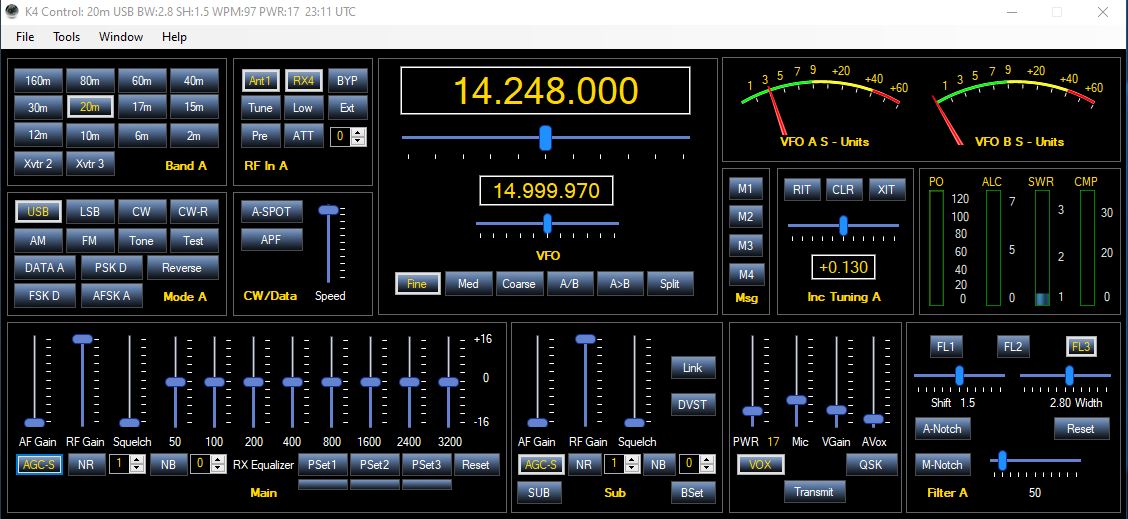
All the functions of the radio are available on the software display and the bandscope and waterfall are superb!! It's nice and easy to adjust the bandscope to increase the signal-peak display size and the ratio of scope to waterfall. The meter is nice and clear but I was hoping for an analogue option which isn't there (in the current version). Long-pressing the "TUNE" button sets the power to 10% (adjustable in menus) and transmits in AM mode so that any attached tuner will activate safely. Long-pressing the PTT button will allow you to choose between the radio's mic or the iPad's mic.
VFO AandB are visible onscreen and it's easy to switch between the two. Everything is very intuitive and there's never a struggle to figure anything out. Take FT8 for example - you can switch to it and be making contacts within seconds! No fiddling around with cables, no special drivers or VACs - it just works. Simple!
Any FT8 contacts that you make are logged automatically and that brings me to the next feature in the SDR-CONTROL toolbox - the LOGBOOK. Yes, there's a logbook built-in and it has an easy export function to transfer your contacts to your QRZ, etc.
By clicking on a button, you can see the full contents of the ToolKit which includes some very handy features such as the DX Cluster. This can show you active signals on the bandscope, allowing you to quickly spot and engage desired DX. There's also a BandPlan, a set of CW Macros, QRZ LookUp and PSK Reporter.
There's lots more to this amazing App and it adds so much to the already pleasurable IC-705. I suggest that you go read the manual by clicking on the image below to find out much more about it...
So, as you can guess, I've been very happy with my 705 - probably more so than any other radio I've owned (and that's saying something). It does pretty much everything I want and it does it all simply, effectively and without fuss. I can play on all the ham bands, in all the modes, I can do analogue and digital and I can enjoy fantastic support from third-parties and a knowledgeable community.
What do I dislike?? Not much really - in fact it seems a bit churlish to complain when a radio offers so very much. If I had to be Oliver Twist and ask for more, then.... I'd ask for CW Decoder instead of the RTTY Decoder. Having said that, the 705 interfaces very easily with my PreppComm Morse Encoder/Decoder....
I do believe that the IC-705 is genuinely the best portable transceiver ever to hit the market. It offers such great value for money and has so many features and functions. And it's not just about the specification list - it's about how everything works - it's incredibly intuitive. Everything falls to hand and makes sense.
There's so many features which make life easy for the operator and where some radios end up looking like a bowl of spaghetti when trying to do something different, the IC-705 often does it wirelessly via WiFi or BlueTooth. Even small things like getting a pair of AirPods working - I've come across so many radios which have BlueTooth but then fail to connect to BlueTooth headsets! The Icom even works with Yaesu's headsets! The very fact that you get a server built into the radio to enable remote operation is pretty darned amazing - especially when you consider that even Yaesu's £3,100 Flagship 101 doesn't have such a feature 😮.
And yes, the £45 SDR-CONTROL software significantly adds to the richness of the 705 which some might say is down to Marcus Roskosch and not the radio, but the fact that the Icom is flexible enough to permit such interaction/connectivity is something that should be applauded.
Okay, so what about something other than a KX3 or 705? Let's say you bought an FT818 or a G90 or a TX-500?
Well for a start, I wouldn't even give the Russian-built TX500 a second thought because I wouldn't want to support the economy of the disgusting terrorist Putin. Although the HF TX-500 is a very visually appealing transceiver and is around 2/3rds of the price of a 705, it lacks most of the features that I personally value.
The G90is a fabulous budget HF transceiver which offers lots for little, but at the end of the day, it's a cheap Chinese radio which I could never consider to be my 'forever radio'. Like the TX-500, the G90lacks valuable features.
The FT818 is an old favourite of most hams. It's been out there for over 20 years and at half the cost of a 705 is always going to be the QRP radio of choice for people who are happy with the basics. But let's face it, it's old technology and looks like a dinosaur compared to the 705. A rugged, reliable shack-in-a-box but limited in a modern world.
So in summary, I am still over the moon with the Icom IC-705 and I'm glad I invested in it. In the past, radios have 'come and gone' but this one has stayed with me and I can't imagine a time when I would swap it for something else. Maybe Yaesu will bring out something to compete, but I can't imagine how they'd actually make something better! If they do, I'll be all over it 😁
HIGHLY RECOMMENDED!
Please remember that these are just the opinions of an M7 operator. My goals, desires and requirements will be different to yours. I'd be interested to hear about them. Please feel free to leave a comment below and include your CallSign if possible. 73, Tom.
UPDATE <<<<<<<
Read THIS POST to see how I connected the 705 with an Expert Electronics ColibriNANO SDR receiver to provide a large screen panadapter.
UPDATE <<<<<<<
Read THIS POST to see how easy it is to use an external amplifier with the IC-705, in this case an MX-P50...
UPDATE <<<<<<<
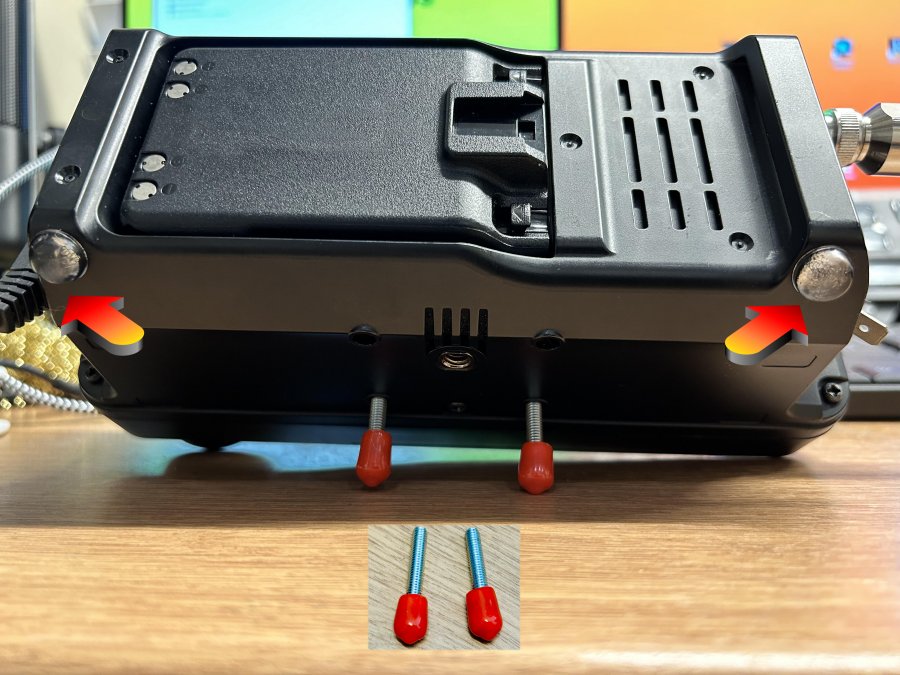
I paid over £20 for my tilt-stand and although it's good for shack use, it makes it a little awkward to fit neatly in my ruckshack, so I've started using a couple of 25mm roundhead bolts instead. Takes seconds to lightly screw them into the base and it results in the radio being tilted to the perfect angle. I got the screws from the local £shop in one of those little multi-pack screw sets.
SMA Caps hot-glued to bolts to provide non-slip solution
Quick 5W QSO - internal battery
UPDATE August 2024
Yaesu just announced the planned launch of the FTX-1F (early 2025) and all the Yaesu fanboys are waving their flags, claiming victory over Icom, who led the way with the 705 FOUR YEARS AGO! 😂
The FTX-1F will be a great radio and having Dual Receive is a big plus for many people, but will it have all the amazing features and benefits that Icom have been supplying for years??
Look at the FT-DX101D : that was launched 3 years after the glorious 7610 and it still didn’t have a built-in Server! It didn’t even have a clock!! 😂 But it did have a 3D scope to keep the Under-12s happy 😂
I hope the FTX-1F has all the bells and whistles of the 705 like built-in Server, QSO Recorder, GPS, WIFI, Bluetooth, etc. I will probably buy one if it’s not stupid money. But I reckon it will cost about £1700 (or more). We’ll see.
I recently purchased a static caravan holiday home and I had every intention of taking my ICOM IC-705 with me each weekend. And then I thought it would be very convenient if I could leave a radio stored in the caravan permanently, to save lugging one backwards and forwards. And besides, the more times you have to transfer kit in that way, the more likely you are to leave something behind.
So with that in mind, I searched for a mint second-hand transceiver. My first thought was to buy an old FT-100 or FT-817, figuring that they would be real cheap, but OMG how wrong was I? There were some right old dogs on sale for crazy prices. I can't believe how much people were asking for radios that could be approaching their 20th birthday 😲
And then I spotted an advert for a beautifully mint FT-857D at £495 - that was more like it!
The Yaesu FT-857D has never appealed to me previously - I always preferred the 817/818, but I must admit that now I've handled one in the flesh, it's pretty compact and not a great deal bigger or heavier than its little brother - it's only around 6"x9". And when you consider that this is a 100W radio, that's pretty impressive!
The radio covers HF, 6M, 2M and 70cm, all modes, all bands. It can provide 100W on HF, 50W on VHF and 20W on UHF. It has a detachable head unit and although it's small in size, it has a nice, large VFO knob. The unit feels very well built (just like the FT-818) and the controls don't feel sloppy or loose.
Operation of the 857 could never be described as intuitive - it's just not. You have to invest time in learning your way around things. There aren't many buttons but there are many menus! Luckily for me, I'm totally familiar with it all, since I've previously had an FT-818 and put the time in. But lets not get carried away - it’s not rocket science!! Operation of the radio can be made simpler by switching the standard microphone for a DTMF mic with multiple buttons for direct frequency input and other functions - a very worthwhile purchase (I already had one).
Sensitivity and selectivity of this little marvel is pretty good. The truth is, when you're out and about at high vantage points with a good antenna, sensitivity becomes much less important anyway, but happily, my 857 even works well at low levels.
NICKY NOOK, FOREST OF BOWLAND Perfect spot for walking, dogs and radio!
The FT-857D is going to be based at my holiday home in Scorton and will probably never stray further than the local high-spot (Nicky Nook) which is a great place to operate from. Signals are very easy to pick up there and you don't need the best radio in the world to enjoy your day.
My antenna of choice for the 857 is SotaBeams BandSpringer Midi using one of their telescopic masts. It's a fabulous antenna with great band coverage.
I'll probably leave my AlexLoop HamPack at the caravan too - it's very discreet and shouldn't attract any attention if I want to operate from the caravan. I'll put a Diamond X30 up on the roof for local VHF/UHF chat.
The FT-857D has 32 preset screen-colours and you can adjust these further if you can be bothered. Contrast and brightness are also fully adjustable. Personally I like the Light Blue and the usual Amber-Red. Some people think you can adjust the colours of the backlit buttons, but you can’t.
The screen is far better than the 818 I was used to, so overall I’m very happy with it. Needless to say, it looks ancient next to the 705, but once you’ve got the colour and contrast to your liking, it’s very easy to live with. There’s also a simple spectrum scope on the 857.
Audio on this radio from the built-in speaker is pretty good and it’s loud enough even in noisy outdoor environments. Things are improved further with an external speaker (which is fine at home but I can’t be bothered with one if I’m going outdoors - in which case I’ll throw a pair of headphones in my rucksack).
The 857D has useful DSP filters built-in which are very handy and work quite well. There’s also space inside for a further two Collins filters to improve selectivity, but they’re quite expensive and poor value for money as far as I’m concerned.
The VHF & UHF performance is excellent and it’s good to be able to use SSB on these bands. It’s a very flexible radio and an absolute bargain at this price.
To go with the radio, I needed a cheap ATU and thankfully, my mate Carl offered me an LDG AT-200 for free!! I couldn’t accept it for free, so I gave him a few quid and was very pleased with it. It interfaces perfectly with the FT-857D using a simple 3.5mm to 3.5mm jack-plug lead. This is perfect for use at the caravan, but I I’ll use my Elecraft T1 for outdoor activities.
So overall I am really pleased with the FT-857D. If I’d only needed HF then I would definitely have opted for an FT-891 because I think that’s a great HF receiver with amazing DSP, but I wanted a complete one-box solution and the 857 gives me that.
A friend of mine was selling his Yaesu ATAS-120A, so I thought I’d give it go. It turned out to be a wise move, performing really well at the caravan park. Of course it’s designed to work specifically with the 857 and 897.
THE NOISE LEVELS AT THE CARAVAN PARK WERE INCREDIBLY LOW!
The ATAS-120A simply plugs into the FT-857D and then you adjust Menu #85 to choose ATAS HF or one of the other options and then save that setting by holding the Function button.
When you first connect the ATAS-120A, you will see the word "INIT" on your screen when you press the TUN button. Leave it for a minute to initialise, then it will change to "ATAS". You are now ready to use the antenna.
To tune the antenna, just hold down the TUN button for a couple of seconds and you will see (and probably hear) the antenna moving up and down until it finds a match below 2:1. You will also see the changes on your radio's SWR indicator.
Occasionally, these antennas get confused and stop working - usually when you've changed bands. All you have to do is go back into Menu #85, switch it OFF and then back on again so it re-initialises.
Don't forget that this is not an all-band antenna! It covers 7MHz, 14MHz, 21MHz, 28MHz and 50MHz. It is also capable of operating on 144 and 430MHz but not very efficiently. And if you're not using it on the roof of a car/truck, then be sure to connect a couple of radials for each band.
Negatives of the FT-857D?? The only real negative is the lack of internal batteries like in the 817/818, but then the size would have increased considerably.
73, Tom, M7MCQ.
UPDATE : Added an external meter!
I was chatting with a mate of mine and he mentioned he had an external meter for sale - an LDG FTL Meter which was designed specifically for the Yaesu FT-8XX range, so I bought it. A lot more readable than the FT-857 meter :-)
I’ve had a KX3 for a while now, so maybe it's time to talk about it. I’m going to be referencing a couple of other radios throughout.
When it comes to choosing a QRP Transceiver, there are basically 3 main dealerships you can visit - DACIA, FORD or ROLLS ROYCE. Or in other words, Xiegu, Yaesu or Elecraft.
Now please bear in mind that these are just my opinions and I'm not saying that my choices are right and yours are wrong. We all have very different requirements, desires and priorities.
At the budget end, Xiegu offer a nice range of QRP radios and I have the Xiegu G90 which is an absolutely stonking bit of HF kit for the money! It really does amaze considering that it costs so little and yet includes so much. Xiegu have other radios worthy of consideration too including the X6100 & 5105.
Somewhere in the middle is the YAESU FT-818 which not only does HF, but also 2M & 70cm. It's compact, tough as old boots, good looking and performs really well out on the field. It's probably the most popular portable qrp-transceiver ever built and has been selling for around 20yrs. Presumably, it'll be replaced soon by a newer model - probably an SDR.
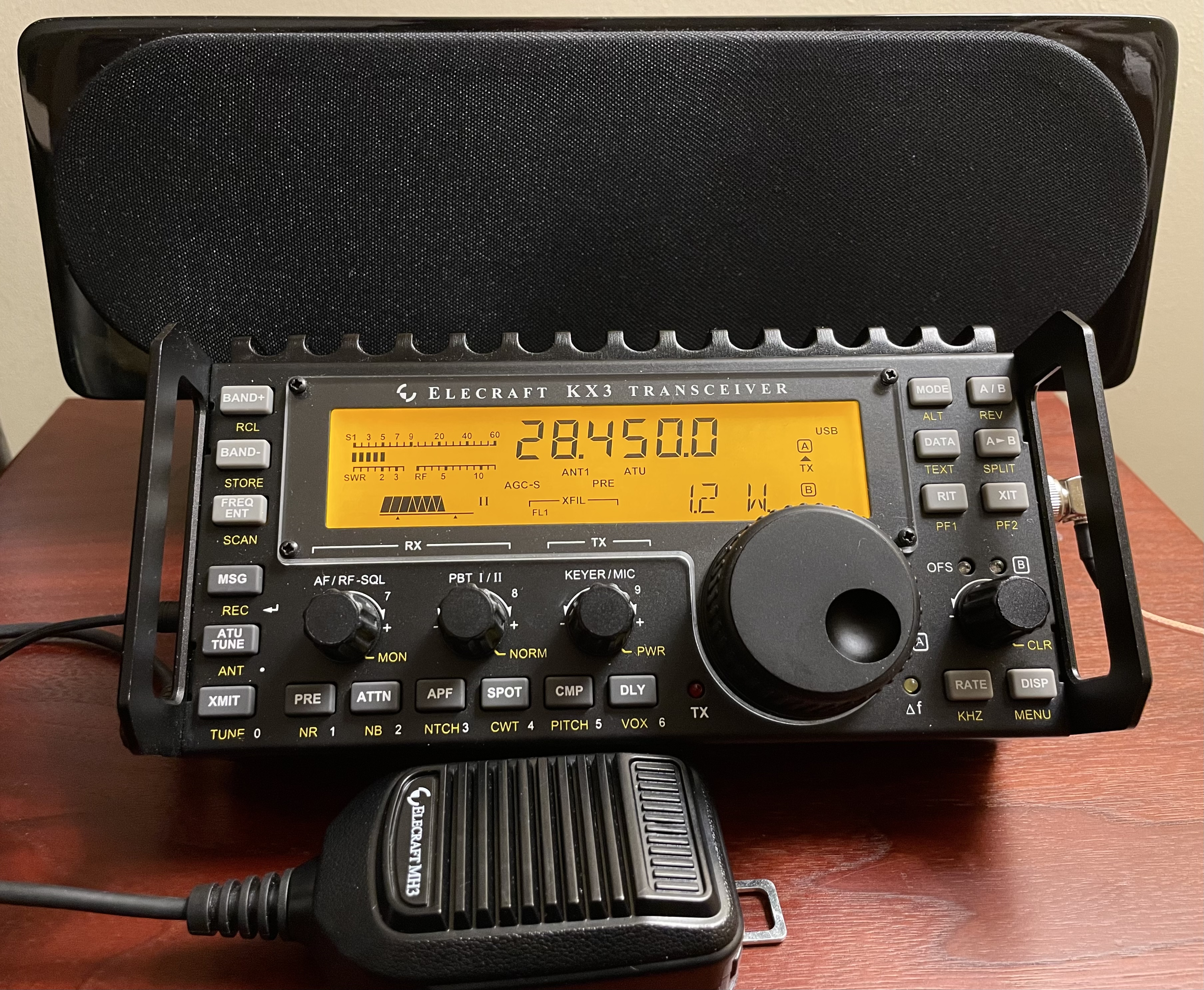
At the top end, there's the stunningly goodELECRAFT KX3 and that's what we'll be focusing on today. It's by far the best radio of this little group, but it costs a small fortune if you spec it up to include all the desirable options.
I took this photo before removing and selling the 2M module!
The KX3 covers 160-6M straight from the box and at the time of writing, that will set you back £1600 plus another £50 'build fee' and then another £90 for a microphone! 😮
On top of that, I have the following optional extras...
* KX32M 2M Module £300
* KXFL3 Roofing Filter £190
* KXBC3 Charger £100
* KXPD3 Iambic Keyer £160
* KXAT3 Auto ATU £295
I sold the KX32M (2M module) because I just never really used it. It could only put out 3W max and I rarely go outdoors to play anything other than HF. If I do decide to spend the day engaging in VHF activities, I'd take something dedicated to the task.
But anyway, if you bought the same spec KX3, at the time of writing, it would add up to a staggering £2645 😮 That is an insane amount of money for a little portable QRP radio! But that's where this radio differs to the others - used with an amp, this radio could easily also be your main Base Station too.
The first thing I want to point out about the KX3 as an outdoor-radio is that although it's beautifully made, it is also (in my opinion) a little vulnerable to damage from knocks and scrapes. The only solution is to protect it (at even more cost) by adding side-rails and a cover. These are readily available on the internet for around £80. Without them, you'd be worrying about damaging that big beautiful screen (although in reality it's the perspex cover which would get scratched).
The other thing I'm not happy about is the KX3's 'clamshell' design. There is no hinge between the upper and lower parts of the case and when you open them up, you have to be extremely careful not to damage the delicate ribbon cable - you also have to be careful not to trap or kink it when closing the case. The supplied heatsink is also inadequate and should be replaced if you plan to transmit at 15W for any length of time. There is obviously zero waterproofing! Quite a poor design IMHO.
The KX3 has a very sensitive receiver and it's easy to demonstrate it's superiority over the other two radios when you put them side by side and tune into weaker stations. On the G90 and the FT818, there's many occasions where you just cannot pick up the signals that the KX3 hears.
It's important to use a good battery with the KX3 (or any other portable radio) in my opinion. Manufacturers incorporate internal Nicad battery trays but they very quickly run low on power which can cause issues such as the ATU being unable to find a match, etc.
If you invest in a good, LifePO 13.2V battery, you will pat yourself on the back every day!! Rely on nicads and expect disappointment somewhere along the line. If you're not going to be climbing hillsides, you can probably afford to get a heavier battery. Perfect for things like Parks On The Air!
All three radios can obviously pick up regular strength transmissions and many operators will be perfectly happy with the cheaper radios. It's worth mentioning though, the KX3's noise floor is supremely low and that's one of those things that just makes you smile every time you switch it on. It's one of the things that makes this radio special. I'll never forget the first time I took it out in the field and switched it on - I thought there was something wrong because it was deathly quiet - and then a signal came in - boom!
The Elecraft also benefits enormously from the KXFL3 Dual PassBand Roofing Filter. The G90 has some great filters built-in but they obviously don't compare to Elecraft's. This filter makes a huge difference and puts the receiver in a class above the rest. I installed a Collins SSB filter to the FT-818, but to be honest, it didn't seem to make much of a difference - to the point where I might actually remove it and sell it!
The other massive advantage of the KX3 is that big, beautiful, crystal clear LCD display! It is just soooo nice to use and let's not forget also, all those lovely buttons and dials which are lacking on the 818 and 90. Many people don't realise that the KX3 screen is exactly the same size as the one used on the Elecraft K3S Base Station!
When I'm using the 818 outdoors, I always seem to struggle to find a good spot for the radio to sit so that I can see the display. The KX3 on the other hand always seems to be in just the right position and everything kinda falls to hand. The G90 (with the H1 cooler/stand) is much better than the 818 in this respect, but the (lovely) 2" colour screen is not always easy to see in strong sunlight.
The G90 has one thing that I truly wish the other two radios had - a panadapter and waterfall. Boy, that is such a great feature and I think the Elecraft should also have one - even if it's a simple affair. Needless to say, you can spend even more money on a PX3, but then the total price just goes into lunatic mode.
One failing of the Elecraft KX3 is the audio! The speaker just sounds dreadful! And even though Elecraft try to ignore the issue by saying it's purely a backup and they expect people to use headphones, the fact is, they could easily have done much better! I have a £25 Baofeng which has a superbtiny speaker built in. I strongly recommend that you use an external powered speaker or a good quality pair of earphones.
The advantage of wearing earphones with the KX3 include the ability to use the DUALWATCH feature where one VFO's audio is played through the left earphone and the other VFO's audio is played through the right earphone. Just bear in mind that A and B can only be a maximum of 15KHz apart, which is a bit poor.
You also get the option to switch on the DELAY feature in single-VFO mode. This adds a very slight amount of echo to the audio, making it sound quite pleasant. You can also use the built-in equaliser to fine tune the audio.
So what's it like to 'lug around'? Well I'd say it's similar to the other two radios. There's not a lot between any of them, but the Xiegu is a bit more awkward due to its length. The 818 is super-slim and if you've got the Yaesu matching leather case, then you can just chuck the 818 into your rucksack without a second thought.
LowePro Tahoe BP-150
The Elecraft fits neatly into my small rusksack and leaves loads of space for other stuff including a LifePO battery, connectors, antennas, phone, torch, whistle, notepad and even a handheld radio for a spot of DSTAR, FUSION, 2M, 4M and 70cm. I could actually use a much smaller rucksack instead, but I like having a few extra bits and bats with me. Inside that top section I also have rather nifty antennas from Hawkins for my 2/4/6M work, which simply hangs from the top of my telescopic mast.
Compact 6M Antenna
If you're really pushed for space and are happy to operate on 20M and 17M only, you can carry your KX3 and battery in the smallest bag you can find and just take Elecraft's AX-1 telescopic antenna with you. It's a fabulous little thing and performs really well if you give it a good take-off point. I've managed amazing distances with it, even from my back garden!
I've tried this beaut of an antenna connected directly to the BNC socket of my FT-818 too and got from Manchester to Denmark on 2.5W. And I'm talking about a proper lengthy chinwag, not a fake report and 73. I sometimes use this antenna at the top of a portable mast so it's 20ft up in the air. I recently bought the 40M extension. Highly recommended bit of kit! Some people have even modified their AX1 to further enhance its capabilities - read this article from Rob Ramsey, AH6X
Anyway, back to the KX3 itself. Amongst its other useful features, it has a built-in, on-screen decoder for CW, RTTY and PSK. Personally, I don't (can't) use CW but I do sometimes like to listen and watch the decoded messages. I also like to be able to SEND CW messages like "CQ TEST M7MCQ" to see how far my signal can be heard on the RBN.
Being an SDR radio, the Elecraft is, of course, able to have its firmware updated and Elecraft are not slow to give their customers what they ask for. The same applies to the Xiegu G90 too, but the FT-818 is obviously a superhet and frozen in time.
Highest power output places the Xiegu in first place with 20W. Elecraft is second at 15W and the Yaesu a lowly third with just 6W. The good thing about the KX3 is that its power can be reduced down to a few mW which can save battery usage and is a lot of fun.
Speaking of power, the KX3 is by far the most energy efficient of the bunch, consuming less than 150mW in receive mode. That is a very important consideration when working outdoors on battery power for hour after hour. To many field-operators it is the Number One consideration when choosing a radio.
Another important option is having an internal ATU. The Xiegu has one built-in and I'd say it's as good as the Elecraft's optional ATU. They're both just superb! Sadly, the Yaesu has no ATU and you have to resort to buying (and carrying around) an external unit. I'd recommend the LDG Z-817.
CONCLUSION
So in summary, I'd say again that the Elecraft KX3 is amagnificent radioand something that anyone would surely be proud to own. It's ridiculously expensive with all the optional extras and the Xiegu G90 almost laughs in its face when measured in terms of cost alone.
There's no denying that the Panadapter & Waterfall of the G90 is handy, but operators have been playing radio without them for many decades. It's certainly not worth buying a PX3 for the KX3 unless you find one super-cheap at a rally (unlikely).
As for the Yaesu FT-818, that too is a fab little rig. It does so much and is so incredibly dependable that it feels like sacrilege to discuss it in anything but positive terms. But the truth is, its design is showing its age. Then again, the KX3 could also benefit from an update - maybe a better battery pack & charging system, a soundcard and a USB-C connector?
If you wish to add computer control to your KX3 in the shack, then there's a few options out there which will not only give you control of the rig, but also a panadapter. Here's one such solution...
Win4K3Suite
Anyway, if you've worked your ass off and saved up some money, or if you just won a bet at the races and want to treat yourself to something REAL SPECIAL, then buy an Elecraft KX3 without any hesitation. They are very special and a joy to use.
CAN IT BE MY SHACK RADIO TOO??
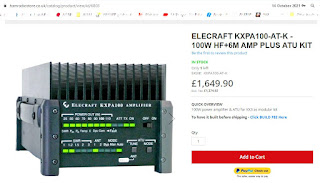
Hell, yes! If you have an amplifier, the KX3 could be your everything radio! There's a wide range of amps out there to choose from and if you've got the money, Elecraft's KXPA-100 is the one to go for....
Pictured above is the matching 100W amplifier - mini review here...Elecraft KXPA100-AT.
HOW ABOUT SWL??
The KX3 would make a magnificent ShortWave Listeners radio, but it would obviously be a very expensive one unless you were lucky enough to find a reasonably priced used one. If you did manage to find one, I'd recommend using it with an antenna coupler or a manual tuner such as the Emtech ZM-2 or the Kanga TransMatch.
Have yourself a Rolls Royce parked on the drive 😂
Mounted on a stand in the shack
Connected to Sony amplified speaker
KX3 SPECIFICATIONS :
KX3 STANDARD FEATURES
•160 - 6 meter ham bands; general coverage receive from 1.5 - 32.0 MHz (also covers 0.31 - 1.5 MHz with reduced sensitivity)
•All modes: SSB, CW, Data (four sub-modes), AM, FM
•Ultra-compact size: 3.4"H x 7.4"W x 1.7"D; 18 oz. (less options)
•Rear tilt feet fold up for transport
•Custom high-contrast LCD with alphanumeric text display
•Internal 8 - AA battery holder
•Current drain as low as 150 mA in receive mode
•High-performance 32-bit floating-point DSP
•Built-in PSK/TTY decode/encode allows data mode operation without a PC; transmit in data modes using CW keyer paddle
•Low-noise synthesizer with 1-Hz tuning resolution
•Firmware updateable via provided application software
RECEIVER
•Quadrature down-sampling mixer compatible with PC-based SDR (software defined radio) applications
•Receiver I/Q outputs for use with PC soundcard
•Dual roofing filter option for enhanced dynamic range. (500/1500 Hz analog filters; effective IF b/w of 1000/3000 Hz)