Showing posts sorted by relevance for query ldg-817. Sort by date Show all posts

Wednesday, 7 August 2019

LDG Z-817 AUTOTUNER

TUNING MADE EASY

I like AutoTuners. They're simple and reliable and fit in well with my modus operandi - KISS. Pressing a single button and achieving a 50ohm match within a few seconds, is right up my street! And if the autotuner is dedicated to your radio, great!


I've had these tuners before and feel good about them. I've actually got one connected to my Icom IC-7100 and I've never experienced any problems. I get the impression from their construction and materials that they are a good quality item. So as soon as I started to look for an ATU for my Yaesu FT-818ND, I had no hesitation looking for an LDG.

The Z-817 is specifically designed as a QRP tuner and it is referred to (by LDG) as Zero Power meaning that it consumes almost no power when in sleep mode. It basically doesn't have an on/off switch - it just goes into a deep sleep when not being used. Power (when needed) is supplied in the form of 4xAA internal batteries which last approximately one year.

The Z-817 interfaces with the Yaesu FT-817/818 via a CAT cable. This makes it an integrated tuner powered by the interface; no extra power cables are needed. Just press the tune button on the tuner and the mode is set to carrier, the RF power is reduced, a tune cycle runs and the radio is returned to the original settings. A CAT pass through port is provided for computer control, which is a great feature - one which Yaesu's own tuners always omit!

The Z-817's are around £129 new, which I think is a bit choppy, so I looked on eBay for a used one. Unfortunately, most sellers on there had the opinion that their used devices were worth almost as much as a new one, so I looked elsewhere and soon found one on a Facebook 818 Group.

The guy wanted just a fraction of the new price and his included a very nice waterproof carry-case, so the deal was done! I do like a bargain :-)


Since writing this little review, I’ve added a Z-100PLUS to the shack which can be seen HERE.

Z-817 Spec
  • RF Power 0.1 to 20 watts SSB and CW, 5 watts for digital modes.
  • Latching relays for ultra low power consumption
  • Battery operated 4 x 1.5V Alkaline AA (not included).
  • Built-in CAT port interface. CAT thru port for computer connection. 38400 baud.
  • 2000 memories when used with FT-817/818 interface (200 memories for other radios)
  • 1.8 to 54 MHz coverage
  • Tunes 6 to 600 ohms (about 10:1 SWR range). 16 to 150 on 6M (about 3:1)
  • SO-239 in and out connections for dipoles, verticals, beams, G5RV, OCF, ect.
  • Dimensions: 5.1L, 4.7W, 1.7H.
  • Weight: 9.3 ounces (without batteries).
  • Includes 3 foot CAT cable.

Wednesday, 30 October 2019

LDG Z-100PLUS ATU REVIEW

LDG's "ZERO CURRENT" ATU

When using a portable radio (eg..ICOM IC-7100) during a Field Day Event I need an autotuner. I could of course use my diminutive Z-817, but that can only handle around 20W which would be no good if one of my radio-club colleagues wanted to sit at the mic.  So the answer was to find a small, light ATU and a quick search resulted in me choosing the LDG Z100PLUS.


It's similar to my LDG Z817 and shares the same "Zero Current" technology which means that in standby-mode there is virtually zero current draw - which is why there's no ON/OFF switch. The unit is powered from internal batteries (which should last for approximately one year) but can also be powered (and controlled) by the radio if you purchase the appropriate lead.

With the control lead fitted, the unit takes its power from the radio (the IC-7300 Molex connector in my case) and also permits the radio's "TUNE" button to be used instead of the LDG's. 

The Z100PLUS can handle 125W which makes it perfect for most of today's popular rigs. It will also handle about 30W in Digital mode. It has 2000 memories for near-instant tuning of previously tuned frequencies.

The LDG Z100PLUS also interfaces with the QRP ICOM IC-705 superbly, using a regular 3.5mm jack to jack stereo lead, so it's a great option for that too. Makes a nice change from having to buy expensive interface leads (are you listening Yaesu?). I think you can also program one of the 705's front-panel buttons to act as a TUNE button. For the IC-7100 you’ll need a 3.5mm to Molex interface lead available from TechnoFix

I see Waters & Stanton posted a video on 14 Aug 2021  virtually claiming that this ATU was designed specifically for the 705 but of course it's not - the Z-100PLUS was in production way before the 705 hit the shelves.


The ATU weighs 570g. Download the manual here.


Since writing this post, I've also bought an Elecraft T1 for portable use with my IC-705. The LDG is much cheaper and performs extremely well in terms of what it will tune-up. It's a great little ATU and I recommend it highly!

Thanks for visiting - please take a minute to leave a comment below 

73, Tom, M7MCQ.


Monday, 18 November 2019

YOUR FIRST RADIO!

Which Radio Should A New Ham Buy?

I've never been asked this question personally but I've seen it asked over and over on forums and Facebook Groups, so I thought I'd write about my own views on it - after getting it so wrong myself! In this post we'll look at the FT-818, G90, IC-7100, IC-705, KX3 and even the (tr)uSDX. All available new or used.

Before I start though - let's state the obvious - your very first consideration should always be your antenna! Spend the biggest part of your budget there and not on your radio. If you can't have a big multiband yagi because of local restrictions, then consider a wire dipole or an EFHW. If none of those options are possible, perhaps you could install a good quality vertical. Personally, I went for an EFHW and love it.

Some (ill-informed) people will come out with ridiculous statements like "QRP IS NO GOOD FOR A BEGINNER".  I can hardly believe the mentality of those guys - it just shows how little they have actually learned about radio.  As a beginner, your licensing conditions will probably insist that you use low power anyway, but even if they didn't, you will learn FAR MORE about radio using 5W than you will by using 500W!

Another piece of advice that you'll often hear is people telling you to buy an older radio (usually their personal favourite). If you have no other choice (due to a very tight budget), then go for it. But if you can afford to buy something newer, then please do, because that way you will have access to all the operating modes including the very latest digital offerings. There's a world of fun out there on digital and some old-school guys are loathe to even try it because it's "not proper radio" 😂

Anyway, let's move on. I should point out that I am from the UK and over here we have the "FOUNDATION LICENCE" which is the entry-point. Thankfully, it allows you to go on pretty much all the bands, giving you HF, VHF and UHF. There are very few restrictions and you can use up to 25W power. Other countries might have much tighter restrictions.

If your licensing conditions don't allow you access to the HF bands, then some of these radio choices may not apply.

When I got my Foundation Licence , I convinced myself that I needed a big HF rig and a great handheld. I actually ended up buying a Kenwood handheld and a Yaesu base-station.  Then I added an RSP1A for a panadapter display.

I tried allsorts over the coming months and wasted some money swapping and changing.

It wasn't until i bought a Yaesu FT-818 that I realised I should have bought a QRP shack-in-a-box right from the get-go!  Originally I had searched for a used FT-817 but soon realised that there's thousands of them out there, but A) they're quite expensive and B) they're quite old!

What's the difference between an FT-817 and FT818? Well they're almost identical but the newer 818 has 20% more power output, an accurate TCXO and a much better internal battery. Additionally, it has better internal shielding and bonding. Some 817 owners were very disappointed when Yaesu introduced the 818, hoping for a radically new radio, but instead they got an improved version of what was already a fine rig. As a result, you'll hear some foolish claims that the 817 is a better radio, lol, such is their disappointment in not getting something altogether different. The simple fact is, the 817 is a great radio and the 818 is greater.

So in the end I bought an FT-818ND. It's a beautiful little thing and it feels amazingly rugged and reliable. There's nothing flimsy about it and it very quickly feels like your old mate! When it's tucked away in your rucksack waiting for the next outing, you kind of miss it - even though you might have a fancy-schamncy base station in the shack - this lil gal keeps on calling your name.

So, for a newly licenced ham who is on a fixed budget, I would strongly recommend an FT-818 as your first and only radio. Update: Since writing this review, Yaesu announced that the radio was being discontinued. A buying frenzy then ensued and people queued to buy the last remaining stock for £625 each, such is the love for this amazing little rig.

With the FT-818ND, you can operate on HF 1.8 MHz - 54 MHz, VHF 2M, UHF 70cm. You have 6W output power and can easily connect a linear amplifier to increase power when you become licensed to do so.  Although you may think 6W is a bit limiting, believe me, many QRP operators (yes, you are a QRP operator whether you like it or not) reach amazing distances on 6W and less! 

The 817/818 not only allows you to work all the bands, but it also let's you work them in any mode you like too - CW, AM, LSB, USB, FM, PACKET. You can get up on your local hill or maybe get to the beach and make some amazing contacts in your log-book on minimum power. There's no better feeling than breaking through a pile-up with a couple of watts (or even milliwatts).


Just a note here for the newcomers - when calling CQ it's always worth mentioning the fact that you are using low power - QRO operators always seem keen to help out low-power users. My CQ-Call goes like this....

CQ CQ CQ, this is QRP station M7MCQ, I repeat QRP station, Mike Seven Mike Charlie Quebec calling CQ and standing by.

Not only are you identifying yourself as a humble little QRP'er but you're also extending your call that little bit longer to perhaps be spotted on a waterfall. Don't be afraid to extend that call even further. The longer your call (within reason), the more chance you have of someone hearing you or seeing you on the panadpter and applying their filters to pull you out of the noise.


Whilst on holiday in the county of Northumbria, I had a few SSB QSO's on 2.5W using the FT-818 and a SotaBeams Linked dipole. Two of the chats were with American operators KE5EE and WD4NGB. KE5EE gave me a 'genuine' 55 report and he was 7,000km away - that's 2800km/W. 

2.5W into the USA from Boulmer Beach, UK


The radio itself is very straightforward to use and although it's menu-driven, it only takes a week or so to become totally comfortable with it. If you're a bit of a luddite and against menu systems, then don't bother with an 817/818. In my opinion though, you'd have to be pretty dumb not to get along with the radio's way of operating. After all, the most important things like tuning, switching bands, switching modes, etc, are all on the front panel.

The receiver isn't super sensistive, but hopefully, you'll be sat on a high hill or at another great take-off point when using this radio - not using it at your home QTH.

Although the 818 comes with an internal Lion battery, I would recommend that you invest in a nice little LifePO battery around 4800mAh if you want to spend the whole day TXing in the hills. It's a very worthwhile investment!

Another great investment would be an LDG Z-817 or Z-100 PLUS ATU... 

With one of these you can use a random long wire or an End Fed Half Wave which covers multiple bands. The Z-817 is designed specifically for the little Yaesu, whereas the Z-100 PLUS can be used with virtually any radio and it can handles 100W, despite it diminutive size.

There's nothing much that the little 817/818 can't do and as an owner, you are in the company of many others who've gone down this path. Owning an 817/818 at one time or another has almost become part of the hobby, lol. You'll have great fun with it at a variety of locations and events, including your shack. A small amp will permit the use of your full 10W and a bigger amp will give you room for growth if you decide to upgrade your licence.


So there you have it. A true shack in a box - in a neat, compact body. Tough as old boots, reliable and functional on almost all the amateur bands. Get a "handbag" case for it and you can take it anywhere with you. 

And bear in mind that if you decide you want a big radio in a few months time, you can always sell your 818 and often get decent money for it! They really do hold their value.

Enjoy!


ALTERNATIVELY....

A lot of folk can't afford to splash out so much on a shack in a box (mortgages, kids, etc) and seek a cheaper alternative. To those operators, I would suggest considering the purchase of a Baofeng UV-9R dual-band HandHeld to cover 2M/70cm and then look at a cheap Xiegu G90 for HF. I have both these radios and there's simply no denying the amazing bang for the buck! Especially the G90 - WOW!


If money isn't an issue, you might want to consider the top-shelf ELECRAFT KX3 fully loaded complete with internal tuner and 2M transverter could cost you as much as £2800 :-O  

Or for half that price, consider the ICOM IC-705. I recently switched to a 705 and I have no regrets at all. In fact, if you have a budget that reaches this level, I'd recommend the IC-705 all day long! The more time I spend with this radio, the more I absolutely LOVE IT but of course £1400 is a lot of money. At the time of writing, this is the most advanced QRP radio in the world.

Then there's the amazing ICOM IC-7100 which is probably the only radio in the world which gives you HF, 6M, 4M, 2M & 70cm. I just love these radios. And you can get hold of a mint one for as little as £650. 

💗 ELECRAFT KX3 💗


💗 ICOM IC-705 💗

💗 ICOM IC-7100 💗


If you're on a very tight budget for HF, you might want to consider the utterly amazing (tr)uSDX QRP transceiver. These can be purchased from as little as £83 as a kit or pay a little more and get it pre-built, ready to use. They include a speaker, a microphone and even a morse decoder!!  I like them so much, I got two!


STEVE NORMAN from the Facebook Group - Amateur Radio UK - suggested an FT-857 or FT-897 as a first radio, saying it's all-band, all-mode, 5-100W and therefore future-proof. That's a good point. I've had the FT-897D and it was a cracking radio but you can't buy them new any more and need to keep an eye on the age of second hand units, for fear of buying an ancient rig. They're not very portable either - well you're certainly not gonna chuck it into your rucksack, lol. The 857 is kind of in-between the 817 and the 897 in size. Again, 100W but more suited to a car. 

NIGEL BROOKS from the Facebook Group - Amateur Radio UK - suggested an FT-840 which obviously suits his interest in HF, but it doesn't operate on VHF or UHF. And it's pretty much limited to home use, being a base station.


SO IN SUMMARY, based on price alone....

  1. (tr)uSDX ðŸ’— with a complimentary Baofeng for VHF/UHF

  2. XIEGU G90 with a complimentary Baofeng for VHF/UHF
     
  3. YAESU FT-818 ðŸ’—
     
  4. ICOM IC-7100 ðŸ’— 
     
  5. ICOM IC-705   ðŸ’— ðŸ’—💗 
     
  6. ELECRAFT KX3 with 2M Module ðŸ’— ðŸ’—

IF YOU'RE NEW TO RADIO, it might be worth your while reading my NEWBIE POST. It's a long post, but it's full of useful info and tips for a beginner.


Thanks for visiting - please take a minute to leave a comment below 

73, Tom, M7MCQ.


Friday, 28 February 2020

ANGLEZARKE

SATURDAY 29th FEB - FIELD DAY

Come hell or high water, on Saturday I'll be over at Anglezarke near Chorley playing radio. The forecast isn't too good on account of "Storm Jorge", but if I keep abandoning trips out because of bad forecasts, I'll be 101 yrs old before the next outing.

Anglezarke is a local beauty spot about 5 miles from my home and is very easy to reach by car, with good parking for about 10 cars. It has a fabulous take-off out to the West, so it's good for Transatlantic DX and it's also good for South-West towards Wales.

The great thing about Anglezarke is that your spouse can also tag along and enjoy a bit of a picnic, beautiful views and maybe a couple of hours reading - all without having to climb a single hillside :-)

Once you're set up, you have open space and the Irish Sea in front of you but behind are the hills of the West Pennines and Winter Hill. The height of this spot is about 150M ASL as opposed to Winter Hill's 450M, so it's quite a bit lower down, but it's a lovely spot to work from. I'll be working mainly on 20M & 40M QRP frequencies 7.090MHz & 14.285MHz unless they're occupied by contesters! I will also try to get some 2M contacts into Wales and the Isle of Man if possible.

Listen out for me - and please - confirm QSO's. 
I add every contact to my QRZ Log and I send
every contact a card through eQSL.

YAESU FT-818ND
LDG Z-817 ATU
SOTABEAMS BANDHOPPER II 20/40
SOTABEAMS 7000HDS MAST

SOTABEAMS SPEECH COMPRESSOR
DIAMOND X-30 VHF/UHF
FLIGHTMAX ZIPPY 8Ah LifePO


=============================

UPDATE!

I arrived at Anglezarke around 10:15am and started to setup the SotaBeams 20/40 Linked Dipole with the fibreglass mast from the same company. I absolutely love this combo - the antenna just works everytime and it's very simple to erect and dismantle. Being resonant, a tuner is not required, but I always use my little LDG Z-817 ATU to get the perfect match across the bands. The telescopic mast is also a great accessory and saves you looking for trees!

The grass was MUCH wetter than I anticipated and within seconds I was covered in mud LOL. Mind you, it has been raining for the last two months!

Once the wire was erected, I connected the 6W FT-818ND to it from within the car (it was freezing cold) and tuned to 20M. The floor noise was incredibly low which was fantastic BUT the band was riddled with contesters - I struggled to find a free frequency to call CQ.

In the end, I gave up looking for a chinwag and decided to respond to some of the contesters. There were simply too many people shouting out and many of them were not following any sort of code of conduct! Eventually though, I managed to find some breaks and got through.

I feel that the SotaBeams Speech Compressor made a real difference. When you're struggling to be heard at QRP levels, this handy little device can make the difference between getting a contact in the log and getting hoarse, lol. If you've got an 817, 818, 857 or 897 I'd strongly recommend buying one of these - they're incredibly good value for money.

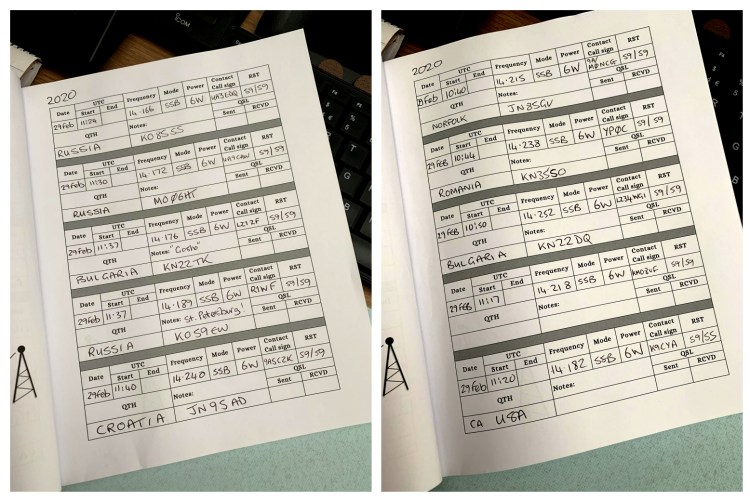
I started off at 10:40am with a guy from Norfolk (South East England) and then proceeded to swap Grid Locators with operators in Russia, USA (California!), Bulgaria, Romania and Croatia. Most of my contacts were Russian.

After a couple of hours I switched to 2M but then noticed the weather pulling in fast and made the wise decision to pull the antenna down. Minutes later it was lashing down with sleety rain. So it was only a short day out. Still, it was good fun while it lasted. Shame the competition flooded the bands and prevented normal chit-chat. Martin (K2TRD) came onto a contesting frequency but I had no chance to speak with him because it wasn't my frequency.

Back home now, warm and dry. Ready to go into the shack for the rest of the day :-)

View from the truck - nice and warm :-)

A couple of pages from the log

Monday, 8 February 2021

ELECRAFT T1A REVIEW

SUPER PORTABLE ATU

I've always been fairly happy with my LDG Z100PLUS and have never seen it as a great hardship lugging it around with me when working outdoors. It is, after all, quite compact and runs off internal batteries. But it does have a steel case and those batteries do add to the weight when you're walking up hill.

So when I bought an IC-705 I started to see more and more posts about the MAT Tuner and the ICOM AH-705 Tuner. Neither of these appealed to me because the first version of the MAT-705 had some quality issues and the AH-705 is just too focused on the IC-705 (and it's too big). I prefer a tuner that I can use with a variety of QRP radios.

So then I recalled just how amazing the ATU was in my Elecraft KX3 and so I decided to investigate the Elecraft T1A tuner. The unit is about the same price as the KX3's internal ATU so although I wasn't exactly thrilled with the cost, neither was I surprised.

The big advantage of choosing this tiny external ATU over the KX3 internal ATU is that you can use it with ANY of your other radios! 


The thing that did surprise me however, was the quality of the T1A's case. It looks rather cheap. The battery cover is one of those slide-on/off affairs and the interface socket on the side looks misaligned. It's really not what you'd expect at this price point 😲


Having said that, everything else is pretty much perfect! This tiny (the world's smallest actually), lightweight marvel runs on a single PP3 battery and is just superb at finding a match on everything you connect it with. It's every bit as good as the KX3 tuner and they don't come much better than that.

Using the device in manual mode is pretty simple - just a case of pressing the TUNE button and then keying up your radio in AM/CW/RTTY mode until the T1A finds a match, then switching back to your desired operating mode.

Elecraft have always said they are going to be making an interface lead to connect the T1 to the IC-705 for automatic operation, but if it's like any of their other stuff, it'll probably be about £75 😂 I've dropped them a few emails asking WHEN the interface cable will be released but they keep saying they have no release date - to be honest, I don't think it will ever happen.


I tried the T1 with my G5RV, EFHW, Random Wire and with my AT1 Telescopic. It worked quickly and flawlessly - which is exactly what I expected from Elecraft. 

Below is a video showing me using the Elecraft T1 with a PreppComm MMX radio. As usual, the T1 performs flawlessly on all 3 bands...
 
If video doesn't display, CLICK HERE

T1 with the fabulous FX-4CR

T1 with the fabulous QDX

T1 with the fabulous IC-705


The LDG Z100PLUS is a great ATU and can handle much more power than the T1, so if you have the licence for extra power, you may opt for the LDG instead of the ELECRAFT.

_________________________


OVERVIEW 

Use with any Low-Power Transceiver 
The T1 can be used with any 0.5-W to 20-W transceiver covering bands in the 160-6 m range. This includes kits, home-built rigs, and commercial transceivers such as the FT-818, XIEGU G90, IC-705, etc. 

Quick, Convenient, and Accurate
The T1's 7-inductor, 7-capacitor L-network provides a wide matching range, and its re-tune time from memory is just 1 to 2 seconds. Equally important, the T1 always tries to achieve a 1.0:1 SWR-it doesn't stop at 1.5:1 or 2.0:1 like some tuners. You won't even need to change modes to tune. You can use SSB voice or a keyer as well as a constant carrier (AM, FM, CW, etc.). 

FT-817/8 Remote-Control Option
For even greater convenience, we offer a "smart" remote control adapter for use with the Yaesu FT-817 . On any band change, the adapter's micro-controller sends band data to the T1, which quickly recalls the appropriate network settings. Imagine instant QSY without the need to transmit-less QRM, less hassle! 

Factory-Assembled or Complete Kit
You can purchase the T1 assembled and tested, or as an easy-to-build kit. Our professionally written, fully illustrated assembly manual provides step-by-step instructions, and no alignment is required. 

Unsurpassed Technical Support
If you have any difficulty, our technical support via telephone and the Internet will get your T1 up and running quickly. You can also get answers to nearly any question day or night from the helpful, tech-savvy hams on our e-mail user group.

SPECS

Inductance range: 0-7.5 μH in 128 steps
  • Capacitance range: 0-1300 pF in 128 steps
  • Network: Series L, shunt C (switchable)
  • * Tuning times (typical): 2 to 8 seconds for initial tuning; 1 to 2 second re-tune
  • Frequency range: 1.8 to 54 MHz
  • Max power: 20 W peak, 10 W continuous (10 W peak on 6 meters)
  • SWR/power display: 1:1 to 3:1 and 0.5 to 10 watts on three LEDs
  • Supply voltage: 8 to 10 VDC; 9-volt PP3
  • Current drain: 20 mA average during TUNE; 0 mA when off
  • Size: 4.4 x 2.5 x 0.9" (11.2 x 6.3 x 2.3 cm)
  • Weight: 5 oz. (0.14 kg)


Additional Features

  • Small size, ideal for home, mobile, camping, and HF Pack use
  • Stand-alone; works with any low-power rig
  • 160 through 6 meter coverage
  • Handles up to 20 watts (10 W continuous)
  • Finds lowest SWR; doesn't stop at 1.5:1 or 2:1
  • Tunes in any constant-carrier mode
  • Many tune-ups are saved for fast re-tuning

Thanks for visiting - please take a minute to leave a comment below 

73, Tom, M7MCQ.