Saturday, 20 February 2021

GOOD DAY ON FT8

91 CONTACTS, 4 BANDS

I noticed some people on FaceBook claiming that conditions for FT8 were poor today, which surprised me because my experience was the opposite. Mind you, I was at it all day and I experienced my share of the usual frustrations.

Perhaps the most frustrating thing which seems to happen time after time is when you find a nice (and rare) gap in the waterfall and then some power-hungry operator comes over to answer your call and then stays on your frequency, staining it in a trail of blood red excess. 

Anyway, it just meant that I had to keep moving around a lot and sometimes changing band completely until they buggered off. I managed to get as far as 5,500km using 10W.

Also today, I uploaded my Log into the UltimateAAC program and I think I've managed to bag 23 FT8 AWARDS 😮

I clicked the 'apply' button, so we'll soon find out if I really have or not.

Saturday, 13 February 2021

FT8 & PROPAGATION

 INTERESTING SIGNAL VARIATIONS


I woke up in the early morning and couldn't get back to sleep so I made a brew and switched on the my little IC-705 for a bit of FT8 play, using the radio's built-in BP-307 battery pack.  I received a -25db report from UN7ZV in Kazakhstan about 3500 miles away. As the time passed, I noticed more and more Transatlantic contacts and received a -25db from WX5CSS in the USA. Similar distances but in the opposite direction.

Nothing unusual there but then I received a +00 from AB3JE in the USA and wondered why my 5W had done so much better within a matter of minutes. 


But then to my amazement, I received a +10db from an operator on Rhode Island, USA. Huh?? How can that be? All similar distances, around the same time and yet 35db apart.


Because I know so little about propagation (I've not studied the subject much at all), I cannot determine whether the +00 and +10db reports are due to propagation or just due to station conditions.

I'm kinda guessing it's more to do with the stations having fabulous antennas and sensitive receivers, rather than swells in propagation. How do you tell? I guess I should study more and maybe find some beacons to listen to for reference purposes. Or make more use of WSPR.


Thanks for visiting - please take a minute to leave a comment below 

73, Tom, M7MCQ.

Thursday, 11 February 2021

HEIL HTHD-I HEADSET

LIGHTWEIGHT HEADSET

I was looking for a new headset to include in my IC-705 RuckSack and thanks to a guy called John Halkiadakis on FaceBook, I came across the HEIL HTHD-I which has a twin-pin plug specifically made to suit Icom HandHeld radios. Luckily, the IC-705 has this configuration, so it fits perfectly.


The Heil HTHD-I is a twin-speaker design with small 'on-ear' faux-leather cushions. They're not perfectly comfortable but good enough for short  periods of operation with a few breaks in-between (just as you would operate normally on a field-day).

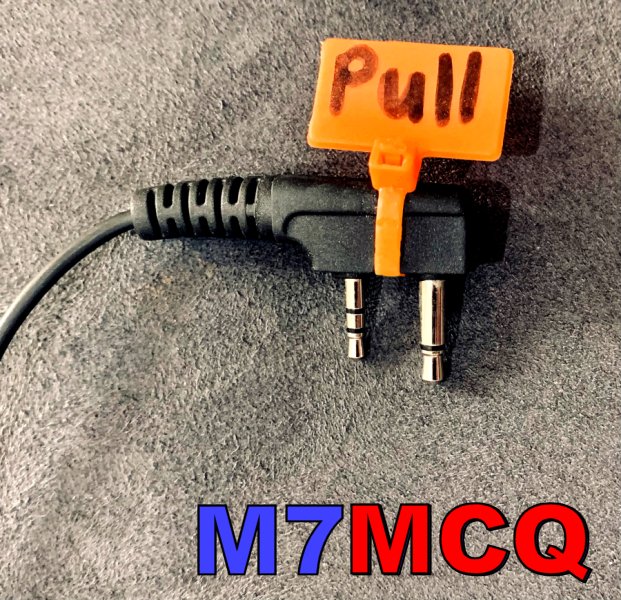
The headset includes a nicely adjustable goose-neck microphone (with a wind-silencing foam covering) which will rotate almost 360 degrees meaning you can position the mic on either side of your head. There's also a convenient PTT switch on the lead.  The 2-pin moulded plug inserts directly into the radio and is easy to insert, but a pig to remove!!! Just yanking it out could lead to stress-damage on the sockets. 

The HEIL HTHD-I has a good range of adjustment in the headband, making it suitable for a variety of head sizes - it would even fit Herman 😂

The quality of the incoming audio is pretty good and certainly good enough for strong signals, but just like any other headsets, SSB can get pretty tiring after extended listening periods. The secret to success is to take frequent breaks.

The outgoing audio has been fine. No one has poured compliments over my audio using this device and no one has complained about it. I don't ask for audio reports directly because people seem to go overboard with their compliments when asked and I don't always feel like they can be relied upon. Mind you, when I speak to some of my regulars using this, I'll get them to give me an honest report and add their comments below.

CONCLUSION

I'm very happy with this headset. The HEIL HTHD-I is extremely light, well constructed and does everything it's supposed to. Given the choice, I'd prefer to have 'over-ears' headphones, but then they'd be a lot bigger and bulkier, so you can't have your cake and eat it, can you?

They cost around £45 which is not a bad price considering the quality of the item. If you have an Icom IC-705, yes, I would recommend one of these for your trips outdoor.


UPDATE!
I've just sorted out a fix for this problem removing the plug from the radio. Simple and effective....


And I spent some time on VHF tonight and got some very satisfactory audio reports. One guy even recorded me and played it back. Happy days!


Thanks for visiting - please take a minute to leave a comment below 

73, Tom, M7MCQ.

Monday, 8 February 2021

ELECRAFT T1A REVIEW

SUPER PORTABLE ATU

I've always been fairly happy with my LDG Z100PLUS and have never seen it as a great hardship lugging it around with me when working outdoors. It is, after all, quite compact and runs off internal batteries. But it does have a steel case and those batteries do add to the weight when you're walking up hill.

So when I bought an IC-705 I started to see more and more posts about the MAT Tuner and the ICOM AH-705 Tuner. Neither of these appealed to me because the first version of the MAT-705 had some quality issues and the AH-705 is just too focused on the IC-705 (and it's too big). I prefer a tuner that I can use with a variety of QRP radios.

So then I recalled just how amazing the ATU was in my Elecraft KX3 and so I decided to investigate the Elecraft T1A tuner. The unit is about the same price as the KX3's internal ATU so although I wasn't exactly thrilled with the cost, neither was I surprised.

The big advantage of choosing this tiny external ATU over the KX3 internal ATU is that you can use it with ANY of your other radios! 


The thing that did surprise me however, was the quality of the T1A's case. It looks rather cheap. The battery cover is one of those slide-on/off affairs and the interface socket on the side looks misaligned. It's really not what you'd expect at this price point 😲


Having said that, everything else is pretty much perfect! This tiny (the world's smallest actually), lightweight marvel runs on a single PP3 battery and is just superb at finding a match on everything you connect it with. It's every bit as good as the KX3 tuner and they don't come much better than that.

Using the device in manual mode is pretty simple - just a case of pressing the TUNE button and then keying up your radio in AM/CW/RTTY mode until the T1A finds a match, then switching back to your desired operating mode.

Elecraft have always said they are going to be making an interface lead to connect the T1 to the IC-705 for automatic operation, but if it's like any of their other stuff, it'll probably be about £75 😂 I've dropped them a few emails asking WHEN the interface cable will be released but they keep saying they have no release date - to be honest, I don't think it will ever happen.


I tried the T1 with my G5RV, EFHW, Random Wire and with my AT1 Telescopic. It worked quickly and flawlessly - which is exactly what I expected from Elecraft. 

Below is a video showing me using the Elecraft T1 with a PreppComm MMX radio. As usual, the T1 performs flawlessly on all 3 bands...
 
If video doesn't display, CLICK HERE

T1 with the fabulous FX-4CR

T1 with the fabulous QDX

T1 with the fabulous IC-705


The LDG Z100PLUS is a great ATU and can handle much more power than the T1, so if you have the licence for extra power, you may opt for the LDG instead of the ELECRAFT.

_________________________


OVERVIEW 

Use with any Low-Power Transceiver 
The T1 can be used with any 0.5-W to 20-W transceiver covering bands in the 160-6 m range. This includes kits, home-built rigs, and commercial transceivers such as the FT-818, XIEGU G90, IC-705, etc. 

Quick, Convenient, and Accurate
The T1's 7-inductor, 7-capacitor L-network provides a wide matching range, and its re-tune time from memory is just 1 to 2 seconds. Equally important, the T1 always tries to achieve a 1.0:1 SWR-it doesn't stop at 1.5:1 or 2.0:1 like some tuners. You won't even need to change modes to tune. You can use SSB voice or a keyer as well as a constant carrier (AM, FM, CW, etc.). 

FT-817/8 Remote-Control Option
For even greater convenience, we offer a "smart" remote control adapter for use with the Yaesu FT-817 . On any band change, the adapter's micro-controller sends band data to the T1, which quickly recalls the appropriate network settings. Imagine instant QSY without the need to transmit-less QRM, less hassle! 

Factory-Assembled or Complete Kit
You can purchase the T1 assembled and tested, or as an easy-to-build kit. Our professionally written, fully illustrated assembly manual provides step-by-step instructions, and no alignment is required. 

Unsurpassed Technical Support
If you have any difficulty, our technical support via telephone and the Internet will get your T1 up and running quickly. You can also get answers to nearly any question day or night from the helpful, tech-savvy hams on our e-mail user group.

SPECS

Inductance range: 0-7.5 μH in 128 steps
  • Capacitance range: 0-1300 pF in 128 steps
  • Network: Series L, shunt C (switchable)
  • * Tuning times (typical): 2 to 8 seconds for initial tuning; 1 to 2 second re-tune
  • Frequency range: 1.8 to 54 MHz
  • Max power: 20 W peak, 10 W continuous (10 W peak on 6 meters)
  • SWR/power display: 1:1 to 3:1 and 0.5 to 10 watts on three LEDs
  • Supply voltage: 8 to 10 VDC; 9-volt PP3
  • Current drain: 20 mA average during TUNE; 0 mA when off
  • Size: 4.4 x 2.5 x 0.9" (11.2 x 6.3 x 2.3 cm)
  • Weight: 5 oz. (0.14 kg)


Additional Features

  • Small size, ideal for home, mobile, camping, and HF Pack use
  • Stand-alone; works with any low-power rig
  • 160 through 6 meter coverage
  • Handles up to 20 watts (10 W continuous)
  • Finds lowest SWR; doesn't stop at 1.5:1 or 2:1
  • Tunes in any constant-carrier mode
  • Many tune-ups are saved for fast re-tuning

Thanks for visiting - please take a minute to leave a comment below 

73, Tom, M7MCQ.

Monday, 1 February 2021

FT85W

 FT8 TIP FROM A FRIEND

I quite like FT8 but sometimes I grow tired of the fight to get a response when I double-click on a CQ CALL in WSJT-X's left window pane. It sometimes seems like I'm being ignored, so I end up just waiting for people to call me instead.

After a chat with my mate today, I altered my approach to making contacts and got some nice results at half my usual power. I didn't seem to have to work any harder with the lower power too!

My mate Dave (G8LIY) suggested that instead of clicking on the CQ Calls, I click on the operators while they are just ending a QSO at the RR73 stage. I'd tried this in the past but it didn't seem to make a difference, although I can't remember if I'd only given it a quick go.

Anyway, it sure did work today and I got over 30 contacts on 6 bands including Top Band, using my IC-705 on 5W through an EFHW.


Thanks for visiting - please take a minute to leave a comment below 

73, Tom, M7MCQ.

Saturday, 30 January 2021

2 METRE, 2 MUCH

I don't often go on 2M unless it's a scheduled call with a friend or if there's a Net that I like. This morning I was awake early and decided to get out of bed and make a nice cup of tea and listen to the radio for a while.

When I powered up, there was nothing on the HF bands to speak of, so I switched over to VHF. Across a silent bandscope I spotted a spike and tuned to the frequency. There were a couple of guys chatting away (I shan't mention their callsigns), putting the world to rights.

It soon became apparent that the core subject was politics and straight away I was reminded why I dislike 2M so much. These two guys were ranting on about how the UK Government were forcing the NHS Hospital staff to purposely let people die, in order to make more room in the country for "Johnny Foreigner". 😮

And these guys weren't teenage brats with nothing between their ears - they were both 'mature' men with advanced licences. It just beggars belief!!  

Previously I've heard all sorts of things on 2M including rants about conspiracy theories involving street lamps containing 5G weapons of war which are there to suppress the masses in case of a future revolution! Jeez!!

80M has its share of these people too, but 2M seems to be getting worse. Everyone has the right to free speech and we can't stop people discussing politics, religion and other potentially volatile subjects on-air, so I have to exercise my right to filter out these morons with my band switch. 

Don't get me wrong - I'm all for a proper chinwag as opposed to '59 and 73', but you can just sense the hatred and bile in some of these  'discussions' and I don't think it's good for the future of radio.


Thanks for visiting - please take a minute to leave a comment below 

73, Tom, M7MCQ.

Saturday, 2 January 2021

FTM-300D FIRMWARE & ADMS-12

 YAESU SHAME

I've just had two hellish times with the Yaesu FTM-300DE. The first horror was updating the firmware and the second horror was trying to program the radio with Yaesu's ADMS-12 software.

The firmware issue was just annoyingly protracted and convoluted! You have to carry out 3 updates and this involves moving miniature switches which are almost invisible and easy to damage, unzip three packages and arrange them on your PC ready to use. You have to update the head unit and the main unit separately and it all seems outrageous compared to how other manufacturers do it (by way of a single downloadable file on a simple SDCARD file).


OMG Yaesu, get with the times!!!

Anyway, once that was over and done with, I decided to download Yaesu's free programming software, ADMS-12. After installing the main program and the included drivers, I began to populate the programmer with some sample frequencies for local repeaters and gateways. Everything seemed pretty straightforward and after inputting a few, I thought it best to try sending them to the radio.

YAESU ADMS-12
 
Well that's where the fun started! OMG it drove me nuts!! With the SCU-20 cable attached between the FTM300 and the PC, I kept getting errors. Reading from the radio (Get Data) worked most of the time, but every time I tried writing the file to the radio (Send Data) I got a TimeOut error on the PC and an Error on the radio which resulted in a full (unrequested) reset, requiring the CallSign to be entered.

Believe me, I tried all sorts to resolve it with no joy, wasting hours of my valuable holiday-time 😡

I decided to forget the SCU Cable altogether and simply send the data to the radio's SDCARD instead. Well that failed too!! OMG I was ready to throw the whole thing through the window at this point. 

To cut a long story short, I found that THE ONLY WAY to get the job done was to do the following. It sounds crazy, I know, but follow these steps carefully and in sequence - and it will work....

  1. Format the SD Card in the PC
  2. Format the SD Card in the Radio
  3. Long-press the F button
  4. Go to Backup and press the dial
  5. Select Write to SD Card ALL
  6. Read from SD Card ALL
  7. Power off radio
  8. Remove SD Card and put in PC
  9. Open ADMS-12 Software
  10. Open up your memory file
  11. Click on Communications Menu
  12. Click SEND DATA TO SD CARD - ALL
  13. Safely remove SD Card and insert in radio
  14. Power on radio
  15. Long-press the F button
  16. Go to backup and press the dial
  17. Select Read From SD ALL

The radio should read the data and then reset. When the radio comes back on, press the V/M button and you should see all your memories.

Blimey, what a rigmarole! Hopefully, this will save you hours of scratching your head (or banging it against a brick wall) LOL. It seems that the supplied USB lead (or the SCU-20 lead) just will not work reliably, so best to follow this SD CARD method.

My thanks to Andreas Macrides who posted this solution on a YouTube video.

73, Tom, M7MCQ.


TAGS : 
ADMS-12 errors, problem programming FTM-300D, ADMS-12 won't send data to radio, ADMS-12 problems, FTM-300 programming problems, FTM-300 sd card issues