Given a couple of minutes thinking time, I can justify any of my crazy purchases and in the case of the X6100, this is how it goes...
Every weekend I go to our static caravan near the Trough of Bowland and every weekend I pack a radio and load it into the truck. So I bought a beautiful used Yaesu FT-818 to permanently leave there - makes sense! And then I started to miss having a panadapter, so I thought I'd swap the 818 for a Xiegu.
I sold the 818 and made £125 profit 😲 and bought an X6100 to replace it. Buying an X6100 makes even more sense when you consider that I recently got my hands on an XPA125B for an absolute song!!
I've previously owned a Xiegu G90 and I thought it was a fabulous little radio, offering great value for money (although I paid £165 less than the usual price and the deal included extras), so would the X6100 impress as much as the G90?
In the UK, the X6100 costs around £580 new from reputable dealers, although you could probably make some savings by purchasing from Eastern outlets. I didn't fancy risking that, so I went with Nevada.
So what is the Xiegu X6100? Well basically it's a portable HF/50MHz, MultiMode SDR transceiver with a 4" full colour display screen and up to 10W output. The radio has a host of useful features...
Built-In Batteries
Built-In CW Keyer
Built-In Modem
Built-In BlueTooth
Built-In WiFi
Built-In ATU
SD Card Slot
USB-C Sockets
Noise Blanker
Digital Noise Reduction
High Stability TCXO (1ppm)
The parcel arrived promptly from Nevada with the L4001 Interface Lead for the XPA125B which I’d ordered separately. According to the information I've read, this interface makes the radio 100% compatible with the amplifier in terms of control functions like tracking the radio's mode, band, alc, etc. We'll see.
In the box you get the radio, an Icom style microphone (with a backlit keypad), a power lead, a charger lead and a computer interface lead. I know from past experience that the microphone is really quite good and it's certainly a step above some of the bargain basement mics that the big manufacturers ship with their radios.
First impressions when you remove the radio from the box are very good. Now bear in mind that I own an IC-705 and have owned a couple of Elecrafts, so I was half expecting to be disappointed by the Xiegu. But I needn't have worried because it's all metal construction and weight (880g) provide a quality feel and the buttons and printing seem to be of a high standard too. The large VFO dial looks good, but the friction provided by a felt-washer below it needed adjustment so that it rotated more freely.
The screen has no touch capability but the menu system is quite intuitive and you very quickly get to know your way around the radio. I like it! By the way, I strongly recommend the book by Andrew Barron - I got it on Kindle and it was a bargain!
The "LOCK" button has a handy secondary feature whereby it reduces the brightness of the screen in five steps, going from maximum brightness to barely visible (for those times when you wish to leave it switched on for hours and don't want any screen-burn).
I was pleased to see that the radio was installed with the very latest FirmWare as advertised on Nevada's website 👍. The battery was showing a 7.8V charge level and I've read in the manual that you need to fully charge and fully discharge the radio FOURtimes for the accuracy of the reading to be reliable.
I was pretty surprised to find that the supplied 600mA mains charger came with a 13A fuse in it, LOL. Surely the UK importers should address that before shipping on to the retailers? 😵 Someone pointed out that many small chargers don't even have fuses and that's true, but here in the UK, if you supply a Mains Plug, you should follow best practice and insert the appropriate fuse.
CHANGE THAT FUSE 😅
The X6100 comes pre-installed with a couple of handy peg-legs to stand the radio at a viewable angle on a desktop. I was pleased to see that, but they do seem a little flimsy so I fitted some laptop stands that I've used on some of my other radios and they help to keep the radio in place as you push the fascia buttons.
First thing to do was to attach a dummy load and scan the bands for unwanted noises and artifacts. Sadly, the X6100 has more birdies than an aviary!! Many of them are LOUD and in places which wouldn't really effect my listening, but some are definitely in the way! I don't know if we're stuck with that or if firmware updates will be able to resolve the problem. (I'm currently on V1.1.7).
Birdies may differ from radio to radio
After connecting a 66ft EFHW, the radio sprung into life and the built-in ATU managed to find a good match on all bands. Within a few moments I was picking up strong, clear signals and got my first taste of the radio's audio - it wasn't bad, but if you wanted to do some extended listening, you'd probably want to connect a good external speaker. I tried a small BOSE SoundLink Mini II and it sounded great, but if you wanted something much smaller and cheaper, then the LeadSound is highly recommended!
I was impressed with the performance of the radio on its first outing. I was connected to a 40-10M End Fed Half Wave and the X6100's internal tuner found a usable match on 80M! And then using the internal batteries and 5W I managed to get a great contact with Graham G4FNL. See video below...
After that, I bagged a few more on 80M before getting into a little net on 40M with a group of guys from Ireland and England. They were all amazed at the quality of the signal from this little 5W radio. 58's and 59's all the way. So the X6100 receiver works just fine on SSB (although it can get a little overloaded and you definitely wouldn't want to have it around other transceivers on a field day). There's no front-end rejection💥
I noticed that in the CW section of the bands, I could detect some voices behind the Morse signals and when I switched to LSB, it became clear that there was a Chinese broadcast station bleeding through. Strangely enough, I couldn’t hear it if I switched to AM 🤷♂️. This interference was on both 20M and 40M - I didn’t try any other bands. This is quite disappointing.
The ATU is good (just like my previous G90) and for many, that's a big plus! As I mentioned earlier, the audio is not bad, but if you ramp up the volume, it does get pretty crappy, so when you're outdoors with higher ambient noise levels you'll definitely need to plug in that external speaker or a pair of headphones. Don't forget to switch the Speaker/Headphone setting in the menu (to be honest, I tend to prefer the headphone setting even when using a speaker!).
Some people have complained about the Noise Reduction on the X6100 but I don't think it's too bad. If yours doesn't sound good, take the time to go into the menus and make adjustments to the DNF settings - it might make a difference.
Rather handily, the X6100 has a CW Practise Mode which is perfect for me because I just bought a paddle to learn the code. In this practice mode, the radio will play the tone without actually transmitting.
The Wi-Fi abilities of the X6100 are severely limited and currently can only be used to connect to the Linux file system over an SSH or to connect a to connect to an NTP Server to get the correct clock time.
The other rather poor implementation is BlueTooth. If you were hoping that it would permit the use of popular hands-free headsets, you’ll be disappointed - probably. My experience was one of complete frustration. The only thing you might use it for is to install a Bluetooth keyboard/mouse (if you can get it to pair), but there’s even limitations on how you can use a keyboard with the radio. 🤬
The internal battery is nice to have, but in reality, it’s not very useful if you plan to transmit for any length of time and I certainly wouldn’t rely on it for outdoor activations - it doesn’t last long at all. I would always take my 13.2V FlightMax LifePO4 with me.
You only have to look around YouTube to learn that there's plenty of unresolved issues with the X6100 (bluetooth, wi-fi and no squelch for a start). These are minor annoyances but still very frustrating. Then again, you musn't lose sight of the fact that this is a cheap transceiver.
If you are looking to buy a cheap QRP radio for outdoor activities such as SOTA & POTA, then this could be the radio for you. Outdoors you'll very likely have a great take off and a good antenna such as a SotaBeams BandHopper. You'll be able to drop the power to conserve the internal batteries and still make a few Transatlantic contacts.
If you fancy buying this radio to be your outdoor and your shack radio, then you might want to look at something else, maybe an IC-705 or a used KX2. Yes, the 705 is crazy expensive, but it's also crazy good! Unlike the X6100, everything works perfectly including full and proper implementation of the Bluetooth and WiFi. The 705 has lots of 3rd party support and it's a piece of cake to work remotely with it - even with an iPad. Another radio to consider might be a Yaesu FT-891 - there’s plenty available on the secondhand market for around £500. They’re non-sdr but what a fabulous receiver!! And up to 100W for those who are licensed to use it.
On the plus side, the X6100 does have that internal tuner and you can maybe put up with the things that aren't quite right in the hope that it will be updated and improved by firmware (although Xiegu have still to fix things on the G90 and that’s been out a long time).
There's also a Discord Group which is taking advantage of the fact that the radio's operating system (Linux) is hackable, so some very clever people out there are making changes which could massively improve the rig. There's even completely alternative firmware available and this makes it a dream radio for the more advanced users out there. I tried it myself but think it’s got a long way to go yet.
Apparently, you can configure the X6100 to run WSJT-X from within the radio itself!! Click here to see a video about it. Personally, I know NOTHING about Linux and so I found the process pretty daunting to consider.
If you don't want to spend a fortune on a new radio and you see yourself as a bit of an experimenter, then the X6100 would be a very sound candidate! It's not an IC-705 or a KX3, but it does have great potential and it's a "likeable" radio.
There’s no denying though, that it’s very annoying to find that a radio from such a big manufacturer which is sold by big ham radio retail outlets across the globe, has so many issues. As far as I’m concerned, all advertised features should work reasonably well.
X6100 & XPA125B for sale!
Please feel free to add your thoughts on the X6100 in the comments section below.
I recently came across the opportunity to buy a £540 AMP/ATU combo (with extras) for a very verylow price and I initially told myself that I had no use for such a thing, but then the devil on my shoulder told me I'd be an absolute fool to walk away from such a bargain and pointed out that after I'd experimented with it for a while I'd be able to sell it and make some profit!
So I thought 'what the hell'....
The XPA-125B hit the UK shelves about 3 years ago and has enjoyed good sales. Obviously, it was immediately popular with Xiegu X6100 radio owners, but has since found popularity with other radios users like the FT-817/818 and IC-705. I have both these models so I'm keen to experiment with them along with my (tr)uSDX and Prepcomm MMX.
In this post I will initially only be looking at the XPA125B as an amplifier for use with NON-XIEGU radios! Later, I will add a section on the X6100.
The amp is supposedly capable of producing 100W from a 1-5W input and in some cases it has reportedly produced 125W. There's a 30A blade fuse in the back of the case so I replaced it straight away with a 20A fuse just to be on the safe side. I'mwell aware that an amp in the wrong hands can be a dangerous thing, so I'll be exercising great caution when connecting radios to it.
When the amp arrived, it was good to see that it was in MINT+++ condition and just as the seller had claimed, it clearly hadn't seen any use other than a couple of holiday outings away from home...
It also came with a pretty handy accessory in the form of the XIEGU CE-19 which apparently makes data-modes an absolute breeze along with a bunch of leads.
I was surprised to discover that the amp doesn’t have a fan inside - not that I'm complaining - quieter the better, but if I was licensed to use 100W then I might be more concerned about the potential high temperatures. Having said that, running 100W Watts into a dummy load on SSB didn't increase the operating temperature significantly.
Simulating operation on an FM repeater was only slightly different, with temperatures in the mid-50’s after a 3 minute transmission. I suspect that data-modes might result in higher temps. It's my understanding that the amp would protect itself by switching off once it approaches 100 degrees💥
3 minute tx on FM - 52 degrees
'Off-The-Shelf' Interface leads are available for the FT-818 and IC-705, but they only provide a means of triggering the PA and not controlling band-switching, so it's very important to remember to change bands on the amp prior to transmitting (or you are likely to see some magic smoke emanating from the case).
You can buy a CN-20 FT-818 interface from Sinotel for just under £30 which still doesn't provide automatic band-switching but it doesprovide ALC control, which prevents your radio from over-driving the amp.
Because my IC-705 would cost £1400 to replace if I blew it up, I decided to start tests with my FT-818 with very low output levels from the 818.
Using SSB into a dummy load, the FT-818's lowest TX power peaked around 90W output from the amp and the radio's highest output peaked around 107W, so there's absolutely no point in using anything more than half a watt to drive the amp.
I’d prefer it if the amp’s power-levels dropped in relation to the input, but they barely change, so basically, there’s little power adjustment with an 818 connected (like there is on Elecraft amps (at 3 times the price)).
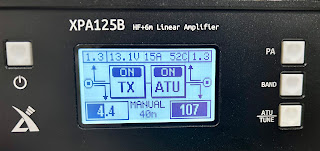
The XPA125B has a bright LCD display which provides all the information you require, but personally, I think it could have been better laid out - I've seen people on YouTube getting confused over what the various readings mean and I don't think the graphics serve much purpose. I think the "RX" should perhaps be changed to "PA". Of course once you understand the readouts, it's no big deal.
The top left and top right boxes show the SWR readings. With the ATU switched OFF, the left reading is the SWR at the radio and the right reading is the SWR at the antenna. Once you have performed a tune, you will see the readings drop according to how well the ATU could produce a match.
The bottom left and right readings show the amount of power from the radio (keep below 5W), while the bottom right reading shows the amount of power being sent to the antenna.
The reading in the bottom center is the currently selected Band and unless you are connected to a suitable Xiegu radio, you need to switch this manually each time you change bands. This of course is only important if the PA is ON and you are transmitting. If you are simply using the ATU to find a match, the PA will be switched off.
Finally, the top center readouts are for input voltage, current draw and PA temperature.
Here's a clearer diagram...
The built-in ATU works very well but not quite as good as an Elecraft. Its tuning range goes up to 500ohm so that's in the “Tune a wet noodle” range 😂 The only downside is that when it finds a match at say 1.3 it is reluctant to try again for a better match - it just won't retune - it's happy, so it thinks you should be too 😆
Using one of my EFHW antennas, I got great matches from 80-6M and an acceptable match on the Top Band. The ATU doesn't seem to have any memories which is a little odd considering that most other ATU's have hundreds. It's no big deal to me though because I tend not to rely on memories and prefer fresh tunes - it only takes a few seconds anyway.
Note the tuning process...
1) Switch off the PA
2) Increase the radio's output to around 5W (it won't tune up from very low power)
3) Key up in a constant carrier mode
4) Hold the amp's TUNE button for a couple of seconds
When you have your match, you can drop the radio's power back down and switch on the PA. So from this, you will see that there's virtually no automation with non-Xiegu radios 😮
You can see in the image below that I used a Samlex 30A mains PSU to power the XPA125B. Using my usual 8.4AhZippy FlightMax LifePObattery to power the amp wouldn't really be feasible considering that the amp could potentially draw 15-20A. That's why I'd prefer to have an option to reduce the amp's output.
I suppose the only way to go if you want to use the XPA125B out in the field would be to purchase a 20Ah LifePO4 battery, which would probably last a few hours on SSB - enough for most people.
It's all hypothetic for me anyway, since I neither need nor want to use 100W, so I'll be selling this lovely bit of equipment to someone who can benefit from it.
Overall though, I think the Xiegu is a cracking bit of kit and it's flexible enough to work with a great many radios as long as you're willing to manually change bands. After a full day of testing and playing around, the amp performed flawlessly and never went near the limit of its operating temperature - even the outer casing had no hot-spots.
I found a neat little carry-bag online (£8) and while it won't offer protection from hard knocks, it will certainly protect it from the usual scratches that these things collect during outings. It also has an inner pocket for leads.
ICOM IC-705 - XPA125B...
Okay, so next was the turn of the IC-705. The connection to the amp was a bit messier due to the fact that I was using the RBI-1 buffer, but at least I felt protected from any potential damage to my prized possession.
A press of the 705's TUNE button initiated a tune, but first of all I still had to manuallychange band on the amp, switch off the PA, adjust the power on the radio to 4/5W, select RTTY mode, key up for the tune and then return the radio settings to what they had previously been (and switch the PA back on).
When it comes to using the XPA125B with a Xiegu X6100, you'd be forgiven for expecting 100% integration, but sadly, it's barely better than when using a non-Xiegu radio! The only real benefit I can see is that you get automatic band detection.
When other manufacturers make a radio and an amp (say Elecraft), you'd be pressing the TUNE button on the radio and it would automatically change to a constant carrier, adjust the power, tune up and then return the radio to its former state. Not so with the Xiegu 😕 All it does, is initiate a tune without making any changes at all. Maybe that will get better in time with firmware (again).
This mini-review probably sounds a bit negative and yes, there are some disappointing elements relating to the current lack of integration with Xiegu radios, but other than that, the XPA125B works really well and there's not many alternatives out there at this price. The price of the "interface leads" is also a bit disappointing considering that they're nothing special - you could make your own!
Bear in mind that you could buy a 100W HF radio (eg FT-891) for the same price as an XPA125B, but that won't give you the flexibility of being able to use virtually any other radio at 100W. Personally, I have 4 or 5 QRP radios and if I had a full or intermediate license, the XPA125B would be a very good addition to the shack. But I haven't and I don't feel the need for one anyway.
I've lost count of how many times I've been in a QSO and dropped from 10W to 5W only to be told that it barely made any difference to my signal strength or readability.
Xiegu XPA125B for sale 😀
Thanks for reading.
73, Tom, M7MCQ.
XIEGU XPA125B Specifications:
Frequency Range: 0.5-54 MHzMaximum
Output Power: 1.8-30 MHz >120 Watts / 50 MHz >90W
Maximum Ambient Operation Temp: 130F Fahrenheit, 55c Celsius
Gain: 13 dB (+/-2dB)
Spurious Suppression: >50 dB
Supply Voltage: 12-15 Volts DC
Transmit Current Draw: @ max output 30 Amps
Receive Current Draw: @ max 700 mA
ATU Frequency Range: 1.8-30 MHz & 50-54 MHz
ATU Tuning Range: 14-500 Ohms
Dimensions: 10.3 x 6.3 x 2.8 inches (Excluding knobs, feets, handle etc)
It's a fact that most QRP radios have pretty poor built-in speakers and while you may 'put up' with them, it would be nice if there was a better option. Well the obvious answer is to carry around an external speaker but the truth is, they're usually bigger and clumsier than you'd like. Enter the LeadSound Portable Speaker...
It's a very compact device around the size of a golfball and has a 3.5mm stereo jackplug which you pop into your radio's headphone/spkr socket and away you go!
It has an amazing sound for something so small and the internal rechargeable battery will last about 8 hours - I've never managed to flatten it even on an all-day Field Day! It recharges with the supplied USB lead. It comes with a protective pouch and is easily stored in your radio bag.
I first got one of these for my (tr)uSDX because the internal speaker is just so shockingly bad and I prefer not to wear earphones if I can help it. I was amazed at the difference and so I bought another one to keep at the caravan.
If the speaker won't plug into your radio's headphone socket because there's something in the way, simply use an adapter lead as shown below.
I strongly recommend these little beauties and use them all the time. You can also use them with any other audio device.
Available from Amazon and probably lots of other places.
I've always fancied learning morse code but felt too darned busy to learn a new language, so instead, I bought a CW Decoder/Encoder from Preppcomm. That works pretty well and I kind of stumble along with it, but feel that other operators can detect the 'machine code' and prefer not to engage with it.
Then last week I went to a presentation at our local Radio Club where Lynda G6QA encouraged people to take up morse and demonstrated how one might learn the code. I was too shy to participate in the 'have a go' sessions, but I was suitably inspired to make an effort once I was back home.
The first step was to buy a key and having once tried an iambic paddle on a KX2, I thought that might be the best one to learn on (some might say it makes more sense to start with a single straight-key, but I just had a liking for the paddles).
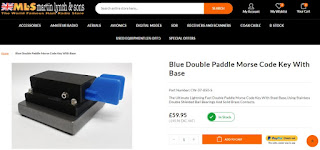
Looking around I spotted some cheap keys from an American company called CWMORSE and they were available here in the UK at Martin Lynch & Sons, so on September 11th I ordered a DOUBLE PADDLE from them....
When it arrived, I could immediately tell that there was something amiss. For a start, it just didn't feel like a double paddle key, because when you pressed one of the paddles, the other moved with it 😮 I removed the top casing and saw that it was indeed a single paddle fitted with two wings.
This was very disappointing and so I wrote to ML&S and explained that I'd ordered a 'double paddle key' from their website and instead received this single key! The box had a label on it which covered up another label clearly showing that it was actually a single key...
There was a great deal of misunderstanding went on between me and ML&S before the correct key was dispatched and it ended up with me having to go into town to take the wrong key to the Post Office and then being told by ML&S that I’d have to pay more for the correct key because it was £63.95! All very frustrating and no hint of apology for the incorrect descriptions on their website and the inconvenience. Worse still, the new key arrived with a price sticker on it of £59.95 😮😡😮 So all in all, with the initial postage and the return postage, I have paid a total of £85.90 😡🤬😡 You couldn't make this stuff up, lol.
Anyway, all that aside, the key is here and seems to be working fine. Initially it needs some adjustment to center the keys and make sure that there's equal amounts of travel in each key. I like the keys to have very little movement, but it's obviously a personal preference. Making adjustments is a very simple and self-explanatory procedure.
The key is 3D-Printed and the quality of materials and construction seems quite good. The internals are very simple, which gives you the comfort of knowing that if something goes wrong after years of use, you'll probably be able to fix it yourself with hexhead bolts and springs, etc. It comes with a heavy steel base so that it doesn't move around on the table, but you can always remove the base if you're taking the key on a SOTA outing and want to lose the weight.
The unit is fitted with a 3.5mm stereo jack socket but no cable is included. You will have to buy or make up a lead yourself, possibly configuring the wiring of the stereo plug to determine which paddle is a dah and which is a dit.
Initial inspection of the key reveals a very slight sloppiness in the vertical plane of one of the paddles which I don't particularly like, but I don’t think it will have any affect the performance anyway. I'm obviously an out and out beginner, but common sense tells me that any off-plane movement is not a good thing (but you have to bear in mind the low price of these keys (starting at £39 without a base (if you’re lucky enough to get what you order)).
I had already learned to key CQ TEST M7MCQ with ease when I had a KX2 so I started with that - it went well. I feel that I can confidently go forward in the (long) journey toward learning Morse.
So there you have it - a cheap and cheerful double paddle key which is super lightweight for SOTA/POTA use, but perfectly planted on the shack desk when used with the heavy base.
The key worked well with my IC-7610, IC-705, FT-818 and (tr)uSDX - no bother at all. A good purchase I'd say. Now the learning begins! 😂 If I feel things are going well, I will look to buying a better key for permanent home use and will throw this cheaper one in my ruckshackfor outdoor ops.
OOOPS!!! Something went wrong!
An hour later I started to notice that my practise work was not consistent even on the short string of letters that I am very familiar with. I lifted the cover off the paddle and saw that one of the upright posts was loose - it had no doubt failed during the actual 3D-Printing process.
As a result, the post was only held on at one side and could fail at anytime. I took a video of the problem and emailed it to make it easy for ML&S to understand what was wrong and then posted the item back to the shop for replacement 😭😭😭
ML&S rang me when they received the email and asked what was wrong with the key - they hadn't even watched the video 😩 so that was a waste of time. They then said that they "didn't really want to be sending these back and forth" which made me feel like it was them who were being inconvenienced!
In the end they said they'd ship another key and credit my account with the £20 which I'd had to pay for returning two keys to them.
Well, 16 DAYSafter first ordering and the replacement key arrives. It is the correct one and it seems to be fit for purpose at last. Am I happy?? Not really. I am pretty much sick to death of fighting with online retailers just to get what I ordered from their website.
It seems that some retailers aren't really familiar with their products but still put them on sale on their website and basically let the customer discover the problems and website inaccuracies.
I know $hit happens occasionally and things can go wrong - it sometimes happens in my business too - and when $hit does happen, that's the time for your customer-service processes to really shine. The way we handle errors usually ends up with the customer thinking more of us than before the error occurred!
Oh, and did I get my £20 credit? Of course not. And did they offer an explanation for me being charged £63.95 for a key which had a £59.95 price sticker on it? Of course not.
Anyway, it is what it is and I'm sick of banging on about it. Vote with your feet!
___________
Ian (G0CTO) also posted these words on Social Media, which is very appropriate to my new quest...
In a world dominated by instant messaging, video calls, and high-tech communication methods, there exists a hidden treasure among radio enthusiasts. It's a language that transcends time and technology, weaving a symphony of dots and dashes through the airwaves, captivating the hearts and minds of amateur radio operators. It's the thrilling art of listening to Morse Code as a conversation, an experience that transcends mere communication and becomes a passionate pursuit of connection and skill.
Amateur radio has been a bastion of communication for hobbyists and enthusiasts for over a century. While it encompasses a vast range of modes and frequencies, Morse Code, or CW (Continuous Wave), remains a timeless and enthralling aspect of this diverse community.
Imagine tuning your radio to a quiet frequency, and suddenly, there are a series of distinct tones, some long and some short, and to those that cannot read it, that is what it will sound like.
To the uninitiated, it might seem like random beeping, but to those in the know, it's a series of different conversations. It's like being in a large hall with people involved in conversations. You can understand those but not those in Morse Code. That changes when you can read the Code.
Listening to Morse Code as a conversation is akin to eavesdropping on a secret code between two friends. Each "dit" (.) and "dah" (-) carries significance, forming letters, words, and sentences. It's like deciphering a cryptic puzzle, one that engages both your ears and your intellect. The anticipation builds as you try to piece together the message being transmitted, and when you decode a word or phrase, a sense of accomplishment washes over you.
What makes Morse Code conversations so exhilarating is the sheer efficiency and range of this communication mode. With minimal equipment and power, radio operators can connect over vast distances, often when all other modes fail due to interference or poor conditions. It's a testament to human ingenuity, enabling communication in the most challenging of circumstances. Yes, it IS ancient technology but one that will be with the amateur community for as long as we have those that learn the Code.
But it's not just the utility of Morse Code that makes it exciting; it's the culture surrounding it. CW operators are part of a global fraternity that appreciates the beauty of this art form. They exchange stories, knowledge, and camaraderie through the rhythmic pulses of dots and dashes. It's a tradition that has persisted through generations, handed down like an heirloom.
There's a certain romance in listening to Morse Code, too. It's a language that connects you not just to the person transmitting the message but also to the rich history of radio communication. It conjures images of intrepid explorers, wartime heroes, and adventurers who relied on these signals to bridge the gap between worlds. Take Bletchley Park for example. The operators there during the war, mostly women, shortened the war with their efforts. There are still a couple that are licensed amateurs actually.
In a world that often seems inundated with noise, Morse Code stands as a beacon of simplicity, an oasis of calm. It reminds us that communication can be both an art and a science, a pursuit that challenges our intellect and enriches our souls. It reminds us that in the digital age, there's still room for the beauty of analog communication.
So, the next time you hear those rhythmic dots and dashes emanating from your radio, take a moment to savor the magic. Revel in the excitement of deciphering messages hidden in plain sight. Embrace the timelessness of Morse Code, and you'll discover a world where conversation becomes an art form, and each transmission is a symphony in dots and dashes.
Ian, a friend from the local radio club, G0CTO, said : Ha ha I had a similar issue with MLS, - ordered an iambic Kent paddle - they sent a single lever rang them and the clown at the other end tried to get me to keep it. I made them collect it and send the correct key. Keys are personal things but engineering is everything - the two paddles I have now are a Chevron AGA and a Begali Sculpture. The one I use most is the Begali as it’s more compact. The two keys are very different as one uses magnets in attraction and is very snappy the other uses them in repulsion and behaves more like a spring. Both keys can be adjusted very finely to such an extent that temperature can cause keying with metal expansion.
An anonymous message…..
“…….. you’re not too old to learn CW. I started at about 58 and I’m now 60. Earlier this year I completed the CWops advanced 25wpm course. One of the chaps on the intermediate course was 85. The whole process has been an enjoyable and fascinating challenge opening up all sorts of opportunities for gear accumulation. I’m now 100% CW and achieved my CW DXCC in about 12 months. Three good resources are LICW, CWops and Morse Code Ninja (great youtube and podcasts).”




uSDX-picnic1-M7MCQ.jpg)