Tuesday, 10 January 2023

WHY JOIN A CLUB?

999999

IS IT WORTH JOINING
YOUR LOCAL RADIO CLUB?


Some hams operate alone and have no desire to get involved with other operators on a face to face basis and that's obviously their choice, but there's a lot to be said for joining a local radio-club and that's what I want to look at here.  Through different hobbies I've learned that there are many benefits to joining a club and over the years I've greatly enjoyed my membership of the local Biker Club, Art Club, Photography Club, and more recently Radio Club.

Clubs offer different things to different people. Beginners who are looking to get into the hobby can gain access to a wealth of knowledge and advice at their local club, including help with training. Radio equipment and antennas are often readily accessible too. 

Clubs offer members plenty of other learning opportunities in the form of Guest Speakers and Demonstrations and not all of these need to be outsiders - sometimes it's equally valuable and entertaining to have a Club Member do a Show & Tell on a subject that he's particularly passionate about such as 'Operating Remotely' or 'Introduction To C4FM' or 'DIY Antennas', etc. There's always something new to learn in this great hobby and at the Club, there's always someone with valuable information to impart.

It's worth pointing out that some clubs might be focused more on Social Meets rather than Radio Activities, so make sure that you choose the right one for you. Or join both! 😊


Most clubs arrange activity events throughout the year and these are varied to suit the many different interests of the members. Some will be interested in a QRP Field Day while others might prefer a day-trip to Jodrell Bank or Hack Green. Everyone's catered for and everyone's free to suggest something. 


As a group, club-members take part in all sorts of little projects like...

  • Building a Repeater
  • Operating Remotely
  • DIY Antennas
  • Learning To Solder
  • Building Electronic Kits
  • Erecting Antennas
  • Planning Permissions
  • Entering DX Competitions
  • Working with Linears
  • Working QRP
  • SOTA & POTA 
  • Exploring Digital
  • Using VNAs
  • Using Morse Code
  • QSO with a Space Station
  • Setting up DSTAR, C4FM, DMR
  • Setting up Logging Software
  • Raspberry Pi for Amateur Radio
  • and many, many more!


More than anything though,
Radio Clubs exist to bring together like-minded people and to create an environment in which they can relax, enjoy, study and learn. In a busy world full of work commitments, stress and worry, your visit to the Club can mean a very welcome break!

So why not try your local Club?
It costs nothing for your first few visits and ongoing membership costs are minimal. You'll almost certainly gain from your membership and although you may not think it, you may well end up helping others out - we've all got something to learn and something to teach. Take a friend along with you!

_______________________________
My Local Clubs


Ladybridge,
BOLTON,
BL3 4RZ.


_______________________________


Hollins Social Club
Off Hollins Lane
Bury
BL9 8BA


Miners Welfare Club
Meanley Road
Gin Pit Village
Astley
M29 7DW.


Sunday, 1 January 2023

NOT RADIO - BIKE (CB650R)

HONDA CB650R NEO SPORTS CAFE

Back in the 70's I was a scruffy little toe-rag with big dreams and little money. As a teenager, I'd stand outside our local motorcycle shop (Charlie Robinson) and stare open-mouthed at the beautiful CB400/4 displayed in the shop window, dreaming of the day that I could afford to own such a monstrously gorgeous machine. My heart actually ached - it was my first love 💖😅

Honda's 400/4 was one of those rare bikes that comes along now and then which is just very, very special. The main features which stood out for me were the simple, almost slab-sided fuel tank void of tacky decals and that drop dead gorgeous 4-into-1 exhaust. Eventually (years later), I got to own one and in later life I even restored one - resulting in a concours machine which actually ended up going back home to Japan, 33 years after leaving.

Anyway, fast forward to 2023 and I'm looking at the equally gorgeous (in my eyes) CB650R NEO SPORTS CAFE which nods its head to the old 400/4 by having a similar 4-into-1 exhaust system.


The 2023 650/4 is a very compact and simple bike, much the same as the old 400/4 and unlike many modern bikes, it has no ride-by-wire throttle, no engine mapping modes and only rudimentary traction control and ABS. 

What it does have though, is a high revving 4 cylinder, DOHC engine with a redline area between 12,000 and 14,000rpm producing around 95BHP and 50 lb ft of torque. Now that's my kind of engine! I know that parallel twins are quite popular these days, with their grunty mid-range, but I'm just not a twin kinda guy. I like a screamer! 😲 I am addicted to the wailing banshee sort of sound that comes from working an IL4 hard. I find parallel twins quite boring.

 
Honda's 'NEO SPORTS CAFE' styling fits in well with the bike and the round headlight harks back to a bygone era (even though it's actually a very modern LED unit). I also love those two offset air-scoops either side of the fuel tank. I'm not sure though, why Honda hint that it’s a Cafe Racer because it doesn’t have a mono seat and it doesn't have clip-ons - in fact the handlebars are wide and the dual seat is quite generous!

Unlike the 70's Honda, this bike is built in Thailand and to a very high standard if appearances are anything to go by. The paint finish, enamelling and anodising all seem to be extremely well done and you only have to examine the switchgear to see that this isn't a 'cheap' bike, despite it's relatively budget price of £7699. When I first saw that it was a Thai Honda I was a little sceptical because of my experience with the CBF1000 back in 2006. The finish on that Thai built bike wasn't the best, but having said that, it was 17 years ago and it was the cheapest 1000cc bike you could buy, so I guess things have moved on considerably.

It's fitted with 'Big Piston' upside down Showa forks at the front and a Showa spring at the rear. Thankfully, for 2023 Honda have changed the colour of the rear spring to red from the old (dreadful) pale yellow. There is no adjustment on the front suspension but there are pre-load options on the rear. There's also twin radial brakes at the front using 4-pot Nissin calipers.

I have to say that I find the ride quite harsh - especially the front end. It really is quite stiff and you feel every bump in the road - it's like you've pumped up your front tyre to 60psi. Now bear in mind that I've previously owned the CB1000R, three Fireblades and a CBR600RR which are all very sporty but none have felt as stiff as this one.

The 'dashboard' is a simple LCD panel which has inverted colours (white on black), showing the speed, the revs, the fuel, the temperature, the time, the mileage and a very handy gear indicator! It can sometimes be a little difficult to see in bright sunlight compared to the very latest TFT screens, but overall it's fine. On the right side of the screen is a bank of warning lights and a long vertical strip which flashes as you approach the rev limit to tell you to change gear.


At the point of sale, I blagged a free QuickShifter from the salesman worth around £285 fitted. The bike already has a beautifully slick gearbox but the addition of a QuickShfter really adds to the fun of fast riding. It should be noted however that this is an UpShifter only, where some bikes (eg Suzuki's GSX 8S) have Up/Down Shifters.


The fuelling on the CB650R is great - no doubt due to the fact that it has good old fashioned throttle cables instead of ride-by-wire. It behaves very well in slow traffic around town, with no on/off surging. The engine pulls well at low revs in city traffic but for rapid acceleration you do need to get that rev-counter swinging.

Out and about on faster roads, you will notice that there are some tingling vibrations around 6,000rpm - they're very noticeable through the footpegs, so you learn to avoid 6k like the plague. Other than that, the engine is super smooth - as you'd expect from Honda.

Something I don't particularly like on the CB650R is the riding lights - the orange indicators stay illuminated (around 50% brightness) as you ride along. This is a very American thing and something I wish could be turned off.

The bike weighs 200kg and is therefore a true middleweight - it's not the lightest out there, but coming from a tourer, it feels amusingly light to me. The seat height is just under 32" which is just about right for me and I'm comfortable with the peg-height. I can also just about get both feet flat on the ground (even though I've got a shorty 29" inseam).

Sadly, there's no center-stand, so you're going to have to invest in a separate stand for doing your chain maintenance, etc. I already own an Abba Stand, so I only needed to pay for a small fitment adapter. I believe there are some paddock stand adapters that can be fitted to the swingarm but not the usual screw-in bobbins.

My first outing on the bike (enroute home from the showroom) was smile-inducing. It was so nice to have something so light and nimble and agile between my legs 😂. It felt like the bike reacted to the mere thought of changing direction. And the acceleration was perfect for British roads. I always remember the owner of Charlie Robinson's Honda Shop back in the 70's telling me that anything more than a 400/4 was a waste on our roads. And you know what? He wasn't far wrong!

After breakfast in Lytham, I spent the day flirting around all my usual haunts in Lancashire and North Yorkshire, going from Blackpool to Glasson, Lancaster, Kirkby Lonsdale, Sedburgh, Hawes, Kettlewell, Grassington and then back to the caravan to let my wife have a look at it.

The seat isn't the plushest I've sat on, but I doubt one would be travelling for many hours at a time on a bike like this. A comfort break every couple of hours is required. It's about that time you'd be stopping for fuel anyway.

I'm extremely pleased with the bike and can see many a happy outing over the next few years.

Regards, Tom.

UPDATE : Made some mods to the bike - nothing too drastic. Added Heated Grips, Puig Retro Screen, SatNav, Bagster Tank Cover, etc...


Thursday, 15 December 2022

CHEAP SDR!

FLEX-1500 USED BARGAIN!

There's a lot of people out there who remain very happy with their analogue radios but quite fancy dipping their toes into the pool of SDR Transceivers. They don't, however, fancy paying big bucks for the privilege. And who can blame them - SDR technology has really shot up in price due to the world economy and the ongoing silicon chip shortage. Thankfully, there's a very cheap option and it's also a really very good one too - the FLEX-1500 160-6M Transceiver.


For the newbies who are new to all this talk of SDR, I should perhaps point out that broadly speaking, there are two types of SDR radios - the ones which require a PC to work and those which don't. Originally, Software Defined Radios always needed to be connected to a computer - all the operational side of the radio was controlled via a computer program - the unit itself had no buttons or dials - they were all onscreen and you clicked the controls with your mouse and keyboard.

Later, SDRs were introduced in the traditional radio form with a built-in display, buttons, knobs and dials - but you could still connect them to a computer if you wanted to and benefit from the "big screen" and the advantages of the software.

The Flex-1500 is one of the former types - the only button it has is an On/Off. Everything else is controlled by your computer.
 
When it was launched over ten years ago, this was a bit of a marvel. A fully featured, Direct Conversion, QRP multi-band, multi-mode transceiver in a small form-factor with fantastic performance and amazing control software. It was priced around $700 at the time and provided many hams with a budget-gateway to the world of Software Defined Radio.

In 2022 it's possible to pick one of these up for around £200 if you're not too bothered about cosmetic appearances and don't mind printing your own manual from the internet. Needless to say, if you find an absolute minter in original packaging with accessories, then you may pay more.... 


The Flex-1500 is a very compact radio and takes up little space in the shack. In fact, you could use it just about anywhere - in the conservatory, in the garden, in a park, basically anywhere that you can attach it to a laptop and an antenna. 
The connectors are simple and well placed. On the front you'll find the On/Off switch, a USB Socket, Headphone Socket (stereo (inserting a mono jack-plug will cause damage)), an RJ-45 Mic Socket and a Keyer Socket. On the back you have the BNC Antenna, 13.8V Input, FlexWire I/O, and three BNC's for Transverters and Reference-In.

Even though this little marvel is getting on a bit,  it's no slouch in 2022 and is still very much relevant. Being an SDR it was regularly being updated via its superb software - PowerSDREven at launch, this software was pretty darned good, but it was nowhere near as good as it is right now.

When Flex Radio decided to discontinue the 1500 (for reasons that absolutely no one understands), someone from the ham community decided to pour themselves into improving the software further still. That person is Darrin Kohn (K9ENS) and his work has taken the Flex-1500 (and 3000 & 5000) from strength to strength over the last few years. His software can be downloaded along with a whole host of useful files, documentation and videos at his incredibly informative website

Before we move onto the software, let's just quickly look at the spec of the radio itself. The Flex-1500 has a usable receive coverage of 490kHz to 54MHz and a transmit range of all ham bands between 160M and 6M. It's a shame that the receive coverage doesn't extend to the LW section but from what I understand, you can add bandpass filters to facilitate this.

The power output is 5W PEP (3W AM) which in my experience is more than adequate to make contacts around the world using nothing more than a wire for an antenna. Personally, I use a 40-10 EFHW at home and even though I've seen people refer to end-feds as "dummy loads", I've found them to be quite the opposite. The main antenna I use for outdoor QRP activities is the SotaBeams 20-40 Linked Dipole - again - another great performer.

The physical dimensions of the radio are 7" deep, 4" wide and just over 2" tall. It weighs around one and a half pounds (680g), so it's an extremely portable device - ideal for POTA and suchlike. One has to bear in mind that in addition to this small device, you also need a LapTop and a power supply of some sort, so that soon adds up to a small rucksack or large laptop-bag.


SO WHAT'S IT LIKE IN USE?

Pretty darned good! For a small amount of money, you have got a powerful radio on your hands, with good sensitivity and selectivity and some pretty amazing filters and noise reduction.

The PowerSDR software (currently V2.8.0.262) offers so very, very much in terms of features and functionality and it's all pretty intuitive too. Even though there's a hell of a lot of options onscreen, everything is well laid out and there's an immense amount of customisation available too, if you're the type who likes tinkering with such things. Darrin Kohn's  website is absolutely brimming with information and there are many YouTube Videos to flatten the learning curve.

With this type of SDR equipment, the software is everything and among SDR users, there's quite a bit of software-envy. You may have an Expert Electronics radio but prefer the look of the Flex software. You might have an Elad but fancy the Apache software. Well be in no doubt, there are plenty of people who would love to have the Flex software to play around with. It's very good indeed! And it's 100% free.


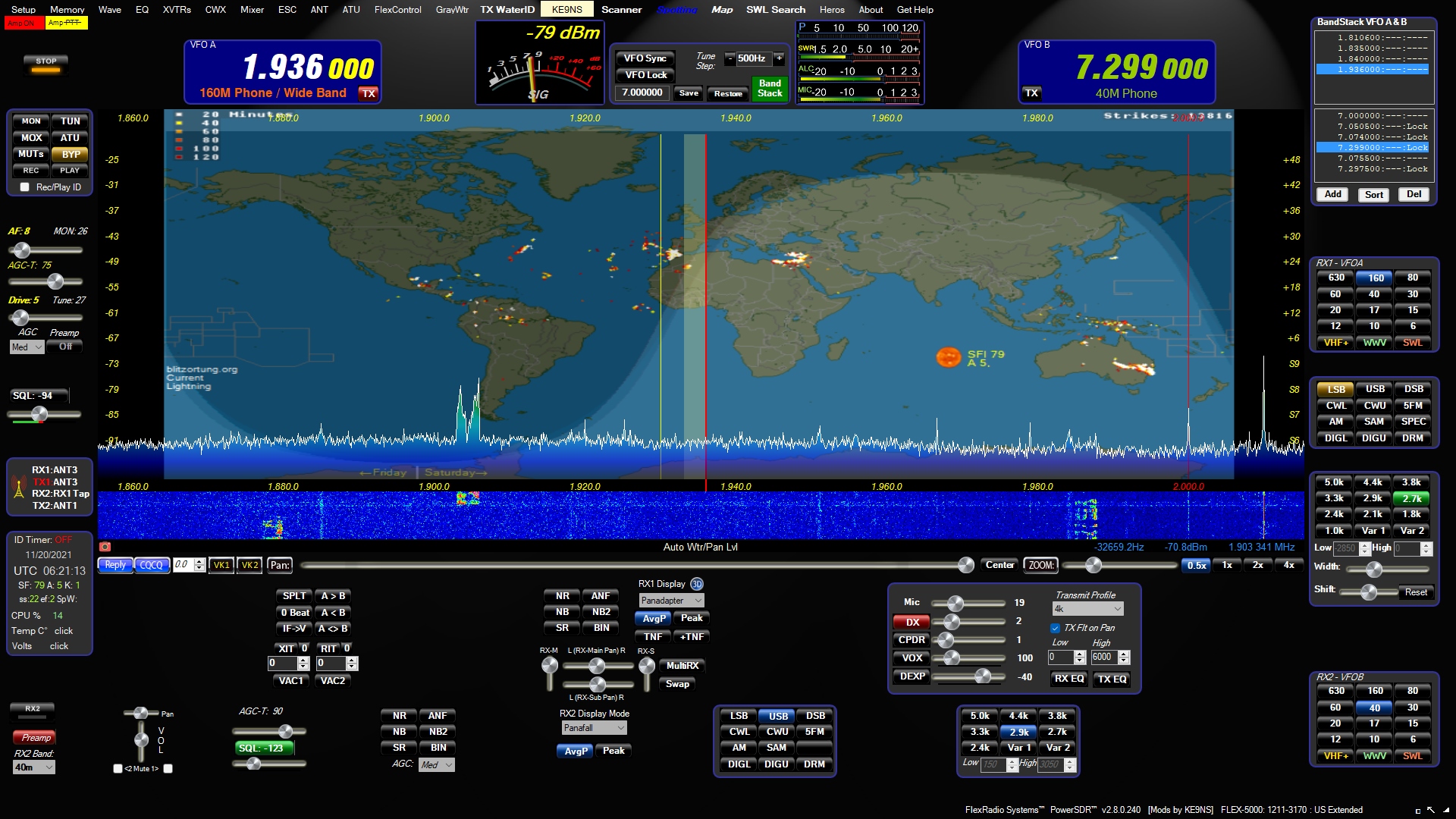
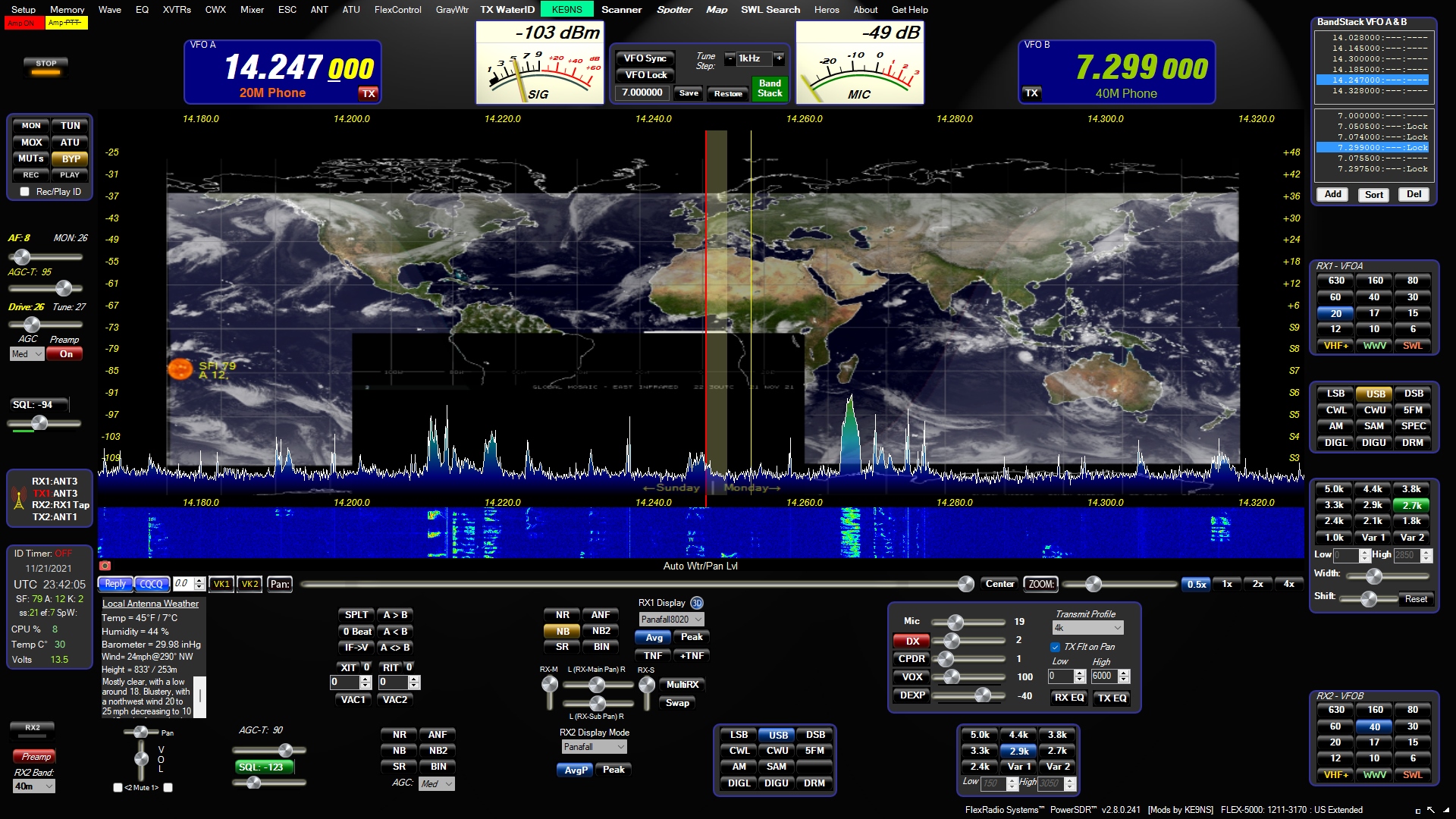
As you can see above, the two VFO's show their frequencies in clear and simple digits. These can be adjusted in terms of size and font and even the last three digits can have a separate colour. 
 

The central portion of the screen provides enough space to display a working map of the world and still have space for the panadaptor. On the left side are the often used buttons and sliders for quick adjustment. On the opposite side are the Band and Mode buttons. Many buttons have left and right click options.  


The lower section of the screen contains a host of other controls and any one of these panels can be relocated to give you the layout of your choosing. The level of customisation is incredible.


Apart from having all the radio's control-options onscreen, you can also have the PowerSDR software overlay the Weather, Lightning-Strikes, F-Layer, D-Layer, Cloud Cover and then there's the Spotter Map and even a Designator Map view. More could be added in the future.


The Spotting feature is quite extensive and Darrin has made it very easy indeed to choose a source and made it simple to switch from one to another. The thing I like the best is that the Spots are shown on screen relative to the LOCATION of the operator rather than the frequency they're on. So if you see a Spot over Africa, that's where his registered QTH is and all you need to do is click that spot and the radio will be tuned to that operators frequency and the mode changed as required. Fabulous! Of course, your own transmissions will be spotted too. 


PowerSDR includes an Audio Recorder (or a QSO Recorder as I like to call it). It's possible to not only record an active QSO, but also re-transmit it. 

Needless to say you can save the audio files for playing back at any time you choose. Additionally, you can create files for Calling CQ, etc and these can be programmed to transmit repeatedly with a timed delay between transmissions.

Because the file-format is a common type, it's easy to share these files online with other interested parties.


Rather strangely, PowerSDR also has a feature called TX WaterID which transmits your CallSign in such a way that it appears on the waterfall for all to see. It obviously has no practical value as far as I can see and I'm not even sure that it would be legal to use it - but it's there. 

You can also use the same feature to transmit a simple 24bit image. Again, why you'd want to, I don't know, but if that's your thing, knock yourself out, lol.

VAC! PowerSDR has two Virtual Audio Cables built-in which make it simple to interface with external programs such as N1MM+, CW SKIMMER, WSJT-X, etc. There is a very comprehensive configuration screen in PowerSDR's Setup menu.

As mentioned previously, this software is infinitely configurable and apart from being able to alter the colours of almost all the components which make up the interface, there are also a number of "skins" to change the overall cosmetic theme. Even the meters can be adjusted individually.
 

It's worth mentioning that the Flex-1500 does not have an SWR meter built into it. I use an external QRP SWR meter from MFJ and if I'm using a non-resonant antenna with an ATU, then I also insert an SWR BRIDGE to protect the PA during tuning. Some may think this is overkill but the last thing you want to do after finding a bargain radio like this is to see magic smoke coming from it.


Connecting the rig to my EFHW (which is not well sited), I soon started collecting contacts. Andy in Germany gave me a 57 and was impressed with the signal from my 5W radio. He was using 700W which earned him a 59 from me.

Other contacts rolled in and I was enjoying the user interface. My only negative comment would be that there’s a tiny spike when you drop the mic. I could see it on the waterfall and could hear it in one of the QSO recordings I made. I imagine that I’ll find the solution on the KE9NS forum.

When I enquired about my transmitted audio, people were quite complimentary which was good to hear, but there's an awful lot that you can do to "tailor" your TX Audio within the software and HERE's an excellent video guide on the subject by Nige Coleman (G7CNF). There are real benefits to experimenting with this.

Is in summary, I can say that the  FLEX-1500 has been a great purchase. Big radio fun for relatively small outlay. Punches WELL ABOVE its weight!

Maybe it's time to treat yourself to a Xmas Cracker...


I’ll update this post as I do more experimenting.

73, Tom, M7MCQ.

Wednesday, 14 December 2022

HAWKINS VIPER VHF-78 Mk.II

2M Wire Antenna

When you consider taking out Yagi's and colinears up the hills, you gotta think about mounting solutions that are in addition to your HF requirements.

So when I saw the Hawkins Viper VHF78 Mk.II i thought it might offer me a simple solution by affording me the opportunity to run a vertical wire down the length of my Tactical 7000HDS mast which is holding up (normally) a HF Dipole in an inverted-V.

These antennas are "built to order" so it'll take a few days to arrive. When it does, I'll nip up to Winter Hill and run some quick tests. I also have the 6M and a 4M version of this antenna to test too.


Back soon with the results...

Thursday, 8 December 2022

HAPPY XMAS ALL

HAPPY XMAS TO MY RADIO FRIENDS ACROSS THE WORLD.

And thank you to each and every person who has gone to the trouble of responding to one of my CQ calls or to those who heard my QRP calls in your pile-up and made it possible for me to get through. And to those who provided me with some amazing DX contacts. Thanks for all those radio reports and tests. Thanks to all the people who run RBN beacons, gateways, repeaters.

Thank you to those people who made contact with me on SSB, AM, FM, CW or DV. Thanks also to those who responded on PSK, RTTY and FT8. And my appreciation to those who joined me on C4FM, DSTAR and DMR, using RF, HOTSPOTS, Peanut, EchoLink or whatever other way we linked up.

Thank you to all the Radio Clubs who work hard to spread the gospel and provide teaching platforms. And all the Elmers out there.

Thank you for your patience and also for your encouragement and lessons. Thanks for your visits here and your kind comments.

And let’s not forget all those fabulous ShortWave Listeners!

THANK YOU ALL FOR MAKING THIS HOBBY SO ENJOYABLE!

I wish you the very best Christmas & New Year.

73, Tom, M7MCQ.