There'slots of SDR radios out there these days - there's been an explosion of them in the last few years and some people think that all SDRs are equal - but they're not!
Sure, any modern radio over $€£1500from the top manufacturers have similar levels of performance and it would be very difficult to tell them apart in a blind listening test, but some have a combination of features/spec which set them apart from the crowd.
No particular radio is massively better than another - but some models offer some people exactly what they want, without compromise. And the radio which does that for me is the Elad FDM Duo and its matching amplifier the Elad Duo Art 120.
The thing about the Elad system which particularly floats my boat is its uniqueness. There's nothing quite like it - it's stylish, compact, functional and has some amazing tech inside.
For those new to the hobby, I'll explain that SDR transceivers started off as plain boxes with no external controls - they were connected to a computer and it was the radio-software which provided all the controls, filtering and DSP. Later, standalone SDR radios appeared on the market which didn't require a computer, having all the regular buttons, dials and knobs of a normal transceiver.
The very first truly standalone SDR transceiver on the market was the Elad FDM DUO and at the time (2014) it was pretty groundbreaking! It wasn't until 2016 that one of the 'big three' responded with an SDR of their own - the Icom IC-7300. The Icom came without software and neither do the later Yaesu offerings.
Being a well established radio manufacturer, sales of the Icom went through the roof and it become the most popular amateur radio ever manufactured. Elad, on the other hand was pretty unknown to the ham radio fraternity so there weren't as many amateurs willing to risk their hard-earned money on a company they'd never heard of - even if Elad pioneered the standalone SDR transceiver!
Me? I don't mind taking chances, so I had no hesitation in buying an FDM DUO some 6 years ago. The big thing about the FDM DUO was that not only was it the first standalone SDR transceiver, but it could still be connected to a computer and be controlled from there.
And when I say it can be controlled by a PC, I'm not talking about basic control - I'm talking about an amazing piece of (free) proprietary software written by Elad themselves. This software (ELAD FDM SW2) provides an insane amount of adjustments and can even provide you with up to 8 virtual receivers PLUS the actual radio itself!!
And each one of those receivers can be controlled independently, so you could (if you so wished) listen to someone at the bottom of the band in CW mode and at the same time play FT8 and listen to SSB higher up. And each "slice" can have its own independent settings (noise-reduction, noise blanking, etc). That's pretty darned amazing! It's like Elad decided not only to become pioneers of SDR hardware, but also thought they'd wipe out anything the competition might do on the software front too!
So is the ELAD system still relevant 12yrs after it was launched? Absolutely!! Not only is it still relevant, but it's also still class-leading in terms of standalone SDRs with computer connectivity.
The transceiver is small enough to throw into a bag and carry to a SOTA or POTA location or connect it to the DUO ART amplifier in the shack and have an incredibly good base station. There’s just nothing like it on the market.
A CLASSIC COLLECTABLE!
Below is my original review of the kit….
ELAD FDM DUO - KING OF HF QRP?
The ELAD FDM DUO is a fabulous 160-6M SDR transceiver which can not only be used as a standalone rig, but also has some superbPC software! To many, it's the KING of HF SDR QRP!
ELAD Elettronica was established in 1990 by Franco Milan - a designer with decades of experience. ELAD excel in technological innovation and skills in the world of electronics. They are electronic engineers first and foremost, producing high end test equipment, but being Italian, also have an eye for beauty and style - this thing wouldn't look out of place in a stylish lounge!
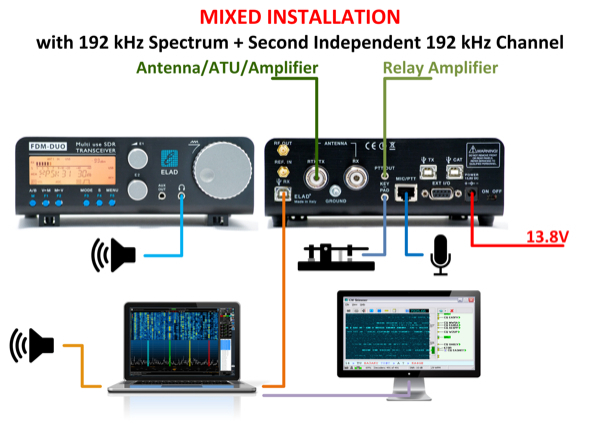
The FDM DUO is a smart, compact (7"x6"), very well constructed radio which can be used as a standalone QRP radio up on a SOTA Summit or is equally happy at home in the shack connected to a linear amplifier. If one receiver is not enough for you, then simply connect it to your PC and run the FDM-SW2 software - enabling you can work on two separate bands at the same time with four independent frequencies on each band - effectively 9 receivers in total!
Depending on the power supplied to the radio and the band used, the FDM DUO will typically output 5Wat 12V and up to 9W at 13.8V (and down low into the mA range ) in all modes (except digital). Output drops according to the voltage of your supply, so using a low-voltage battery will drop the TX output typically to 5W. Personally, I use a 13.2V LifePO battery so I should get close to full TX power when playing outdoors. It's worth noting that the Elad has a current draw of 500mA in receive mode, so this would be considered too high for many POTA/SOTA operators. I wouldn't let that bother me for a POTA outing because I've always got my truck close to hand with extra batteries, should I need them, but for SOTA that's a different story. Back in the shack (where a radio like this would probably spend most of its life), a 13.8V PSU will always guarantee max power out.
The Elad FDM DUO is a Direct SamplingSDR which means that the antenna is virtually connected directly to the A/D convertor. The advantage of this is that once a signal has been digitised, it's no longer prone to degradation, so the sooner you can achieve that, the better.
The RX range of the Elad is 10Khz to 52MHz, so it is also a good choice for ShortWave Listeners. Performance below 54MHz is superb and if you use the PC software you can actually go much higher (at reduced quality).
You can choose from Black or Silver finish, but me being me, I opted for the Special Edition "RED" version in 2019. This special edition came about after Martin Lynch reviewed the radio on YouTube and suggested that it was "like holding a Ferrari in your hands", so the MD of ELAD decided to do a short run of red radios, lol. The finish on the steel case is very nice and looks pretty durable. The legs at the front of the rig might look a bit flimsy but they are in fact quite robust. The VFO dial feels smooth and dependable and the screen is bright and crystal clear.
Under the cover: there's a very fast analog-digital-converter which samples the received HF directly into digital signals and a downstream DSP module provides for filtering and processing, while another ARM processor handles the signals of the control unit. One highlight of the FDM-DUO is the possibility to use it standalone without a computer.
It's a perfect companion for QRP fans, allowing you to have an advanced SDR with you even when you're working far from home. The controls are very easy to use for a small QRP transceiver and in addition to the big VFO knob, there are two smaller knobs for volume and filter-center/width (amongst others). Six blue buttons below the LCD-screen access the most important functions directly, while less frequently used settings are available via menu system.
On the rear of the panel you have an RF OUT (0db), REF IN, RX-USB, two SO-239 connectors (one for a TX/RX antenna and one for an RX-ONLY antenna), PTT-OUT, KEY/PADDLE, RJ-45 MIC connector (Icom compatible), two more USB ports (TX & CAT control), a DB9 connector for accessories, a power connector and a small ON/OFF switch.
When connected to a PC, FDM-DUO is a very advanced SDR receiver and transmitter with capabilities which are usually available only in large radios. The device receives from 160M to 6M. A 16-bit ADC with 122 MHz sampling rate is built-in.
Selectable modes are:
LSB,
USB,
CW,
AM
FM,
Extra modes with the Software are:
Sync-AM
Multiple CW modes
DSB
ECSS
RTTY
WFM (incl. Stereo and RDS!)
RTTY,
DRM
IQ Out
The Elad has a built-in, onscreen CW DECODER, which is always a nice addition.
The accompanying PC software is called FDM-SW2 and is constantly being updated. The software gives you a staggering amount of control over the radio - much more than any other SDR software out there!
Just stop for a moment and think about other Standalone SDR Transceivers on the market from the big boys like Icom and Yaesu - do they provide you with FREE comprehensive software?? No! Hell, you'd be lucky to get basic-control software.
Elad on the other hand provide FDM-SW2 (always being updated) totally free of charge and it permits you not only to control the basic functions of the radio, but let's you delve deeply into the nooks and crannies of the radio and change pretty much anything you want in search of a better signal.
You can open multiple windows and spread them across your monitor in a layout which suits your method of working and they can even be spread across multiple monitors. One big plus to me, is the fact that you can properly resize windows to fill your screen(s).
Using the software, you can play with a great many features including the amazing 10 noise-blockers and 10 filters that are available for all modes. You can open up an equalizer to tailor your transmitted audio or adjust the level of compression. You even get a nice visual waveform to see your transmitted audio - a nice touch.
The Noise Blocker on this radio is just staggering (to me at least)! Occasionally at my home QTH, someone in the neighbourhood switches something on 😡 which virtually wipes me out and the only noise blockers which can deal with it are the one on the Elad and the one on my TS-590SG (to a lesser extent). All others have failed completely.
Setting up pre-recorded voice messages (eg for calling CQ) is easily configured and these messages can be set to automatically repeat. If you have a USB headset or a USB microphone connected to your PC, you can choose which one to use to transmit from.
There's so much more that can be done from within the software - it really is quite amazing the amount of control the manufacturer has chosen to give to the operator. So much so, you might find yourself resetting the radio to the manufacturer's default settings when your tinkering has gone a little too far, lol.
The ELAD FDM DUO is a cracking little QRP radio with a stunning receiver which will never fail to impress you and the software just takes it to another level. It's also easy to hook up to a linear for those wanting to use it in the shack as their main rig.
Everyday operating of the Elad is really quite straightforward and although you do have to remember what some of the buttons do, it only takes a couple of days to feel completely comfortable navigating your way around all the options. The VFO dial is large and nice in the hand.
Although the screen is quite small, it is extremely crisp and easy to read - there's bags of information on there too. The colour of the backlighting can be altered and you can even set it up to change when transmitting - say to red.
When connecting up to a PC to run the FDM-SW2 software, I find it much better to use a TMATE-2 instead of mouse and keyboard. Having said that, you usually find yourself working a combination of the two.
If you want CAT Control, then you only need one of the three USB leads.
When you listen to the Elad, you just fall in love and forget about any gripes. This is an outstanding receiver!
You will note from the images that a matching speaker is available - the SP1A. External speakers from radio manufacturers are a great annoyance to me - I think they're outrageously expensive! Not so with Elad.
They cost £135 brand new and are super stylish and superbly well engineered! The SP-1A is an amplified speaker which conveniently has a PowerPole pass-thru. It has decent power output and has a built-in 3-stage DSP circuit. It fits in very well and completes the station.
To see the beautiful matching 100W Linear Amplifier, click the image below...
Here's a video recording of me speaking to W2RE using the ELAD and a G5RV...
This beautiful, high performance transceiver from Italy is a shining star in the SDR world, for sure. It's completely standalone but is backed up with some of the very best software available on the market for those who want to link up to their shack PC.
It's small enough to be thrown into a rucksack and be taken with you on your travels, but that (relatively) high current consumption will mean that you probably won't want to take it to the top of a mountain with a small battery. Having said that, not many people spend all day on top of a mountain 😁 You tend to bag your 10 contacts for the activation and enjoy the local scenery on your descent. My HobbyKing 8400 LifePO battery has never failed me.
I see the ELAD FDM DUO as a top-end performer that is absolutely perfect for the shack or Field Day or a POTA outing. You'd be very hard-pressed to find a better receiver - especially if you take advantage of the software on a computer, laptop or tablet.
I guess some people would baulk at the £1k price tag of a 5-9W radio and put their money into one of the run of the mill 100-Watters out there. As a lover of QRP though, I prefer to do things a little differently. Not everyone will. Are there better receivers out there? Of course - at three times the cost! Are they three times better? Of course not!
Here's a black edition that I bought for my static caravan. Up there in the Forest Of Bowland the noise levels are extremely low!
Dave Kennett (K8KFJ) put together 3amazingly useful videos on how to get the most out of the ELAD FDM DUO and I have to admit that there were plenty of tips that introduced me to features I wasn't even aware of! Bear in mind though, that these videos are for owners of the Elad who want to invest time in learning everything about this wonderful transceiver. They are not reviews. Sadly, Dave has now gone silent-key😥.
Thanks for your amazing contribution Dave 🙏
ELAD GUIDE - Part 1
ELAD GUIDE - Part 2
ELAD GUIDE - Part 3
One of the very most experienced users of the Elad system here in the UK is M0OXF. He has an amazing YouTube channel which is brimming with Elad and SWL related content.
His YouTube channel can be found HERE and is well worth paying a visit.
RX Stand-Alone Specifications
Frequency range: 10kHz - 54MHz.
Direct sampling receiver operating @122.88MHz, ADC: LTC2165 16bit.
DDC (Digital Down Converter) made with FPGA Xilinx Spartan 6.
Filters & Std-Alone Demodulator made with ARM STM32F4 microcontroller with floating point unit.
Demodulation: CW, CWR, LSB, USB, AM, FM narrow.
Selectable LSB and USB filters; 1600Hz to 3100Hz with 100Hz step plus 4000Hz, 5000Hz and 6000Hz values.
Selectable AM filters from 2500Hz to 6000Hz with 500Hz step.
Selectable CW filters; 2600Hz, 1500Hz, 1000Hz, 500Hz, 300Hz and 100Hz plus 4 CW peak filters applied after 100Hz filter to obtain an overall filter of 20Hz bandwidth.
Selectable FM filters: narrow, wide and data.
Pitch setting: up to 1kHz with 10Hz step.
RIT feature.
Three audio volumes: main, auxiliary and sidetone.
Squelch: off and 10 on levels.
Gain Control: automatic (AGC) and manual, with settable threshold.
Noise Reduction: off and 10 on levels.
Noise Blanker: off and 10 on levels.
Auto Notch: off and 2 on levels.
TX Stand-Alone Specifications
Supports bands from 160m to 6m.
Modulation and filtering made with ARM STM32F4 and DDS AD9957 with 368.64MHz clock.
Modulation: CW, LSB, USB, AM, FM narrow.
Microphone input (ADC 48KHz@16bit) with selectable gain (+/-12dB). Tx bandwidth selectable. Compression gain settable.
Key and Paddle input for CW operation, supports Iambic A and B, settable CW speed for Paddle, settable CW delay.
Not filtered 0dBm output on SMA connector (can be used as test equipment or as digital RF generator).
Up to 5W output power on all bands plus Max Selection (e.g. 8W@14MHz).
PTT Output to drive external amplifiers.
Main Features
VFO A and VFO B, with dedicated frequency, step and mode.
200 MEMORIES with dedicated frequency, step, mode and alphanumeric label.
QuickMem feature: up to 20 re-callable memories for band selection (memories 180 to 199).
QuickStep feature: allows to quickly change step without modify VFOs or MEM step.
Tune feature to facilitate antenna tuning with external antenna tuner.
VFOA=VFOB feature.
VFO to MEM and MEM to VFO features.
Std-Alone Split feature, VFO A for RX and VFO B for TX.
2 customizable keys (F4 and F5) with various functions: CW message sending, split management, tuning knob lock, CW/CWR choice.
2 frequency entering modes : with step and digit by digit.
Integrated CW decoder.
LCD color programmable with RGB values for the various operating modalities (RX, TX , PC remote control, ...).
All programmable components (ARM RX, ARM TX, Flash for FPGA, User Interface microcontroller and USB controller) are firmware upgradable.
General Specifications
Antenna connectors: RTX SO-239, RX SO-239.
CAT USB control interface with FTDI controller, manages also RTS and DTR signals to transmit.
Proprietary EXTIO Interface to connect accessories.
10MHz Reference Input on SMA connector.
Power supply: 2.1mm DC Plug, 13.8VDC.
RX consumption: typ. 500mA@13.8VDC.
TX consumption: <2.2A@13.8VDC (5W output).
Size: Width 180mm (7.00"), Depth 155mm (6.10") including Knob and connectors or 130mm (5.10") only enclosure, Height 70mm (2.75").
What can you buy for a couple of tenners these days? A bottle of wine? A couple of cocktails? A quarter tank of fuel?
Well I bought this little beauty from China and I have to say - I'm dead chuffed with it!
I've been ignoring this radio (and its predecessors) because if I've wanted to throw a compact radio into my pocket when I go for a walk, I pick up my Belka DX, but I have to admit to growing a little tired of the Belka's ergonomics. Selecting bands and just general tuning is less than perfect, especially since the encoder has started to play up a little.
The ATS MINI V4 is much smaller than the Belka but has a much more informative screen - which is also colour! Despite its size (1.9"), it's extremely easy to read and there are options to change the display settings to suit your own personal preferences.
Apart from the On/Off slider on the left of the radio, there's just one multi-purpose rotary control which is used primarily for tuning and is then pushed to access the menu. I found the menu-system super easy to understand and navigate. If you're not quite happy with the V4's firmaware, you can actually flash an alternative onto it from H.J.Berndt which gives new features including a tiny panadapter and CW/RTTY decoding. Personally, I shan't be bothering.
The Mini V4 is offered in a plastic or aluminium case and I opted for the latter due to having a little bit of credit on my Bangood account. I sure am glad I went for the metal case because this thing feels real good in the hand. I guess it also gives the tiny rear-mounted speaker a firmer base to mount onto.
Generally speaking, the sound coming from the V4's speaker is thin, but it's also nice and clear and proper adjustment of bandwidth can really make a difference to the listening pleasure.
The reception of UK Broadcast Stations is almost as good as my Tecsun PL-990 using the supplied telescopic whip (which is quite short). Needless to say, the audio cannot compare to the Tecsun, but listening through a pair of headphones is a delight (and the radio uses the cable as an antenna). With a strong FM signal, the audio is perfect, but weaker signals seem to attract a feint clicking sound in the background - not sure why.
Switching to SSB provided great results and I could easily pick up a myriad operators on the ham bands while indoors at home. Connecting my little wire-reel antenna made things even better, but to be honest, when you're outdoors on top of a hill, reception is never really a problem and I've always been happy to use the telescopic whips on casual listening sessions.
There's also a mini loop-antenna provided with the V4 and at first, I thought it was going to be useless, but in all fairness, it works quite well on certain bands.
The battery life of the V4 is not the best, but it's certainly good enough (800mAh) to last a typical listening session, even on a long walk. Recharging is carried out using the USB-C connector.
Conclusion: This is a cool little radio! It's cheap as chips and unlike many electronic goodies to come out of China's online superstores, the V4 is well worth the money. Even if you only used this for Broadcast Radio, it's worth buying. Absolute belter!
Specifications: Shell Material: CNC Metal Control Chip: ESP32-S3 + SI4732 DSP Reception Modes: FM/AM/LSB/USB Frequency Range: LW/MW/SW: 150kHz - 30MHz VHF: 64MHz - 108MHz Display: 1.9-inch IPS HD Color Screen (Resolution: 170x320), adjustable brightness (32~255 levels) Speaker: Built-in 1W speaker Audio Output: 3.5mm stereo jack (three-segment type) Antenna Connector: SMA-KE Charging Interface: USB Type-C (not compatible with fast charging) Battery: Built-in 800mAh rechargeable battery Firmware Upgradeable: V1.01 latest firmware pre-installed
I recently received an email from a fellow radio enthusiast and it made my day! Jacques wrote to congratulate me on the blog and it was all the more appreciated, knowing it was from someone so senior - someone who’s been active in radio for 46 years and is still enjoying the hobby.
On Thu, 19 Mar 2026 at 11:54, Jacques Hankin wrote:
Hello Tom.
.....I stumbled across your site, (following up on an IC-705 review - I'm thinking of revamping my shack-)
and I have found a treasure trove in your site!.
So after much interesting reading, my first instinct was to write to congratulate you on a very readable, helpful site.
I hope many budding SWL's wanting to go the next step will find your "Starting in amateur radio" item. most helpful.
I also like your writing style, which I find very nicely paced, very factual (and honest),with no superfluous padding.
I am 79, and just getting fired up again on morse (struggling) and although not a tyro, have been active in radio in one form or another since I got my full licence in 1980, (career and raising a family permitting)!
Keep up the very good work.
Best wishes,
Jacques
I replied…
Wow!! Thank you Jacques, for your lovely email and kind comments. It’s so nice when people take the time to contact me and I truly appreciate it.
I must admit that I’m surprised to find I’ve had almost 800,000 visits to the Blog and yet just a handful of contacts like yours. I guess most visitors take what they need from the information posted and just move on (which is fine).
I only write the blog to help others (and often to remember how I got something working, lol), so I’m never looking to profit from it, but it sure is a treat when someone like you comes along and lets me know that my efforts are appreciated. Thank you so much!
First off, please excuse the tinkering that I've done with my images - I was just trying to get away from all the usual boring photographs that I normally post by injecting a bit of colour and fun 😊.
Following on from my initial review of the Hermes Lite 2, here’s a revisit, some two and a half years later. I recently purchased the new (Mk2) version of the Icom IC-7300 and it got me thinking about value for money and in particular whether the £1350 radio would bag me more contacts than the diminutive HL2 which costs a whopping £1000 less!
Now obviously, the 7300 is a 100W radio and the HL2 is a 5W radio, so I will be running the latter with a 25W amp and I’ll run the 7300 at the same power level. I’m keen to know how the two receivers compare - not so much in terms of receiver sensitivity, but more in terms of effective Noise Reduction, because at the end of the day, noise reduction has become one of the most important considerations in the electrically noisy environment we call home.
The 7300 Mk2 is Icom’s latest iteration of their famously popular budget base-station and by using the might of Icom’s design team, it has supposedly improved the RX & TX characteristics. By comparison, the HL2 uses a cheap AD9866 Cable Modem chip and you have to wonder how it achieves such high performance levels. The HL2 also benefits from Pure Signal adaptive transmission pre-distortion which is normally only found in very high-end transceivers.
My own Hermes Lite 2 is the PLUS model which has an extra companion board providing the following additional features…
Adds a headphone socket with a sidetone in CW mode.
Adds a microphone jack to the front panel with PTT.
Adds an Iambic Keyer to the key jack on the front panel.
Adds a dedicated Hardrock-50 interface with bandpass switching.
Adds a dedicated AH4 ATU control interface option.
Adds a local speaker output with sidetone in CW mode.
Adds an On/Off power switch option.
Greatly reduces latency in both CW and SSB.
The HL2 is part of an OpenSource project which facilitates the use of a very wide range of software including SparkSDR, SDRconsole, SDR++, piHPSDR, PowerSDR, Thetis and many more. The majority of people choose to use Thetis with the HL2 and there is one version of Thetis in particular which has been modified by MI0BOT. This special version takes advantage of the differences between the HL2 and Apache Labs radios and it introduces some new features. The very latest version (at the time of writing) is V2.10.3.12.
My home location (like many others) is blitzed with unwanted noise and I generally struggle to hear all but the strongest signals - it’s the reason that I spend so much of my operating time outdoors in the countryside. I often wonder how good it must have been for hams a few decades ago, before there were dodgy Chinese switched-mode power supplies, broadband hash, LEDs and solar panels!
My antenna for this comparison is a highly compromised, ground-mounted vertical from Sigma with no counterpoise. It’s far from ideal, but due to local restrictions it’s the only option open to me.
As much as people criticise these antennas, you have to applaud their performance given the locations/situations that they are frequently expected to work from. And although this antenna is sold as an 80-6M, it easily tunes at 160M and while it’s a dummy load on SSB, at least it gets me FT8 contacts on the top band - happy days!
The antenna is shared between the IC-7300 and the Hermes Lite 2+ using a high quality switch from Cross Country Wireless. With the 7300 I use an external speaker (Icom SP38) and with the Hermes I use the computer’s speaker (Bose Mini II). I did my utmost to level the audio output of both radios so as not to influence my decision on which signal sounded the clearest. If anything, the Icom should have a slight advantage due to the fact that the computer speaker (Bose) has a softer (warmer) sound than the more clinical sounding SP38.
I have conducted comparisons on all of the bands over the course of a few weeks, during the day and the night. I’ve made contacts on SSB and used my own ears to determine which radio provided the most audible signal. I have also conducted FT8 comparisons on all the bands too and allowed the factual signal reports to be the judge.
To eliminate any Common-Mode currents (and reduce noise), I have a LINE ISOLATING CHOKE installed from RFCOMMS. This is a high quality unit and using such a choke is always a good idea when using 1/4 Wave verticals or end-fed wires.
Thankfully, there were plenty of Contests on over the test-period, which meant that the same people were constantly calling, allowing me to repeatedly switch between radios. As much as I hate to admit it (considering I’d spent £1400 on the Icom), the Hermes came through time and time again when it came to the simple test of making out the callsign of a weak operator on SSB.
Having the ability to tweak the myriad Thetis settings makes a huge difference - it’s the software which makes this radio special and in particular, the DSP - it really is good. I cannot think of another radio which has noise reduction as effective as the humble HL2 (and I’ve owned some pretty fancy models).
The Hermes NR1 is pretty much the same as what’s available on the Icom, but NR2 is just out of this world. I’m not exaggerating! If you live (as most people do) in a very noisy environment, NR2 can make you fall out with all your other radios, lol. It’s got to the point where I just leave it on most of the time.
With the Icom (and any other radio I use in the shack), I tend to control noise with the RF GAIN more than the DSP, but when the signal is really weak, that’s not an option. Don’t get me wrong - I’m not saying that the Icom’s noise reduction is useless - I’m saying that the HL2’s is outstanding.
NR2 uses an NPE algorithm and sounds superb at the default settings, but there’s nothing to stop you experimenting with the settings if it’s not quite ‘hitting the spot’, but in all honesty, you’re unlikely to improve on all the hard work put in by the developers. If you do want to play around, be sure to make a note of the existing settings and apply the NR2 before the AGC.
Thetis has a lot of settings that you can play around with and that can be great fun and great frustration at the same time. If you go too far with your experimentation, you can make a right mess of things, so it's always a good idea to make backups. There's lots of help and tips online, none more so than ON7OFF'ssuperb YouTube channel.
If you don't want to spend your precious time finding the perfect setup, you could always download someone else's instead and use it as a starting point for further refining to suit your personal preferences and voice characteristics. The one I like is from Kurt (ON7OFF)...
So, after spending a great deal of time (according to my wife at least) switching between one radio and the other, I can "Hands On Heart" say that there's very little difference between the £350 Hermes and the £1350 IC-7300 receivers in everyday use. I will admit that I'm not one for breaking my neck trying to dig out the faintest of the faintest, so if you are, you may come to a different conclusion.
Let's remember though, I started with the question "Will the 7300 bag me more contacts than the HL2". The answer was no!
I love the IC-7300-2 and I think it's worth every penny of its RRP. It offers so much for so little and IMHO it beats the competition with its amazing feature-set. But when it comes to out and out Value For Money, the award has to go to the HL2.
Okay, so there's a matter of 100W vs 5W but even if you add a MICRO PA100 you'll still only be paying around 40% of the Icom's cost and to many people that's a BIG consideration. Let's not forget though that the HL2 needs a computer, where the 7300 is a standalone radio.
I’ve said it before and I’ll say it again - every ham should have a HL2 in their shack!
Oh and we've not even touched on the HL2's Pure Signal capability!! I'll write another post on that in a few days time. Thanks for reading.