Sunday, 19 December 2021

KX2 vs KX3 vs IC-705

A BRACE OF BEAUTIES...
...AND THE NEW KID ON THE BLOCK


I've said all along that the Elecraft KX3 is a magnificent radio but I also said that it  feels a little vulnerable for using in the rugged outdoors. Not that it's flimsy or poorly built - it's most definitely not,  but compared to other QRP field radios I own (or have owned in the past), there's always a nervousness about handling it outdoors. I guess a lot of that is due to the unusually high cost of the unit. 

To repeat myself (I do that a lot),  I liken it to driving a Rolls Royce Wraith up to the top of a hill when you know that you should have taken the Land Rover Defender!


So maybe the smaller Elecraft KX2 (the smallest fully featured HF radio in the world) is better suited to the job? 

The KX3 is about $400 more expensive and weighs almost twice as much as the KX2, but it benefits from having two extra bands (160M & 6M) as standard. It can also benefit from having an optional Roofing Filter and charger installed which aren't available for the KX2. The KX3 can also be fitted with an optional VHF Transverter for $340 and it has FM mode.  Finally, the KX3 has an IQ-Out and panadapter-socket allowing you to connect it to Elecraft's PX3. An internal ATU is available for both radios at a cost of $300.

So the KX3 kit can very quickly get super expensive and I personally consider it to be better suited as something you'd use for low-risk Field Days where you'd have the radio in a Pelican Case in the back of your car and virtually drive right up to a picnic table and set up your station.

The KX2 on the other hand is much more an outdoor radio. It's incredibly small and light and has an amazing battery life (at QRP levels) using the internal Li-ion battery. The screen is identical on both radios but  the idle current drain is fractionally lower on the KX2. It doesn't have any special damage-protection or weatherproofing, but its dimensions just make it easy to handle and reduce the risk of it being dropped I guess.


My KX2 has a slightly better sounding speaker than my KX3 but it's still not great. I know that Elecraft claim most operators will be using headphones and the speaker is more of an emergency backup, but that's a load of tosh to me! If Belka can fit a perfectly good speaker in their tiny receiver, I'm sure Elecraft could have done the same. Jeez, I've got a $20 Chinese UV5R with a superb speaker in it!! If I'm not using headphones, I tend to use a separate speaker with the KX2 and KX3.

The KX2 has a built-in microphone but the vast majority of users plug a hand-mic in. Considering that Elecraft went to so much trouble to build such a tiny transceiver, including an internal battery pack and an internal ATU, I'm staggered that they didn't create a matching microphone! To pair the KX2 with their MH3 is like putting a size 12 Boot on a baby!! Every time I pick it up I find myself shaking my head. Compared to Yaesu's smaller microphones (or Icoms or Kenwoods), the MH3 is a brick! And it's not even a speaker mic (although the inners indicate that it was possibly meant to have that option)!

 
I know nothing about electronics, but I'm going to see if I can find some help from more advanced operators to find out if the little Yaesu Spkr-Mic can be modified to allow it to be used with the KX radios. If it can, it would be a wonderful upgrade - even if it's only as a mic.

The ATU in the KX2 is definitely not as good as the one in the KX3, but to be honest, it's good enough for any antenna that I use. It also seems a tiny bit slower than the KX3 tuner, although that might just be my imagination. 

Like most other QRP operators, I do my best to use resonant antennas because I don't want to waste a single milliwatt, but sometimes you don't have a choice and also, some "resonant" antennas are only resonant at one end of a band and need a bit of tuning at the opposite end.

My SotaBeams 20/40 Linked Dipole and BandHopper EFHW both benefit from a little fine-tuning, so it's good to have the ATU installed. The KXAT2 would really come into its own when users employ a random length wire and I feel quite confident that a usable match would be achieved on virtually any band.


The tiny KX2 fits inside a very small soft case, complete with the (oversize) mic and the very capable AX1 antenna which covers 40, 20, 17 and 15M. This is for sure the most compact HF kit around and although that AX1 is a compromise antenna, it has proved itself to be a very capable performer if the conditions are right.

I think perhaps too many people expect too much from this antenna and don't put enough effort into helping it work well. I've even seen people try to use it without the supplied counterpoise wires (there's one for 20M and another for 40M). It can be negatively affected by body capacitance and height, so wherever possible, I use it away from my operating position and often on a raised tripod. That's not always convenient though and sometimes I have to have it connected directly to my radio using Elecraft's little support legs, which add a surprising amount of stability.
 
For power, the KX2 uses a great 2600mAh Lipo battery, which I prefer to the KX3's Nicad arrangement. The only good thing about the KX3 battery arrangement is that you can recharge them without removing them from the radio - that's not the case with the KX2. It's a small hardship having to remove the Lipo to use an external charger, but one I wish they'd have overcome at the design stage. If there's one thing I don't like doing with either of these radios, it's opening them up routinely. It's just not a good thing as far as I'm concerned. And there's STATIC sensitive boards in there!

Thankfully, I tend not to rely on internal batteries, preferring instead to use a lightweight 13.2V LifePO. I have two of those, one 8.4Ah and one 4.8Ah. I got these from HobbyKing and over 3 years later, they're still going strong - amazing!

The KX3 performs better with a good, strong battery and I think Nicads only ever give problems. Don't bother with them - use a good external battery.
 
The radio itself displays no difference in receive performance to its bigger brother and the only tangible difference (to me at least) is the addition of the dual roofing filter in the KX3. They both receive fabulously well, making it easier to pull out those very weak stations from the noise. It's always a pleasure to use Elecraft radios and I never feel like I'm compromised in any way by operating a portable when it's one of these beauties. It's like having a top-end radio in your rucksack.


It's worth pointing out that these two Elecrafts share the same wonderful screen from the K3S Base Station! So opting for the much smaller radio doesn't mean that you're stuck with a much smaller screen - no - they both share one of the best high-contrast LCD screens on the market. No matter how bright and sunny it is outdoors, the screen is always perfectly readable.

The KX3 benefits from being able to provide a 15W output, (with a good external battery or PSU) whereas the KX2 can only manage 12W. Having said that, the KX2 can produce 10W from the internal battery, whereas the KX3 can only manage 5W. To be fair, many buyers of these QRP radios will probably want to use 5W or less anyway!

When out and about, after establishing a contact, my goal is to try and reduce power to the mW range and see how low I can go (that's if the other operator is willing to oblige me). Most operators are good willed enough to play the game and they're often surprised and entertained by it.

So of the two Elecrafts, which one is the best? Well clearly, that would be the KX3 for sure. It's just got more options available for it and is more fully featured. It could easily be used as your main radio in the shack (with a 100W amplifier if you wanted). But you've got to accept that such a fully featured radio would cost an awful lot of money (£2,500 fully loaded) and you'd probably be worried sick every time you took it with you on a hike - but then again maybe not.

The KX2 on the other hand has no Top Band, no 6M, no 4M/2M option and no roofing filter option. It also lacks the superb optical encoders of the KX3. But my word, it's TINY!! And it's a good performer. 


Both radios can be fitted with Elecraft's brilliant Paddles which are very compact but not restrictively so. Sadly, I cannot work CW but it's a great desire of mine to learn it one day. 

At 63yrs old I'm not altogether sure that I am capable of learning what is effectively a whole new language, but then again, retirement is hopefully not too far away. These Paddles can be used with a sidetone on either radio to practise sending morse, so I might give it a go. 

As much as I would LOVE to keep the Elecrafts, I have to admit to the excessiveness of having both models. One of them will have to go - it's the KX2.

The KX3 is simply too amazing to let go!


So where does this leave the Icom IC-705?

The IC-705 is so different to the Elecraft that I feel I can justify keeping two radios. The IC-705 not only covers HF but it includes the Top Band, 6M, 2M, 70cm and even provides DSTAR operation. 
The IC-705 is a full SDR radio with a staggering range of features including a full-colour touch screen with a real-time Bandscope & Waterfall - something which can be an amazing help finding a signal on a quiet band or finding a quiet spot in a crowded band.

It also has GPS, Wi-Fi, SoundCard, BlueTooth, QSO Recorder, Remote Operation capability, SD-Card and even a compact Speaker-Mic! Like the KX2 it has a built-in Lipo battery but it can only produce 5W unless you attach an external supply to it, whereupon it will happily go up to 10W. The only thing that people complain about is the lack of a built-in tuner. Personally, I think that's a very unfair complaint considering all those other amazing features which are included. I think buyers should remember that a fully loaded KX3 would cost around £1,000 more than a 705 and it would still be lacking many of it's fine features - you don't even get a microphone with a KX3!!

You can use a variety of ATUs with the Icom and they are all simple to setup and use. Personally, I use an LDG around the house with it and a little Elecraft AT1 when I go outdoors. Needless to say, the LDG is infinitely cheaper than the Elecraft.


So yes, I will be keeping my Icom IC-705 alongside an Elecraft KX3 because they're both amazing in their own rights. The 705 could easily be considered good enough to be the only radio you need in or out of your shack - it's that flexible!

Some readers might wonder why I've not mentioned the YAESU FT-817, FT-818 or XIEGU G90 in this post about QRP radios. Well that's because I've reviewed those elsewhere (click the links). They're great radios and I wish I could have kept hold of them, but I sold them after investing in a 705. 

Finally, I'd like to acknowledge that I am incredibly fortunate to be in a position to afford these radios and appreciate that many Hams can only ever afford a single radio (some can't afford any).  Then again, some people annually spend similar amounts to me on things like Cigarettes, Booze, Football Season Tickets,  and other costly hobbies.

AND FINALLY, can I just say that everyone has the right to an opinion and most people are quick to give it, but the best opinions come from those who've put their hand inside their wallet, spent their hard-earned money on something and actually spent time with it before spouting off about it. Too many people bad-mouth or recommend equipment that they've never even owned.

Make hay while the sun shines and enjoy whatever you can afford at the time!

73, Tom, M7MCQ.

Feel free to comment below :-) 

-----------------------------------------


Saturday, 18 December 2021

HANS SUMMERS SUMS IT UP

 I LOVE THIS POST BY HANS SUMMERS OF QRP-LABS…


In the end I think amateur radio is a very broad hobby and this is one of the best things about it, that we should all appreciate the most. Let the CW fan hammer brass and the FT8'er's computers handshake. Bounce signals off the moon, build enormous antennas or a piece of wet spaghetti, a kilowatt or a milli watt. Talk, beep, whisper. Build, buy. Climb a mountain, sail to an island, walk in the park. Whatever takes your fancy! Just live and let live!

Amen!
73, Tom, M7MCQ

Sunday, 12 December 2021

ICOM IC-7610 LOW ON POWER

"MY IC-7610 IS LOW ON POWER"

Yesterday, my friend swapped his FT-DX101D for an IC-7610 and I went over to give him an Interface Lead I'd made, to allow him to connect it to his ATU. While I was there, he noticed that the radio was down on power - and I'm not talking about that "perceived" low power on SSB! 


He was running in RTTY mode to get a constant carrier and tried transmitting at 50W. That produced around 25W. When ramped up to 75W it produced 30W and at 90W it produced around 45W. When he tried to transmit at 100W, the radio reset itself! 😮

After a couple more tests (including a Factory Reset) he rang the seller to inform him of the problem and arranged to take it back.  It was at this point that I suggested that it might be his power-supply, so he swapped over the power leads to another PSU and hey-presto, it worked! 

I only posted this because most beginners wouldn't give their power supply a second thought and would probably end up sending their radio off for repair. It's easy to overlook your PSU when experiencing problems, especially when it appears to be working normally. Oftentimes, you're not even aware that they are malfunctioning and it takes a completely new situation (like installing a new radio) to make you notice a problem that you were previously unaware of.


Anyway, my mate has ordered a new Power Supply and all is well with the world again.

#my radio is low on power
#my icom is low on power
#my ic-7610 is low on power

Friday, 10 December 2021

SAMLEX SEC-1235G PSU

In a corner of the lounge sits my KX3, where sometimes I sit comfortably instead of being in the shack, sat on a stool. Needless to say, I can only really do this when my wife has gone out 😂

Well today was one of those times, so I switched the radio on heard a strong station on 17M and decided to try a contact. At 5W he couldn't quite make out what I was saying so I switched on the PSU to use 10W.

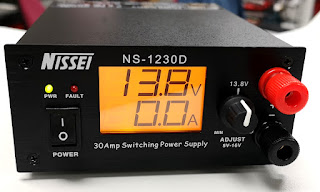
Switching on the Nissei PSU 1230D suddenly produced a huge amount of horrible noise! I checked all the connections were in order and tried again with the same result. The noise raised and lowered in a sweeping pattern and nothing I could do (including altering the voltage-adjuster) made any difference.

The 1230D was a pretty inexpensive PSU but I liked the way it looked and I also appreciated that it had the traditional banana-plug sockets on the front and the more contemporary PowerPoles at the rear. I was quite disappointed to see that it was failing. After digging out the receipt, I discovered that it's two and a half years old.

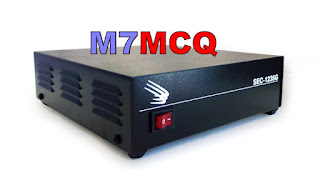
So when looking for a replacement, I decided to forego all the fancy displays and adjusters and simply put the money into the PSU itself. So on that note, I looked at the Samlex range and opted for the SEC 1235G model which is a 30A PSU with no bells and whistles to distract from the main job of supplying steady, noise-free power.


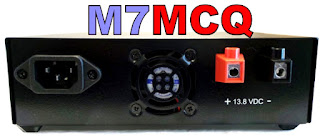
The Samlex SEC 1235G is about as plain as you can get. It has no LCDs, no LEDs, no knobs, dials, Anderson PowerPoles and no Banana-Plug sockets - just their own power-connectors to which I'll add a pigtail terminated in PowerPoles. 

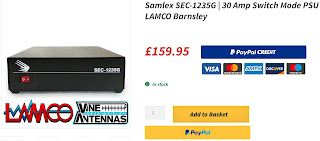
Of course after finding this PSU, I read reviews and then sought out the cheapest internet price. On Lamco it was a rather hefty £159 but Moonraker were selling it £30 cheaper, so I went with them. 


Much to my surprise, I found that I had built up some credits with Moonraker, so I used the discount and ended up paying just £71 for the Samlex! Happy days 👍
 

I'll report back on the PSU when I've used it for a while. From what I've heard up to now though, they're meant to be a pretty good supply. I'll also open up the Nissei when I get a minute and see if I can find anything obvious at fault.


UPDATE : 

I have modified the Samlex SEC-1235G to include an extra outlet on the front panel. Click the image below for more information....


Wednesday, 8 December 2021

SHERWOOD ENGINEERING TABLE

DOES IT MATTER?

When I started as a licensed operator, I was eager to find some sort of 'benchmark' so that I didn't make a newbie error and buy a duff radio. It didn't take me long to find the Sherwood Engineering Table.


At the time, this seemed like the be-all and end-all, so I gave it much credence and considered it to be more important than the opinions of YouTube reviewers (many of which were financially invested in their suppliers).

Over time I got a little wiser and it was when I purchased a Yaesu FT-DX101D that I realised there was so much more to buying a radio than an RMDR figure from a lab-test!

It made me ask myself a question relating to some older radios I'd either owned or used. The question was simple - did you consider that radio to be a really good receiver??

  • YAESU FT-1000MP Mk5 - Yes!!!
  • YAESU FT-DX3000 - Yes!!!
  • KENWOOD TS-2000 - Yes!!!
  • YAESU FT-891 - Yes!!!
  • Hell, I even consider the tiny BELKA DX to be an absolutely great receiver!
I'm sure that having the 'top-spot' in the Sherwood Table makes for great sales, but it certainly doesn't relate to a great operating experience! I very much disliked the FT-DX101D and ended up going back to an IC-7610.

As far as I was concerned, the two receivers (or should I say four, lol) had nothing between them - they were both superb - it all came down to preferred features and operating methods - and for me, I thought the Icom was the much better radio.

I don't doubt that if you sat down a few operators in front of an FT-1000MP Mk5, they'd be swooning over its superhet sweetness and yet it sits in 107th place in the Sherwood League. 
 

My little KX3 sits 10 places higher than my IC-7610 😮 Is it the better radio? I don't think so, 😂. These are just lab-numbers. Sure, they matter in terms of manufacturers trying to make constant improvements and after all, you can't improve if you don't measure.

But I have now come to realise that the Sherwood Table is not something I should refer to when considering the purchase of a new radio. 

UPDATE
Even though the FT-DX101 is at the top of the Sherwood Table, here's what people have said....

"I've tested extensively, hours and hours, the 101d against the 7610 in the last CQWWCW, in very crowded bands and with all the filters and all sort of conditions, above all comparing side by side very weak signals very near to very strong signals. NO differences at all. 

The 101 could not receive a signal better than 7610. In fact, the 7610 could receive the signals easier, faster, without so many adjustments. Icom 7610 offers much more (best waterfall, better software, more realiability, easier to get good results, better audio, with more bass and smooth, clean, soft sound, LAN, i/q output, play/record, menu system easier, parameters more adjustable , better noise blanker, etc, etc).

ROB SHERWOOD (Sherwood Engineering) 
The FTdx-101D measured better than the IC-7610 on one measurement only, dynamic range because it has a roofing filter.  My three 7610's have never been close to overloading from a local signal let alone a skip signal.

I spent the last two contest weekends (ARRL 160 and 10 meters) doing A/B comparisons between the 7610 and a K4D.  Both are direct sampling and by definition no roofing filters.  The 7610 won hands down on CW and SSB.  Thank goodness modern radios are firmware upgradable for feature improvements and bug fixes. The latest update to the 7610 (and other Icom transceivers) was the new scroll feature. This was a massive improvement for a contester the way the waterfall no longer smears / skews off at an angle when tuning.  

So Rob Sherwood himself has THREE IC-7610's!! I guess that speaks volumes about the value of the table in the "real world".


I recently saw a very sensible post on Groups.IO about this very subject....


Believing the Sherwood Engineering RX Performance List is a list of radios in there rank of performance is false. It is definitely NOT!


It is a list in the order of the radios’ 3rd order dynamic range measurements. (“DR3”)

BEFORE SDR, it was generally OK to consider this also a list in the order of ultimate performance.

Not so today, not by any means!


According to Rob, THE #1 Criteria for choosing a radio is . . . you have to enjoy using the radio.

And THIS is where the RGO-ONE excels!


The early SDR radios (i.e., Flex, with the 5000 being the flagship) topped the list in DR3 performance but their DR3 would fall by 20 dB when used in the presence of other near-by transmitters.   They were very poor radios for use at a multi-TX Field Day site, or a Multi/Multi contesting site.

But for “Home Alone” (i.e., Kevin), they were great radios… if you were OK with a radio having no knobs.


Later radios improved significantly, especially the high end radios.

The problem was overloading of the front-end digital circuitry (i.e., the Analog-to-Digital-Converter or ADC). 


Overcoming this is a two-sided sword.

  • On one hand, the advantage of these new radios is, you could monitor a broad frequency spectrum all at once.
  • On the other hand, to do that, you could not have ham-band specific bandpass filters (BPF’s).


The radios were soon improved in three ways:

1.       Careful gain management, with as little as possible front-end gain before the ADC’s.

2.       By adding switchable BPF’s, one for each ham band . . . or better yet, an analog front end using a Crystal roofing filter, then mixing it to baseband and on to the ADC’s.  But this ‘Hybrid’ front end is very expensive.
 

3.       By using a feature called (among other things) “IP+”, in which a signal is generated within the radio and dithered to the wanted signal. Its effectiveness is dependent on its clock speed and more important, the algorithms used to apply the dither.  There are significant differences in how effective this work from one radio type to the next. 


#1 As you can see from the above, “cheap” can’t get us a good receiver.

#2 does not help improve DR3 measurements because the two signals used are spaced just 2 kHz apart, and are the only signals the radios hear.  This is not indicative of our bands, especially during a contest.


#3 separates the men from the boys.  However, like #2, cannot really be measured in the lab.   We need a very crowded ham band to check this.


As a result, Rob will test all of the high-end radios in at least one major contest, such as CQWW DX, etc.

His evaluation of the radio after using it in a contest is not reflected in lab numbers, nor in his RX Performance List. For this you must read his Full Test Review of each radio.  In it he reports ALL of the lab measurements and then writes a page or 2 or more of comments on how he subjectively evaluated the radio during the contest.


These comments include statements about the ergonomics of the radios.  This includes using the manual controls and the software menus.  Again, there are huge differences in the radios.  They also include comments on audio clarity/distortion.  Rob has said he would not want to use a few of the radios which place high on his list, although he probably won’t say publicly which ones they are.  (‘Your’ mileage may differ.)


Finally:  Dirty Transmitters.  In the past there were huge differences in the different transmitters, and I don’t mean just IMD.  Composite noise is just as important, but it was never measured nor reported.  Since Rob (and others) have begun measuring and reporting this, one company who previously had very dirty transmitters, now has some of the cleanest transmitters available.


Rob’s Info ONLINE:

·       Full Reviews of the Radios:

o   https://www.dj0ip.de/sherwood-forest/sherwood-hf-xcvr-tests/

·       List of transmitters ranked by TX Composite Noise (bottom of page):

o   https://www.dj0ip.de/transceivers/tx-noise/


In summary,  of all of this, the things we like best about the RGO-ONE will be found in the comments of the full-review, not necessarily in the RX Performance List.   This will help spread the word, but only to those who take the time to read the full reviews.

IMO, the RGO-ONE is an outstanding radio for enthusiasts, but will probably never be first choice among those who win contests. … and that’s OK, because most hams have never and will never win a contest!


For now, the RGO-ONE remains an insider-tip.


73 - Rick, DJ0IP

(Nr. Frankfurt, Germany)

May the Sunspots be with Us!


Your comments would be welcome.

2e0fmi

Monday, 6 December 2021

LEARNING PSK ON THE IC-7610

DATA MODES WITHOUT COMPUTERS

Being relatively new to the Amateur Radio hobby, I've never experimented with PSK or RTTY and I thought it was about time that I tried it - after all - experimentation is what this hobby is all about, isn't it??

Thankfully, the ICOM IC-7610 has a built-in Decoder for PSK & RTTY, so no computer is required. At the back of my mind I'd always linked software to operating these data modes and I've always felt that I've got enough on my plate without having to involve computers, software and drivers.


The IC-7610 can operate these modes without any PC involvement and thanks to its ability to connect a keyboard (wired or wireless), it's a doddle to just have a go! 

It was G4ILO's great enthusiasm for the mode which originally got me interested and I was very sad to hear that Julian passed away. Apparently, he'd been battling cancer for quite a while and finally succumbed to it 😢

Julian Moss - G4ILO - RIP
 
One of the things that I learned straight away from Julian's blog was to take great care not to transmit bad signals on PSK. InterModulation Distortion (IMD) was apparently a huge problem due to poor or careless operators transmitting very distorted signals which would wipe out other operators on the band and make it impossible to decode messages.

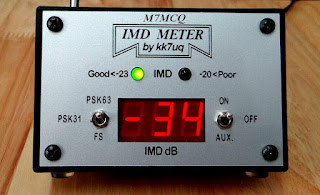
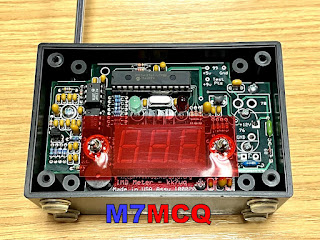
Measuring intermodulation distortion of course, is not an easy thing to do unless you have specialised equipment, so most operators just ‘ wing it ’ by dropping their ALC levels and hoping for the best.  Julian chose to invest in a very neat and affordable meter which gave clear indication of your station's IMD - KK7UQ's IMD METER!

These meters are pretty cheap and can be found on the secondhand market for around £50. I got mine on eBay - a bargain. Of course you don't need one of these, but it's good to know that you're running a clean station and not causing interference to others. That is, after all, part of our licensing conditions.

So the IMD Meter is super simple to install - there are no connections to your computer, radio, or even antenna. You just sit it in the shack, raise its built-in telescopic aerial and away you go!


Julian had this to say about the IMD...

"The IMD Meter is an excellent, reasonably priced shack accessory that does a very important job helping you to operate within your license conditions by occupying the minimum necessary bandwidth for the mode, and it could not be simpler to use. I just wish it could be made compulsory that everyone had one of these meters! "

After setup, any transmissions with unacceptable levels of distortion will result in a warning light, and audible tone and an informative readout on the display. It also has a Field Strength mode, so you can use it to sniff out RF in your shack or anywhere else. Now onto the actual operating procedures...

It's always difficult to go into a new mode of operating when you're brand new to the game. The very last thing I wanted to do (apart from transmit noisy signals) was to interrupt other people, annoy them with my rookie attempts and get flamed!

So I looked around the internet for some tips on how to start. Thankfully, there's some great advice out there for learning both PSK and RTTY.  It seems that PSK can be more of a chat environment, whereas RTTY appears to be made up of brief 599/73 type activity.  I might be wrong there, but that was my initial impression, so I might end up coming back here editing this paragraph, 😂. In any case, I don’t think there’s a great deal of RTTY activity these days.

Anyway, I decided to start with PSK and the first thing to do was find out where the signals are to be found on the bands, so a quick trip to the RSGB BandPlans revealed the correct part of the spectrum to be tuning into for the digibands.

With the correct frequency range tuned in and the IC-7610’s decoder switched on (it’s visible in the Menu once you’re in PSK Mode), I started to watch the messages going backwards and forwards. It all seemed a little confusing at first and I wasn’t sure at which point I would be CQing or responding to a CQ. So I watched for a while and followed other people’s interactions and did my best to learn about the best operating practises in this mode.

So I started with the 20M band because that's where my EFHW antenna is most efficient. Tuning into 14.070.150 brought in a stream of messages between operators and it allowed me to get an idea of how people were using PSK and what sort of exchanges were favoured.

Following particular individuals, it soon became apparent that some operators liked to 'chinwag' just like on SSB, while others were less keen on that and simply wanted a short exchange for the log.

The IMD Meter showed that my transmissions were perfectly clean at -34dB which makes you feel good that you're not splattering the band with distorted signals.

The other thing I'd have to learn about is all the abbreviations! I'm obviously familiar with most, but some I had to look up like KN and OM. My overall lack of knowledge of this mode led me to start off by responding to CQ's rather than me calling CQ. I usually do the same in FT8.

It's been a very enjoyable start to learning to use PSK and (like FT8,etc)  I'm sure it's going to be a regular mode of operation when the bands are quiet on SSB phone.

Common operating frequencies...

Amateur BandUSB Dial Frequency
160 metres

80 metres

40 metres

30 metres

20 metres

17 metres

15 metres

12 metres

10 metres

1838.150 kHz

3580.150 kHz

7040 kHz and up

10142.150 kHz

14070.150 kHz

18100.150 kHz

21080.150 kHz

24920.150 kHz

28120.150 kHz

If you're a newly licensed operator and have never tried PSK, give it a go! It can be fun.

73, Tom, M7MCQ.

Thursday, 2 December 2021

RURAL RADIO SILENCE

PLAYING IN THE TROUGH

In the last 3 months I've felt under a great deal of pressure at work and haven't had a day off (or even an hour) in the last 3 months! At weekends I've just felt too knackered or stressed to go out and relax.

So I eventually managed to get a couple of days off to get my head out of the work-pit. Thursday, Friday, Saturday and Sunday all to myself and considering the weather was unusually bright today, I decided to grab my rucksack and go for a walk in the TROUGH OF BOWLAND which is just under an hour away from my home.


It's a beautiful place which I know very well because I have a holiday home just around the corner from it. Because it's Winter and the days are short, I couldn't go to some of my preferred (higher) locations, so I had to stay relatively low.

If you've never walked around the Forest of Bowland, you really must do something to change that - it's a stunning place, offering something for everyone, including families with kids. Needless to say, it's great for dogs too, but they must be kept on a leash - there's lots of wildlife and livestock around.


After stopping for a hot drink and breakfast sandwich at a well known Chuck Wagon in the Trough, I started my walk and pretty soon I was setting up my station which consisted of the ICOM IC-705 and a SotaBeams EFHW with counterpoise. I also had an Elecraft T1 ATU with me.


By the time I got set up, it was incredibly cold and there was a steady wind that kept the temperature low. Brrrrrrr! Of course, like an idiot, I forgot my gloves, so it was all very uncomfortable.

Switching on the radio warmed my heart though, because the noise level was on the floor. Almost silence!! Spinning the dial found loud, clear signals straight away. They weren't particularly strong, but boy, were they clear. I made SSB contacts all over Europe, Russia, and Canada. I was going to play some FT8 but my fingers were FREEZING! So after a couple of hours I closed shop and headed back home with heated seats on the highest setting 😂

Had a fabulous day and it was much needed!

Thanks for visiting.

73, Tom, M7MCQ.