Thursday, 21 May 2020

NEW VHF/UHF DIGITAL STATION

YAESU FT-991A


JUST MY OPINION! One of the local radio clubs is about to set up a new Fusion Repeater when the lockdown is over, and being just 7 miles away from my QTH I was thinking that this may be my route into C4FM operation using RF instead of my usual access point - an OpenSpot and internet. There's no guarantee of course that I'll be able to reach the repeater, but the fact that I can access other UHF repeaters such as Blackpool, some 26 miles away, gives me hope.

Currently I have an Alinco DR735 2M/70cm radio in the shack and as much as I love this wonderful radio, it does bug me that I can't work sideband. So I figured that now's the time to kill two birds with one stone - get a new radio which does both sideband and Fusion. So I ordered a used Yaesu FT-991A from a big online reseller after checking that the parcel would definitely go out that day and arrive the next morning, Thursday, before 12noon. 

Annoyingly(!) the next day I got a call to say that the radio would  not arrive until Friday. I pointed out that I had specifically checked the delivery date before ordering and was told that I must have spoken to a member of staff who wasn't aware of the delivery schedule. And also, the V2000 antenna I'd ordered which was showing as "in stock" was actually out of stock

I don't mind one bit waiting for something that is scheduled for delivery in 3 days time, 3 weeks time or even 3 months time  IF  I am told that date. But when you've been told NEXT DAY delivery and have PAID for next day delivery (£20 in this case), then I do expect next day delivery. Why can online resellers not get this bit right???

Anyway, it's a shame that I have to pay for the HF portion of the 991A because I won't be using it in the shack (the 7610 is my HF rig), but that's by the by. I'll be using the radio's N connector for 2M/70cm and the SO239 for 6M.


When the Diamond V2000 arrives (found one in stock at ML&S) it will give me all three bands on one antenna which (assuming it works well) is a godsend. In the past I've had to either use my EFHW or erect a separate 6M temporary antenna in the garden.

DIAMOND MX-62 DUPLEXER


The FT-991A reminds me very much of the old FT-897D. I love those radios - they just had a great look about them - a military ruggedness almost. And of course they were a 'shack-in-a-box' with all bands and all modes and 100W HF, 50W VHF, 20W UHF.

The 991A is the modern day equivalent, with 100W HF and 50W on both VHF and UHF. It also adds the increasingly popular C4FM Digital mode. Of course other modes include SSB, CW, AM, FM and RTTY.

Instead of the tiny monochrome screen of the 897, the 991 comes with a beautiful TFT colour touch-screen. It's around 3.5" diagonally which is big enough for all but the most ham-fisted operators (pardon the pun).  The main frequency is displayed clearly and boldly at the top of the screen, with a smaller indication of VFO-B frequency below.


Below that is the S-Meter which doubles up as a secondary meter which can be switched between Power, SWR, ALC, etc by the touch of a button. Speaking of buttons, the display always shows four buttons at the bottom and these can be altered to suit your individual requirements.

In the middle sits a real-time Spectrum Scope and Waterfall which looks pretty cool. It looks fairly 'lo-res' compared to the superb IC-7610, but hey, there's a big difference in price LOL.

The radio has a 32bit DSP system which reportedly works very well - hopefully making those weaker SOTA signals more intelligible (and therefore workable).

There's an inbuilt ATU which will be handy for tuning the 6M part of the V2000 (it's annoyingly tuned around the 52-54MHz mark instead of 50-52MHz). The tuner has 100 memories.


Band selection and Mode selection is made by pressing the relevant button to the right of the screen and then choosing your option by pressing one of the virtual buttons onscreen. Very simple and effective.

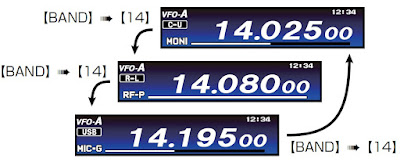
Band-stacking is also provided by adding your three favourite parts of the band and then cycling through them by repeated presses on the relevant frequency. I like this feature and always make sure that the first frequency in stacks is the QRP frequency of each band.


What I don't particularly like is the TX INDICATOR which is over to the right of the main screen. It's a red LED which to me, is not particularly bright. When I'm operating a radio, I tend to always have my eyes on the main screen and when you press the PTT nothing really alters there. It's just a personal preference, but I would always like a big change during transmit - like the screen going predominantly red or something like that. Ah well, that's just me.


One more nice feature (as far as I'm concerned) is the inclusion of the AirBand. I'm not an avid listener, but I often have it on in the background if I'm doing something in the shack other than amateur radio. 

So that's it for now. I'm quite pleased with my choice of radio for this part of the shack and I hope it lives up to my expectations. I'll update in a few weeks.


UPDATE :
The FT-991A has disappointed me somewhat (even though there's a lot about it that I like). The lack of DualBand is a pain in the ass - I can't monitor say 2M & 70cm 😒

I also can't believe the FT-991A's Wires-X limitations 😮

Yaesu's flagship C4FM radio, the FT-991A should be everything you need surely??  Well apparently not, because the FT-991A is not really equipped to be considered as Yaesu's 'flagship' C4FM radio despite its £1300 price tag!

If you want to connect your radio to a PC and use the Wires-X software (which I often do), then you'd better look elsewhere, because the firmware architecture of the FT-991A doesn't really permit this. It's just too old hat. There needs to be a 991B introduced.

The only way that I can use the Wires-X software on my PC is by connecting my Yaesu FT3D to the PC in PDN Access Point mode and then using the 991A to  transmit and receive.

So in that configuration, my expensive handheld Fusion radio is tied up in the shack (literally, by cables connecting it to the computer). And it's not just one cable, it's the SCU-19 and a twin audio cable (collectively called the SCU-39 at the princely sum of £70)!!


CONCLUSION :
I think I'd be better off with an IC-7300 for HF and an FTM300 for C4FM, VHF/UHF.


Tuesday, 12 May 2020

FT3 vs D74

KENWOOD OR YAESU? 

That is the question I see posted so often in forums and groups. Do you go for the Yaesu FT3D or the Kenwood TH-D74? Well I actually chose the D74 and then later added the FT3, so I'm in the fortunate position to be able to compare both of them side by side AND compare DSTAR with FUSION.

Let me say right from the start that this is no technical test and there'll be no oscilloscopes involved, 😂 - it's just plain old amateur me and my very amateur opinions. You will have your opinions and I will respect them, so please respect mine 😉


The D74 is probably the most expensive Amateur HT every made. I fully appreciate that not many people can afford (or even want) to spend £600 (at launch) on a handheld transceiver, but secondhand units are now becoming available for £400+ (usually with valuable accessories), making them a
 very desirable radio.

It's an awesome bit of kit and it just oozes quality! Kenwood's cutting-edge piece of portable technology is the first to incorporate APRS and DSTAR.

In the US markets, the D74 is a tri-bander with 144/220/430MHz coverage, but here in Europe we don't get the 220. It has a wideband, multimode receiver covering 0.1 to 524MHz.


Operating modes include CW, LSB, USB, AM, FM, WFM and DSTAR of course. Being able to listen to HF stations on SIDEBAND is a MASSIVE PLUS to me and I now struggle to take a portable HT out with me that doesn't have this facility. 


Just a couple of months ago I was sat in the lounge playing with the D74 when I heard a station calling on 20M. I had previously been sat in the shack with an expensive base station and an EFHW complaining that the band was dead, and here I was now, sat on the couch with a little hand held and a ferrite rod, picking up a station (IZ6BXV) some 1800km away! I returned to the shack and got the caller in my log. Don't get me wrong, the HF receiver is no TS-990 lol, but if you're out and about on the hillsides, you're going to have some listening fun that wouldn't be available to you if you took the FT3.


The D74  turns out to be a superb Airband Scanner too and is very sensitive. The memory-scan speed is fast enough not to miss any juicy transmissions and the only downside of using the D74 at air shows/ports is that it's an awfully expensive thing to risk dropping/losing when your mind is on so many other things. I suggest you buy a leather case and shoulder-strap! Obviously, the radio allows you to listen to both Civil & Military airband transmissions, AM & HF. How cool is that?


The APRS facility is fully featured - probably the most comprehensive available and the built-in GPS is super fast at locking on to satellites even indoors. The only bug-bear for me is that the GPS icon flashes when it's locked on and is solid when it has not acquired a lock. A bit counter-intuitive!


The radio has built-in Bluetooth and it works pretty well with a variety of devices for TX/RX, but it goes one (or two) steps further by allowing you to Read/Write memories with the FREE Kenwood software MCP-D74 and even for controlling the radio via the FREE Kenwood software ARFC-D74


HDSDR

ARFC-D74 free software

MCP-D74 free software

In fact, you can even use the popular HDSDR software with the D74's IF OUT to get yourself a panadapter and waterfall (albeit a narrower bandwidth than you may be used to). Now that is fantastic if you fancy taking a little radio and laptop/tablet away on holiday for some serious SWLing. 


Both the D74 and the FT3D come with a USB lead but the BIG DIFFERENCE is that the one which comes with the FT3D does not allow you to connect to your PC for running any software other than firmware updating.

In fact, in order to do something as simple as editing your radio memories via a PC, you  have to purchase a £70 lead!!!! That is shocking and Yaesu should hang their heads in shame!


At the end of the day, one of the biggest deciding factors for buying one of these radios is going to be whether you are a DSTAR fan or a C4FM fan. 


I was interested in both modes but having experienced them side by side, I find DSTAR slightly more user-friendly and easier to obtain a connection and maintain it. Also, I find DSTAR audio more pleasant to listen to and more intelligible. In all fairness to the Fusion System though, the audio could be improved if everyone used the Voice Wide mode instead of keep using Narrow 😵

And the digital audio of the D74 is exceptionally good - you just know when someone's using a 74 - it sounds that good. The radio includes an equaliser not only for RX but also for TX. Kenwood have this reputation as the Kings Of Audio and it's well deserved. 


Kenwood TH-D74  &  Yaesu FT3D


On the subject of  audio, let me tell you that there's a world of difference between the D74 and the FT3's speaker. The 74 wins hands down!! I've read a few stories where people actually sent their FT3 back to the store after hearing the audio output and I understand why. 

And even with both radios plugged into their OEM speaker-mics, Kenwood wins again - easily! In addition to sounding better, the Kenwood speaker-mic also has a handy rotary volume control where the Yaesu doesn't. Why use a speaker-mic in the first place if the D74's internal speaker is so good? - because it's good to get some separation between the radio and head/body and it feels so much more natural to operate with a fist mic. Plus, on windy days, you can comfortably hold the speaker-mic up against your ear.


The FT3 is wide and stumpy, and although I don't particularly like the D74's shape and size, it feels better in the hand. The negative thing about Kenwood's handheld is that you're always worried about dropping it because of its value.

The (2.2Ah) batterylife on the Yaesu seems to be significantly better than the (1.8Ah) Kenwood, so I ended up buying a spare battery for the 74 - a negative for the Kenwood. 

This is beginning to sound like I'm an FT3D Basher. I'm not. I paid strong money for this radio and I'm not here to slag it. It's a beautiful radio with a gorgeous, colour touch-screen (although the fact that it's recessed makes some menu options awkward to select) and superb VHF/UHF performance. At the time of writing, it's Yaesu's flagship HT and is the perfect portable for C4FM users. It's also about two thirds of the price of the D74 which is very significant!


But money aside, the D74 is the clear winner as far as I'm concerned. It just does everything so well and so easily. It has so many features and facilities which suit me and of course, it has that HF SSB/CW receiver. The FT3D has much wider RX coverage but it's all above 500MHz where I never venture. I prefer that the D74 actually goes lower down.


The D74 feels great in your hand, looks good, has a high resolution screen, richly featured APRS, fast GPS, superb audio (including adjustable TX/RX filters) and much much more. 

I have no reachable DSTAR/C4FM Repeaters in my area so I am not biased in favour due to accessibility. I actually use an OpenSpot2 for both radios (although I have a DVAP dongle for the Kenwood too).


I think I may sell my FT3D because I just don't use it enough. I LOVE how Kenwood provide everything you need from the get-go including fully functioning cables, drivers and software (memory-management and control). 

Having said that, one of the Radio Clubs I joined has just been granted permission to build a 70cm Fusion Repeater, so I'll wait to see if I'm in the catchment area before selling. If I can join my pals and others easily and without any problems, then hey, it'll be a keeper!


Kenwood D74 Quick Review

Yaesu FT3D Quick Review


The TH-D74 is, in my opinion, the best HT ever built. A true classic! It started to hit the UK stores in 2017 and five years later, no one has surpassed it. Even Icom's very latest HT, the ID-52E lacks the D74's feature set. 

Sadly, the D74's life has ended prematurely due to the fire in Japan's biggest semiconductor factory. For the same reason, Yaesu and Icom were forced to stop making some of their radios too. I believe that the D74 will become a collector's item in the not too distant future - if you own one, look after it!


UPDATE 1 : Since writing this post, my local radio club has erected its C4FM repeater  I will probably keep hold of my FT3D though, because I've got an SCU-39 cable-kit CHEAP so I can connect it to Wires-X on my PC, so the FT3D has won a stay of execution LOL. I also use it at my caravan with the OpenSpot4. 

Since writing this post, the NWFG have expanded C4FM coverage significantly and have encouraged people to use VW which really makes a difference to the audio. I spend much more time on Fusion than I did before and I now have a DSTAR/C4FM 50/50 split in terms of usage.

UPDATE 2 : October 2023 : Kenwood have announced the imminent arrival of the 74's replacement radio, the TH-D75. It looks very similar to the 74 but has some new features. Will I upgrade? No, the 74 will always have a place in my shack.


YAESU FT3D
Key Features...


2m/70cm Dual-Band Digital Handheld Transceiver providing reliable 5W RF power output in a light weight, compact design. Even in its amazingly small size for a full-featured 144/440 MHz HT, enjoy analog FM and digital C4FM voice quality with 700mW of audio power. 

Two independent receivers support true dual-band operation (V+V, U+U, V+U, U+V), plus C4FM digital voice and data with the A and B receivers, C4FM and C4FM standby. The FT3DR has an eye-catching full color high-resolution TFT LCD touch display which highlights the frequencies of both operational bands. With ease of use in mind, three-in-one touch-keys at the bottom of the display access mode change, direct frequency entry and the function menu. 

The high visibility color display enables the advanced features of the new High-Resolution Band Scope. Monitor up to 79 channels centered on the current VFO frequency in real time. Bluetooth is built-in! The FT3DR features voice activated transmission (VOX) to enjoy hands-free operation with the optional Yaesu Bluetooth Headset, model SSM-BT10, which is also equipped with a PTT button for standard operation. 

All of features of System Fusion II are in the FT3DR C4FM Digital HT; Automatic Mode Select (AMS), Digital Group ID (DG-ID) operation, Smart Navigation functions and more...

-Transmit Frequency Range (USA): 144 – 148 MHz, 430 – 450 MHz 
-Wide-range RX coverage with continuous reception from 500 kHz to 999.99 MHz (A Band)/ 108 MHz to 580 MHz (B Band) 
-Simultaneous AM/FM broadcast Reception while monitoring two frequency channels 
-Built-in High-Sensitivity 66 channel GPS receiver and APRS Data modem (1200/9600bps) 
-Built-in On/Off Timer, Automatic Power Off (APO) and Time-out Timer (TOT) 
-2,200mAh High-Capacity Li-ion Battery Pack (SBR-14LI) as standard 
-Individually selectable power levels by band to save battery power; 5W, 2.5W, 1W and 0.3W 
-micro SD Card Slot supports Voice Recording Function; received and transmitted audio saved as files 
-WiRES-X Portable Digital Node Function support 
-CAM (Club Channel Activity Monitor) Function 
-IPX5 Rating Water Protection 
-Dimensions (WHD): 2.44 x 3.94 x 1.28 inches without knobs and antenna 
-Weight: 9.95 oz. (282g) with battery pack


KENWOOD TH-D74
Key Features...

Compatible with the APRS communication protocol, which allows real-time two-way data transmission by using packet communications. This stand-alone device provides enjoyment of communications that make use of a variety of features, including sharing of local and GPS positional information and message exchange.

Compatible with D-STAR, the amateur radio communications network that has both voice and data modes. Both local and international communications are possible through diverse operations including simplex communications, single repeater relay communications and inter-repeater gateway communications.

* Wideband and multimode reception.
* Built-in IF filter for comfortable reception
* IF output mode
* High-performance DSP voice processing.
* Tough weatherproofing meeting IP54/55 standards
* Easily understandable pop-up screens
* Built-in GPS

Receiver Sensitivity - Main & Sub Bands
Amateur Band
FM 12 dB SINAD
FM / NFM 144 MHz Band-A: 0.18 / 0.22 uV
FM / NFM 144 MHz Band-B: 0.19 / 0.24 uV
FM / NFM 430 MHz Band-A: 0.18 / 0.22 uV
FM / NFM 430 MHz Band-A: 0.20 / 0.25 uV
DV PN9 / GMSK 4.8 kbps, BER 1% 144 MHz Band-A: 0.20 uV / 0.22 uV
DV PN9 / GMSK 4.8 kbps, BER 1% 430 MHz Band-B: 0.22 uV / 0.24 uV
SSB 10 dB S/N Band-A: 0.16 uV
AM 10 dB S/N Band-B: 0.50 uV

RECEIVER RANGE
RX 0.1 - 524 MHz 

DUAL RECEIVE
VHFxUHF, VHFxVHF or UHFxUHF

TRANSMIT RANGE
144-146MHz, 430-440MHz

TRANSMIT POWER
5W - 2W - 0.5W - 0.05W

MODES
TX: FM, NFM, DV
RX: FM, NFM, WFM, AM, SSB, CW

MEMORY CHANNELS
1,000

EQUALISER
TX - 4 Bands
RX - 5 Bands

AUDIO RECORDER
Yes - to internal SD Card

DIMENSIONS
W x H x D
with KNB-75L: 56.0 x 119.8 x 33.9 mm
with KNB-74L: 56.0 x 119.8 x 29.3 mm
with KBP-9: 56.0 x 119.8 x 36.0 mm
- Projections not included -

WEIGHT
with KNB-75L: 345 g (w/ antenna, belt clip)
with KNB-74L: 315 g (w/ antenna, belt clip)
with KBP-9: 360 g (w/ antenna, belt clip, AAAx6 battery)

INPUT VOLTAGE
DC-IN: DC 11.0 - 15.9 V (STD: DC 13.8V)
BATT: DC 6.0 - 9.6 V (STD: DC 7.4V)

WATERPROOFING
Yes - IP54/55


Thanks for the visit! Please feel free to comment on your opinion of the FT3D or TH-D74


Sunday, 10 May 2020

GB0VED - SPECIAL EVENT

VICTORY IN EUROPE

West Manchester Radio Club obtained the special callsign of GB0VED to use over the weekend of 8-10th May 2020 to mark the 75th anniversary of VE DAY in 1945.

Many of the Club Members devoted time to working the callsign from their home QTH and (with the generous supervision of a fully licensed member), I was able to work the 30M band on FT8.

I managed to get 150 unique callsigns in the log and I worked 33 different countries! And I'd like to thank each and every one of them for helping me to achieve this.


One thing which bugged me a bit during the course of the FT8 operation was the number of operators who can't be bothered to fill in their Locator Square or even their Name!

This meant that I had to go looking on their QRZ page to retrieve the information and enter it into the WSJT-X log. Well, I guess I didn't have to but I hate leaving bits of information blank in logs.


Apart from that, I enjoyed myself and was pleased to do my bit to raise the profile of the Club - not to mention commemorate a very important date in history.

73, M7MCQ.


Saturday, 2 May 2020

nanoVNA-F

VECTOR NETWORK ANALYSER


Having recently borrowed a friend's antenna analyser, I was interested in buying one for my shack, but the cost of the MFJ's was approaching £400 which seemed a bit excessive considering the amount of use such a device would have, so I looked for something else.

I knew about the nanoVNA because some friends had bought them and they looked great, but the screen seemed a little small, but then I noticed that there was a new "F" model which had a 4.3" screen and it came with a steel case!


Here's a video of the device just as it arrived through the letterbox..


CLICK TO PLAY VIDEO

I was very impressed with the package initially but then realised that the outer case didn't offer that much protection after all - well it certainly wouldn't withstand much pressure and the screen was very close to the flexible plastic case.

Luckily, I had a foam-filled Pelican Case which came with my used LDG-817, so I thought I'd see if it fit inside. It did!!


The screen would normally be placed face-down

Thankfully, I could retain the use of the protective foam which came with the nanoVNA and it left me with space to store additional adapters and cables.

With that little job sorted, I ran the Calibration procedure and saved it. I then connected my EFHV to see how it looked across the bands. Here are the results.....


The nanoVNA-F shows that the EFHW from www.wirelessantennas.co.uk is a great bit of kit. It does superbly on Top-Band, something which I've never been able to use before. At the other end of the scale (6M SSB) it fairs less well at an SWR of 2.35 but still well within the reach of my radio's ATU.

Operating the VNA-F is pretty straightforward even for a luddite like myself. Once you're in SWR Mode, you simply enter a Stop and Start frequency range such as 144MHz to 146MHz and it's done!

Rather than do a sweep across a few bands, I preferred to sweep individual bands. A little more work entering the freq-range each time, but a nice way to see any peaks and troughs in detail.

This is day one and so I'll have more play-time with it later. For one, it needs the FirmWare updating but that needs care taking due to the number of people who are making these VNA's and the minor differences between them - you could end up updating with a bin-file meant for a slightly different version.


So how does this compare with the MFJ?? Well I must admit, I do like the clunkiness of the old 259/269 and I like the simplicity of twiddling knobs and reading a simple LCD display.

But the nanoVNA-F is much cheaper and it still comes with a very nice steel case. You can do allsorts of exrta stuff with a VNA and of course it's upgradable with new firmware. 

And then there's all the stuff you can do with the computer software that's available out there!

So yes, it's a big thumbs up from me so far. Let's just hope I don't turn it into a paperweight when I do the FW update :-) 


73, Tom, M7MCQ


UPDATE : 3 |May|2020

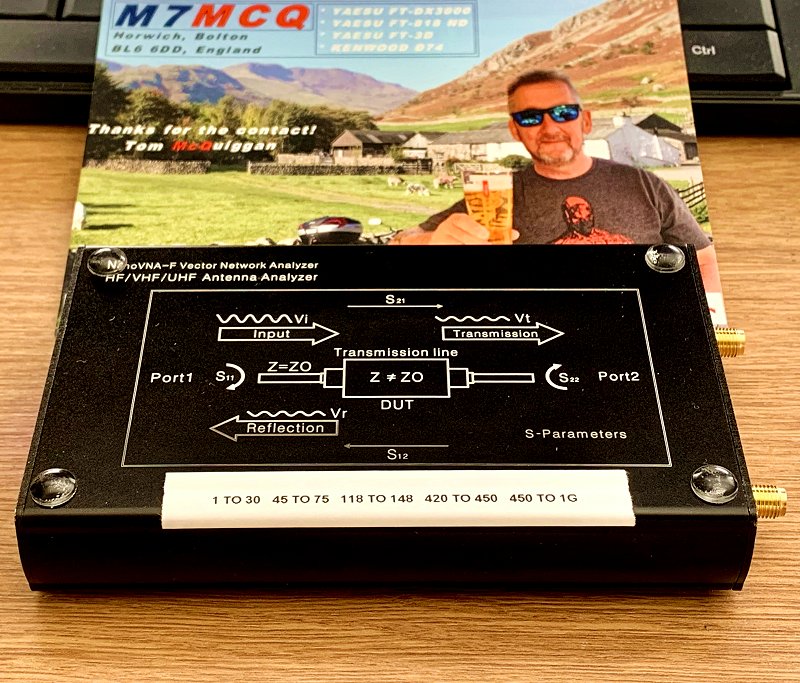
I did the update, it was a piece of cake. Now works up to 1.5GHz and has some other features and changes. I also put some small rubber feet on each side of the vna to prevent the surfaces being scratched when laid down.

FirmWare Update 0.1.4


I also ran calibrations on five frequency ranges which are saved to memory....

Mem-0   1~30MHz
Mem-1   45~75MHz
Mem-2   118~148MHz
Mem-3   420~450MHz
Mem-4   450~1.5GHz

In addition to the usual OPEN, SHORT, LOAD and THRU, I did the ISOLN by connecting two 50 Ohm loads. Not sure if it's completely necessary, but hey-ho.

Thanks for visiting - please take a minute to leave a comment below 

73, Tom, M7MCQ.

Monday, 27 April 2020

AOR ABF128 FILTER

FILTERING FOR AIRBAND


As you can see above, I live very close to a major transmitter (Winter Hill, 1500ft ASL) which pumps out around 500kW of signals to feed TV and Radio to the North West viewers and listeners. Generally speaking, I don't suffer massively from the close proximity to Winter Hill, but nonetheless, it does have an impact.


And listening to anything on a wideband receiver adds to any problems, so when I saw the ABF128 AirBand Filter from AOR, I thought it might be worth a punt. I bought the BNC version and now I wish I'd gone for the SMA model instead.

At £55, it's not cheap, but then again, many other filters for your radios are even more expensive. Rather than me trying to explain the technicalities of the device, I'll reprint what I found on Waters & Stanton's website where I bought it from and then I'll post a little video so that you can see and hear the difference .


-------------

The AOR ABF128 is a receive bandpass filter especially designed for serious VHF airband listeners. This filter improves the strong signal handling characteristics of scanners and wideband receivers for VHF commercial Airband listening. The ABF128 is suitable for connection to most scanners and wideband receivers on the market, regardless of brand. The addition of this filter to the antenna's signal path provides additional selectivity which enables the receiver's circuitry to better cope with strong interfering signals that can leak into the 108-136 MHz VHF air band.

The ABF128 provides additional selectivity to any receiver's front-end by reducing a multitude of unwanted strong signals from reaching and saturating the receiver's first mixer stage. This results is less interference and improved reception. The ABF125 offers excellent out-of-band attenuation typically of 25 dB from 0.3 to 75 MHz and 20 dB from 190 to 400 MHz. This makes the ABF128 suitable for connection to both external antennas and for connection directly under the whip aerial of a hand-held receiver. A BNC socket (female) is fitted to the top of the ABF128 and a BNC plug (male) to the other making connection to an aerial easy and straight forward.

The ABF128 is not an amplifier so will not boost signals, however the additional selectivity offered can significantly improve reception in many situations by removing unwanted strong signals which may overload the receiver and reduce it's effectiveness. When any connection is fitted to the aerial signal path some reduction of signal is resulted (attenuation) however the ABF128 in band attenuation level is very small due to the excellent in band V.S.W.R. of 2:1 resulting in a loss of only about 4 dB.
-------------

I made this recording using the Yaesu FT3D and I wish I'd used my Kenwood TH-D74 instead because the D74 has infinitely better sounding audio! Ah well.
I tuned into Manchester's (EGCC) ATIS frequency of 128.175MHz. The airport is 20 miles away from me and is not a particularly strong signal, so it's perfect for this test.

NO CHANGES WERE MADE
TO THE RECEIVER
BETWEEN RECORDINGS
Click To Watch Video

So there you have it - much clearer signal with the ABF128 fitted. The filter does a fabulous job and I'm now much more inclined to invest in similar filters - say for 2M portable work, where you can come across all sorts of noise problems when out and about.
Oh, nearly forgot! If you're scanning banks which contain frequencies outside the AirBand, you're obviously going to struggle to hear them while the filter is attached, so be sure to have a dedicated VHF bank setup for your airband listening.

Thanks for visiting.
73, Tom, M7MCQ.