Tuesday, 10 March 2020

UNIDEN UBC125XLT

AIRBAND SCANNER


Last year during a day-trip to Manchester Airport Visitor Centre, I nearly lost my Kenwood D74 and I vowed not to take it to places like that again! If you're out "playing radio", then you're very focused on what you're doing and you're using the radio all the time, but when it's a family day and you're focus is on aircraft, cakes, ice-cream and beer, then it's very easy to forget you've left your HT sat on a bench. So I decided to buy an AirBand Scanner and leave my valuables at home!

I thought about looking for an old favourite on eBay - the Yupiteru 7100 but damn, they still demand strong money and so too do the Alinco DX-2000's, so I dropped that idea and turned to the cheap and cheerful Uniden UBC-125XLT.


The 125 is a neat, compact and light receiver which covers 25-960MHz (with gaps) and has 500 memories grouped into 10 Banks of 50 channels. The channels can be given AlphaTags which is a nice feature. They typically sell for £120-£140 but I got mine second hand in mint condition, boxed with charger, standard antenna and a "Super Gainer" antenna.  The seller was advertising it on FaceBook's MarketPlace and I thought I'd try bidding him in the nuts, telling him that I was local and able to collect immediately with cash - he agreed :-) 

The radio is easy to program thanks to some free software that's available online, so it wasn't long before I'd got all my local frequencies into Bank 1, ready to go. I noticed that the previous owner had filled Banks 7,8, 9 and 10 with all the UK Military aviation frequencies, so I left them there.


Two 2300mAh rechargeables provide the power and regular AA's can be put in if required. I've got some Eneloop Pro 2500mAh batteries that I'll probably use. The radio can also work from mains power via the provided power-supply/charger unit. Plugging it into my Discone (outside on the roof) I immediately started to pick up all the Manchester traffic, plus the odd contact from the Isle Of Man. Sensitivity seems pretty good.

Scanning speed is pretty good and even when scanning my regulars in Bank 1, I can include all the Military channels without unduly slowing down the process. So overall I'm very happy with this purchase. The radios are already cheap (and good value) at £120, so my second-hand purchase was especially good.


UPDATE :  I only really wanted the scanner for AirBand, so I ended up selling this and bought the magnificent YAESU FTA-550L.


UNIDEN SPECS:


Frequency coverage from  25-88MHz, 108-174MHz, 225-512MHz and 806-960MHz with 5/6.25/8.33/10/12.5KHz frequency steps.
Includes Civil & Military Aircraft Band, VHF/UHF Amateur Bands, CTCSS/DCS Squelch Modes and has Alpha Tagging features.
Main features include:
  • 500 memory programmable channels in 10 banks
  • Alpha Tagging - each channel can be assigned an Alpha Tag for easy identification
  • Includes civilian aircraft and military aircraft frequency bands
  • Close call RF capture with Do-Not-Disturb
  • Close call temporary store
  • CTCSS and DCS squelch modes
  • Direct access
  • Lock-out function
  •  Automatic close call detection with tune into nearby transmission
  • Triple-conversion circuitry
  • Text tagging
  • Priority scan with Do-Not-Disturb and priority plus scan
  • Scan/Search Delay/Resume function
  • Custom/Quick/Turbo Search option
  • Search lockouts
  • Modulation
  • Display backlight
  • Signal strength meter
  • Memory backup
  • Key confirmation tones
  • Battery save and low battery alert
  • PC programmable
  • USB interface for connection to PC and for battery charging


Friday, 28 February 2020

ANGLEZARKE

SATURDAY 29th FEB - FIELD DAY

Come hell or high water, on Saturday I'll be over at Anglezarke near Chorley playing radio. The forecast isn't too good on account of "Storm Jorge", but if I keep abandoning trips out because of bad forecasts, I'll be 101 yrs old before the next outing.

Anglezarke is a local beauty spot about 5 miles from my home and is very easy to reach by car, with good parking for about 10 cars. It has a fabulous take-off out to the West, so it's good for Transatlantic DX and it's also good for South-West towards Wales.

The great thing about Anglezarke is that your spouse can also tag along and enjoy a bit of a picnic, beautiful views and maybe a couple of hours reading - all without having to climb a single hillside :-)

Once you're set up, you have open space and the Irish Sea in front of you but behind are the hills of the West Pennines and Winter Hill. The height of this spot is about 150M ASL as opposed to Winter Hill's 450M, so it's quite a bit lower down, but it's a lovely spot to work from. I'll be working mainly on 20M & 40M QRP frequencies 7.090MHz & 14.285MHz unless they're occupied by contesters! I will also try to get some 2M contacts into Wales and the Isle of Man if possible.

Listen out for me - and please - confirm QSO's. 
I add every contact to my QRZ Log and I send
every contact a card through eQSL.

YAESU FT-818ND
LDG Z-817 ATU
SOTABEAMS BANDHOPPER II 20/40
SOTABEAMS 7000HDS MAST

SOTABEAMS SPEECH COMPRESSOR
DIAMOND X-30 VHF/UHF
FLIGHTMAX ZIPPY 8Ah LifePO


=============================

UPDATE!

I arrived at Anglezarke around 10:15am and started to setup the SotaBeams 20/40 Linked Dipole with the fibreglass mast from the same company. I absolutely love this combo - the antenna just works everytime and it's very simple to erect and dismantle. Being resonant, a tuner is not required, but I always use my little LDG Z-817 ATU to get the perfect match across the bands. The telescopic mast is also a great accessory and saves you looking for trees!

The grass was MUCH wetter than I anticipated and within seconds I was covered in mud LOL. Mind you, it has been raining for the last two months!

Once the wire was erected, I connected the 6W FT-818ND to it from within the car (it was freezing cold) and tuned to 20M. The floor noise was incredibly low which was fantastic BUT the band was riddled with contesters - I struggled to find a free frequency to call CQ.

In the end, I gave up looking for a chinwag and decided to respond to some of the contesters. There were simply too many people shouting out and many of them were not following any sort of code of conduct! Eventually though, I managed to find some breaks and got through.

I feel that the SotaBeams Speech Compressor made a real difference. When you're struggling to be heard at QRP levels, this handy little device can make the difference between getting a contact in the log and getting hoarse, lol. If you've got an 817, 818, 857 or 897 I'd strongly recommend buying one of these - they're incredibly good value for money.

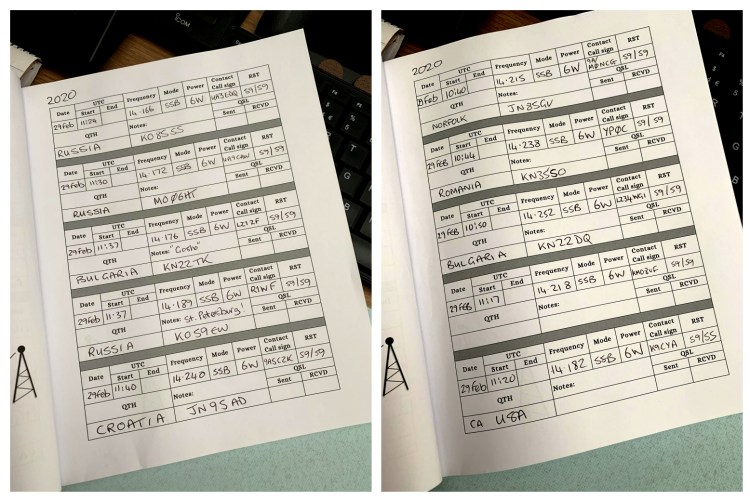
I started off at 10:40am with a guy from Norfolk (South East England) and then proceeded to swap Grid Locators with operators in Russia, USA (California!), Bulgaria, Romania and Croatia. Most of my contacts were Russian.

After a couple of hours I switched to 2M but then noticed the weather pulling in fast and made the wise decision to pull the antenna down. Minutes later it was lashing down with sleety rain. So it was only a short day out. Still, it was good fun while it lasted. Shame the competition flooded the bands and prevented normal chit-chat. Martin (K2TRD) came onto a contesting frequency but I had no chance to speak with him because it wasn't my frequency.

Back home now, warm and dry. Ready to go into the shack for the rest of the day :-)

View from the truck - nice and warm :-)

A couple of pages from the log

Saturday, 22 February 2020

MY FIRST QSL CARD

IT'S BEEN A YEAR, BUT...

After a year as a licensed Amateur Radio operator, I received my very first postal QSL CARD today and I don't mind admitting, I'm well pleased! 😀

K3LR

Friday, 21 February 2020

TECSUN PL-680 QUICK REVIEW

COMPACT WONDER

I got this wonderful radio as a birthday gift a couple of years ago from my wife (after pestering her) and I've loved it ever since. It reminds me in some way of the FT-818 - it's not the best in the world, but you just bond with it. 

I liked how it looked from the get-go and I liked how it came as a complete kit with leather carry case, wire antenna, telescopic and even an earplug. The whole tidy package cost me £149 from Martin Lynch & Sons. The radio oozes quality and you'll never feel like you've bought something cheap. 


Apart from covering the ShortWave band, MediumWave and LongWave, the radio also receives FM VHF and even the AirBand (something that I often monitor in the background). Additionally it has SSB and automatically switches between USB & LSB.

The radio's sensitivity is extremely good for a radio at this price point and the only criticism I can aim at it is that it can, at certain frequencies, be TOO sensitive when connected to an outdoor antenna - it gets overloaded. But that brings me to the main feature of this radio - it works superbly on its telescopic antenna - even in an electrically noisy household.


Broadcast radio from stations on the other side of the world are pulled in easily and with very little fading. The AGC seems a little eager when you first tune into a signal, but it very quickly stablises.  The SSB functions really well and there's been many a time when I've comfortably listened to the HAM bands on the telescopic antenna, indoors. Outdoors with the supplied wire connected, it's amazingly good!


FM VHF is also good but not perfect as far as I'm concerned. The quality of the audio is just missing something, but I'm always quite critical when listening to FM. Airband on the other hand is spot on! The radio isn't too good on batteries, but then I've only used rechargeables - it's probably much better on quality Lithium AA's (4). 

The PL-680 has two very nifty stands - a small pull-out stand at the bottom to stop it being easily tipped over, and a larger one on the back which allows you to have the radio on a desktop at a 45 degree incline. Nice!

2000 Memories make it easy to store your frequencies allowing good spacing. The display is large enough to read easily and has a good signal meter. There's a built-in clock with two timers and a SLEEP function (which drives me potty because I keep inadvertently switching it on). There's also a nice LOCK feature to keep it from being accidentally activated in your rucksack.

So there you have it. A fabulous little radio for around the house or in your rucksack when you're out having a picnic. To finish off, I thought I show how it performs with its telescopic antenna against a £3000 radio connected to a 52ft G5RV dipole.

M7MCQ

I'm no video-editor, lol.


FEATURES

FM-stereo/MW/LW/SW/SW SSB/AIR band with high sensitivity,
selectivity and user-friendliness
FM band coverage: 76 – 108 MHz
Shortware Single Side Band (SSB) with upper sideband (USB)
and lower sideband (LSB)
Equipped with Synchronous Detector and Dual Conversion
technology for MW band; this greatly enhances the receiver’s
sensitivity, selectivity, image rejection, and interference from
adjacent stations
FM/SW external antenna jack sensitivity selector: DX/Normal/
Local antenna gain
Multiple tuning methods
Store up to 2000 stations (manually, semi-automatic and fully
automatic)
Equipped with a high-sensitivity acoustic speaker with treble/bass
tone control switch (FM-stereo via earphone)
Auto Alarm-Off Timer: when the alarm goes off, the preset radio
station will play for 1-90 minutes
Sleep timer (1-120 minutes) to turn off the radio automatically
User-friendly interface
Built-in charging function
Powered by 4 x AA (R6) size batteries, DC 6V
Luxury carrying case
Dimensions: 188 x 116 x 31 mm


It's nice to take into work with you for lunch-break listening :-)


Thanks for visiting - please take a minute to leave a comment below 

73, Tom, M7MCQ.

OV1CDX

I only just realised that I never put a QSL Card on here from Frank, OV1CDX. That's because I never received one, lol. I first worked Frank in August 2019 when I was sat in my garden with the Yaesu FT-818 and tried connecting the little Elecraft AX-1 telecopic antenna to the BNC connector.

To my utter amazement, I got a contact straight away, deep into Denmark on just 2.5W and had a good chat with Frank. I didn't know at that time that Frank had become blind and didn't get involved with Eqsl but was willing to exchange paper QSL cards (which I didn't do at the time).

So anyway, I'm going to send one off in the post to Frank and thought I'd include his card here.


OV1CDX

Monday, 17 February 2020

SHACK PIC - IC-7610


I spent my weekend putting the shack back together, having removed the ELAD, replacing it with the ICOM. The shack was a mess on Saturday morning and to be honest, I wasn't really in the mood for it, but after a lengthy amount of procrastinating, I got off my backside and started the work.

First decision was what to put where! In the end, I decided that the IC-7100 was not going to be installed - I was going to leave it on the top-shelf disconnected so that I could just grab it and throw it in the truck for mobile/portable work. That decision made the shack-rebuild a little easier.

I had originally thought of installing it permanently in the truck but I just can't be bothered - after all, I don't do much radio work while travelling - in fact, I don't do much travelling at all unless I'm specifically travelling somewhere to play radio from the side of the truck.

Joining the 7100 on the "storage" shelf is the Yaesu FT-818 with its matching tuner. I love this little rig and will never, ever sell it - not even if I bought a 705. It's just an absolute gem!

In the background you can see the lovely TECSUN PL-680, another fine little toy. I like to take this with me if I can't play TX for whatever reason. It's a fabulous portable, with full HF coverage, (SSB), Broadcast and AirBand.

I then found a spot for the HandHelds and their chargers. Both of these run from HotSpots because there are no Repeaters nearby. The Kenwood D74 uses a DVAP Dongle and the Yaeasu FT3D uses an OpenSpot2. When I find time, I'm gonna run both radios from the OpenSpot (more than likely).

So, back to the main event - the 7610. Unlike the DX3000, there isn't a simple "RF OUT" to feed my SDRPLAY RSP1A.   I thought that I'd be able to connect to the RX OUT BNC connector, but using that results in the Main VFO going quiet. The only way around it is to connect a loop through to the RX IN BNC using a splitter like the MINI CIRCUITS ZSC -2-2+ which is quite expensive and not easy to get here in the UK.

So I decided to share the G5RV antenna between the RSP1A and IC-7610 using an MFJ-1708B which I already had in the shack. You can rely on the MFJ's "RF Sensing" or you can feed it a line from your radio's PTT Out. I chose the latter.

So that meant that I had to run coax cables from the G5RV Switch, to the MFJ-1708B, then to the MFJ-993B ATU, then to the NISSEI DG-503 Meter and finally to the IC-7610. What a pain!

With the horrible bit out of the way, I could focus on connecting the other cables to the 7610 and pushing the radio into its resting place on my worktop, directly beneath the bottom shelf. Perfect fit!! In front of it I placed a Logitech K400 Wireless Keyboard with TrackPad. This worked perfectly as soon as I pushed the little wireless dongle into the 7610. Excellent!

With everything connected, I fired up the radio, pressed the TUNE button and the MFJ-993B almost instantly provided a perfect match and an SWR of 1.1:1 on 20M. I tuned around and found OE17AAW, a special callsign for the 17th Antarctic Activity Week 2020. I made contact and enjoyed a very comfortable QSO with a 59 report each way.

Then I spoke with Fred in Austria (OE8NDR) and couldn't believe how good the signal was. Fred told me that I was a beautiful signal back to him and thankfully, I recorded it (below). What I didn't realise at the time, was that my Mic Gain (the physical adjuster underneath the SM-50) was WAY too high!

> VIDEO <


Unfortunately, Fred had some operating difficulties and went off-air, so I carried on and worked CT1BOL in Portugal (57/57) and DJ0AJ in Germany (59/59) on 40M before switching to 80M to have my first contact on that band with G0ORG in England (58/57).


So I was quite happy with that start, but I now needed to get the rig connected to the PC. I thought it was going well - I installed the Silicon Labs USB Drivers and installed RS-BA1 software (V2). The radio connected to the software no problem and all the 'virtual' knobs and dials activated the same on the rig.

BUT the audio and mic was still in the hands of the radio and NOT the computer. It's obviously some settings in the radio's menus, but I just ran out of time and didn't manage to fix it yet. I also need to get HDSDR working with the USB-3 cable.

Something for another weekend :-) 


.


Friday, 14 February 2020

NICE TO HEAR FROM YOU!

IT'S ALWAYS NICE WHEN.....

...someone reaches out to say hi. Apart from the on-air contacts one makes in HAM radio, it's always nice to receive an email now and again from someone across the globe to say that they've enjoyed reading my odd ramblings 😃😃😃


….started with reading about your cheat sheet (AZ silent key originated, God bless him) and have been reading your blog like crazy..
It’s now 10:30 at night here in Miami Florida and I have been reading your blog since 7pm LOL.  Thanks for all the info- especially about batteries, I don’t know enough but your blog has helped me out.  THANKS for all your work Tom its guys like you in this hobby that make it great!!!!!!!!!!!

73,  Todd    K9TWM