Monday, 28 October 2024

TECSUN PL990X 2024

This is a quick look at the Tecsun PL990X Triple Conversion, Multiband SW portable radio. It's the sort of radio that I tend to use with a copy of WRTH to hand and a couple of hours leisure time. I've always found shortwave listening fascinating and if you're reading this post, then you no doubt understand why.

I already tried a Tecsun PL680 and an S2000 and was happy with both of them, except for the size - one was too big and one was too small. The S2000 is a bit of a whopper and reminds me of the old ghetto-blasters that you used to see in the 80's and 90's. They have a real presence and all that real estate means that you can get some great speaker units inside the case, so for taking out in the garden at home or sat at a picnic table, you can enjoy some quality listening time. But they're pretty useless for lugging around with you away from home.

The PL680 is much smaller and it's a good radio, but the fact is, I fancied something with a bigger speaker - nothing huge, but something which had clearly better audio and give me a more comfortable listening experience - especially on FM and SSB.

The new 501X from Tecsun is bigger than the 680, but it's a step too far in terms of size and price, so that was out of the question. Somewhere in-between is the PL990X and that's the one I decided to buy.


The 990X is the replacement for the well established (and well liked) PL880. I was actually considering a used 880 but I always feel drawn towards the latest designs which usually have more features and have the bugs of the previous model ironed out.

Needless to say, I did not want to pay the full retail price of the radio, so I had to be patient and use my usual techniques to find a bargain. In the meantime, I advertised my PL680 and got the most I could for it using a great advert. In the end, it cost me £85 to swap.

When the PL990X arrived in the post, the opening of the package was a very pleasing experience - the presentation of the product is first class as usual. The radio comes in an attractive box and contains a nice faux leather case (as did the PL680) and a useful retractable wire antenna. There was also the world call-sign map and fold-out guide. It's a really nice little package and you get the feeling that Tecsun haven't skimped on anything.


The radio is powered by a (supplied) single 18650 3.7V Lithium Ion rechargeable battery which is unbranded, but lasts a decent amount of time and the battery-indicator seems to be usefully accurate. I already own some high quality, high capacity 18650 batteries, so I'll switch to them to improve battery-life further still.
 
 
Handling the PL990X for the first time gave me the impression that it's quite a beefy radio, but it's only because I'm so used to handling the smaller 680. After a while, I was happy that it was 'just right' (sounds like the Three Bears story) and this would definitely be my go to radio for general SW listening.

The quality of build is typically 'Tecsun'. I really do favour this brand and have never been disappointed with their products. The plastics and general fit and finish has always been of a good standard and the controls always seem to feel smooth and yet rugged - sometimes more so than on some other more expensive radios from the big name manufacturers!
 

The antenna feels smooth and well made, but I really do wish that manufacturers would consider fitting a BNC connector to their larger radios - that way we could quickly and easily try out different length telescopics. Speaking of antennas, they include a wire antenna on a retractable spool and whenever you're using an external antenna, you get the (important) option of being able to bypass the internal antennas (ferrite and telescopic) by flicking a switch on the front fascia. Another switch below that, adjusts the front-end gain.

One of the best things about the PL880 when it was introduced back in 2013 was the radio's audio quality and I'm pleased to say that its successor has carried that forward. The sound from the single speaker is really pretty good at normal volume levels. 

Broadcast stations on FM sound fabulous and connecting a decent pair of stereo headphones makes it an even better experience. SSB signals sound great too. Like other compact radios, things can head South if you crank up the volume too far, but in the main, it's very pleasing. Some claim that the 880 has a slightly better sounding speaker and that might well be true, but the fact is, it's discontinued model and the newer features and improvements of the 990 more than compensate.

Unlike the PL680 the 990 has no AirBand coverage, which is a great pity. To be fair, I tend to use dedicated AirBand radios with fast scanning abilities but it's always nice to have the option of tuning to a single frequency such as your local Tower and listen in while doing something else.

The 990 benefits from having switchable LSB/USB and I have to say that the audio is far better than on the PL680. I was particularly impressed by this and was reassured that I'd made the right decision upgrading. Another big difference between my 680 and the 990 is how the 680 is very sensitive to touch - having your hand too close to it altered the signal strength, which was annoying. Thankfully, the 990 is fine when being handled.

Synchronous Detection is available and I found that it works fairly well but does introduce some unwanted filtering of the audio on certain frequencies. From what I've read though, this is infinitely better than the 880 (so the 880 must be real bad).

When listening to the ham bands on SSB (something I do a lot), the AGC seems a little slow to react, but I have to remember that I'm subconsciously comparing it to my (costly) ham radios, which is kinda unfair. I guess I'm being a little picky about it.


Tuning around on the 990 is a very pleasant experience. I love the knurled tuning dial and the equally useful fine-tuning dial. On the top of the dials there's a friction pad to make it easier to turn them with your fingertip. Direct-Input of frequencies is simple, making well known stations easy to tune into.  Needless to say, the radio has a massive memory bank with useful 'Pages' for grouping. With the rear stand flipped out, this radio is supremely comfortable to use as a desktop radio.

Using the built-in telescopic antenna, the sensitivity of the radio is really quite good and I did a few side-by-side comparisons with other radios including my Belka DX (a miniature marvel which positively shines on its (BNC) telescopic) and my IC-705. They compared favourably and the same could be said when connecting an outdoor antenna. 

With the 990 connected to an outdoor EFHW, stations from much further afield could be pulled in, but it's important (IMHO) to use a coupler or manual atu in order to get the best out of the antenna. You don't have to buy something expensive - you can use something cheap from a radio-rally or buy a Kanga kit or maybe use a ZM2 if you have one. But use something!


Other features of the PL990X include an SDCARD slot which can be used to store MP3s for replay through the radio's speaker. There's even a useful bank of control buttons for Play, Pause, Stop, etc. Sadly, you cannot use the card for recording signals from the radio (probably due to some copyright laws). Initially, I didn’t think I’d use the MP3 player much, but I actually use it quite often and I love how you can use the Main Dial to move through tracks and the sub dial to move through albums.

Another useful feature is the built-in Bluetooth. This allows you to connect the radio wirelessly to something like your iPhone which is great if you want to play music, podcasts, etc.

On the left side of the radio there are sockets for external antenna, line-out, headphones and a USB port for charging (charger is included). The USB port can also be connected to a PC to play computer audio, but I can't imagine many people will. On the other side is a slider to alter the audio tone. On top of the radio is the option to put the radio in snooze-mode, adjust the display or lock the radio.

CONCLUSION. This brief look at the PL990X, leaves me thinking that it's a real nice bit of kit which works extremely well, is fully featured and has a lovely sound in all modes of operation. Even CW sounds nice and crisp with the 500Hz filter engaged.

Guzheng/Guqin
There’s something quite magical
about sitting on the sofa, radio in hand, tuning through the bands and virtually travelling across the globe, listening to different music, languages and viewpoints. I can never quite explain to people why I’m able to enjoy listening to some pretty esoteric music, such as a Guzheng player in a studio 6,000 miles away! I think it’s something to do with my experiences as a youngster with my little 6-Transistor radio. 

It's a nicely sized package (as the actress said to the bishop) and is super easy to use on a desktop or in your hands. I’m absolutely over the moon with this radio ands would strongly recommend it. The biggest drawback is the (UK) price of £269 at the time of writing. I think it cost far less at the time of launch, but prices of electronic goods have rocketed over the last couple of years. If you're willing to chance purchasing directly from a China based store, then you can drop that price significantly. Or alternatively, buy second-hand.

Features of Tecsun PL-990x radio:

  • FM reception range 64-108MHz, suitable for global FM broadcast reception.
  • Single sideband (SSB) 10Hz minimum step, independent selection of upper sideband (USB) and lower sideband (LSB).
  • Synchronous detection range +/- 1kHz
  • Arrangement for connection of an external antenna for SW reception
  • External antenna input for all bands
  • Local, Middle and DX input selector
  • Independent fast and slow dual tuning structure
  • Seven methods of channel selection: automatic search and store (ATS), manual search of pre-stored stations (VM), manual search of station frequency (VF), direct entry of frequency numbers, direct entry of station address numbers pre-stored stations, automatic navigation of radio frequencies and automatic frequency display of pre-stored stations
  • Storing up to 3150 radio frequencies in 25 memory pages
  • Ability to play SD card, supporting 16bit/44.1KHz WAV, FLAC, APE, WMA and MP3 format audio files
  • Class AB power amplifier and super dynamic full-range speaker
  • Headphone output, suitable for stereo headphones below 300 ohms
  • Audio output, for external amplifier or recorder
  • With programmed switch-on and automatic switch-off function
  • Powered by 18650 lithium battery, with USB smart charging function

Specifications of Tecsun PL-990x radio:

  • Longwave (LW) 100-519kHz; 9 kHz steps, 1 kHz fine tuning steps
  • Medium Wave (MW): 520-1710kHz; 10 kHz increments, 1 kHz fine-tuning increments; 522-1620kHz; 9 kHz step; Fine tuning steps of 1 kHz
  • Shortwave (SW):  1711-29999 kHz with 5 kHz step, 1 kHz fine tuning step
  • FM: 64-108Mhz, 76-108MHz, 87-108MHz, 87.5-108Mhz selectable, FM tuning step 100kHz/10kHz
  • IF Frequency: AM   1st IF, 55.845 MHz, 2nd IF, 10.7 MHz, 3rd IF, (DSP) 45 kHz
  • Audio Format: supports 16-bit/44.1kHz WAV, FLAC, APE, WMA and MP3 formats Micro SD (TF) card up to 128G (not included)
  • Speaker: 4Ω, 3W
  • Diet:  3.7V (18650 rechargeable lithium battery)
  • External DC Power: USB current 5V ≥1A
  • Dimensions:  198x120x38mm
  • Weight: 620 g

Tecsun PL-990x radio package includes:

  • 1 TECSUN PL-990x receiver
  • 1 x 18650 lithium battery
  • 1x external antenna
  • 1 Hi-Fi Stereo Headphone
  • 1 x USB charging cable
  • 1 USB charger

(Frequency limits vary according to tuning step settings)

LW: 50-519/50 - 522 KHz (LW can be disabled if desired)

MW / AM: 522-1620 / 520 - 1710KHz

SW: 1621-29.999 / 1711-29.999KHz

FM: 64-108 MHz (lower limit selectable at 64, 76, 87 or 87.5 MHz)

Tuning Steps: LW/MW 9Kkz/10Khz/1Khz

FM: 100KHz / 10KHz (PL-990X only: 50KHz when AM set in 9KHz steps)

Direct frequency entry from keyboard

Page memory system with VF (Frequency Display) / VM (Memory Display) switch

Scan Up / Down / Auto or Manual Auto Tune Storage

Main and fine tuning knobs

FM Stereo / Mono switch

Triple conversion on LW / MW / SW

SSB with LSB / USB mode

Synchronous detection with LSB / USB mode

SW Meter Band buttons

Memories: 3150 total positions with 25 memory pages

DX / Norm / Local gain switch for all bands

Clock (24 hour mode) with alarm clock, sleep timer, snooze

Multifunction display with time / signal / SN ratio

The LED lighting can be set to Auto or Always On

Audio Player - Micro SD card 128GB max (playback only)

Supported audio: 16bit / 44.1KHz; FLAC / WAV / APE / WMA / MP3

Bluetooth audio playback

Computer speaker mode via USB input

Bass/treble tone switch

Key lock

Output power 450mw

Speaker: 4 ohm 3W

Headphone output 1/8 "Jack 300 ohms

Line Out 1/8 "jack (level adjustable for FM individually and as a group LW / AM / SW)

Antenna Aux Input Jacks for ALL Bands 1/8: Mini jack

The antenna switch disconnects both internal antennas when using external antennas

Power supply: 3.7V (18650 Li-ion battery or external DC 5V (USB Type B mini plug)

Size (Approx.) 198mm / 7.8" (W)x 120mm / 4.7" (H) x 38mm / 1.5" (D)

Weight without battery 611 g


73, Tom, M7MCQ.


Tuesday, 1 October 2024

CHATGPT ME!


😂😅😂
Well I never! A podcaster who I know was telling me that they asked ChatGPT to describe them and they were amazed at how the AI platform generated an incredibly accurate description of them in relation to their podcasting activities and achievements, so I gave it a go and this is what ChatGPT said about me...

Tom McQuiggan, known by his callsign M7MCQ, is a prominent figure in the amateur radio community in the UK. He has made significant contributions through his activities, achievements, and mentorship efforts:

Activities and Achievements

  1. Amateur Radio Operations: Tom actively participates in various amateur radio activities, including contests, where he showcases his operating skills. He often explores different modes, particularly digital modes like FT8 C4FM and DSTAR.

  2. Community Engagement: He is involved in local amateur radio clubs and events, helping to foster a sense of community among operators. His presence at field days and outdoor events encourages others to participate and learn.

  3. Content Creation: Tom creates content, including YouTube videos and blog posts, where he shares his experiences, technical tips, and insights into the world of amateur radio. This helps demystify the hobby for newcomers and provides valuable resources for seasoned operators.

Mentorship

  1. Support for New Operators: Tom is known for his approachable demeanor and willingness to help newcomers. He often provides guidance on obtaining licenses, setting up stations, and understanding operating procedures.

  2. Workshops and Training: He may organize or participate in workshops aimed at educating new hams about various aspects of amateur radio, from basic theory to advanced operating techniques.

  3. Online Presence: Through social media and forums, Tom engages with the amateur radio community, offering advice, answering questions, and creating a supportive environment for learning.

Overall, Tom McQuiggan (M7MCQ) exemplifies the spirit of amateur radio through his dedication to promoting the hobby, supporting fellow operators, and sharing knowledge with the community. His mentorship and active involvement continue to inspire others in the field.

😂😅😂

I'm a bloody ham angel and should be getting my knighthood very soon.

73, Sir Tom, M7MCQ.

Tuesday, 17 September 2024

ELECRAFT KX3 & EMTECH ZM-2

After another miserable fortnight of Covid, I was looking forward to my week off work so that I could spend some quality time playing radio in the great outdoors. Originally, I had planned to take my dog Betty out with me, but with all the antenna wire and counterpoises I though it would be better to leave her behind and so I took her for a good walk before heading out for the day.

Today's destination was a local highpoint close to my holiday home (static caravan) called Nicky Nook in the beautiful Forest Of Bowland. It's a lovely walk, with plenty of space to setup antennas with little risk of impacting other walkers. The climb is a surprisingly steep one, made all the worse by a set of high steps that sap your strength. There’s also some gravel paths inbetween. The elevation is about 750ft above sea level and it overlooks the Bay Of Morecambe, out to the Irish Sea and beyond.


Normally, I walk up to the Trig Point of Nicky Nook without a second thought, but within two minutes of starting the uphill walk, I was knackered and my heart was POUNDING!! I was obviously suffering the after-effects of Covid and I had to seriously make an effort to slow my heart rate.

It seemed like I had to pause for a break every few steps and I must admit that although I wanted to ‘soldier on’, it made sense to take my time and keep stopping to catch my breath. Crazy!

I was regretting leaving Betty behind - she would have provided some useful pulling power, LOL. Every time I saw someone coming down the track, I pretended to be taking in the views instead of looking like a frail old man with some sort of lung problems.

About 2/3rds of the way up, I spotted a little oasis. A small pond off to the right of the footpath, with some small tress which offered great shade from the increasingly hot sun. Normally I’d walk all the way up to the trig-point, but today wasn’t normal and I didn’t feel like going much further, so I hopped over the fence and sat under one of the trees.

A previous visit to Nick Nook 
 
Even though my KX3 has a built-in ATU, I decided to take my  Emtech ZM-2 for a bit of fun  The ZM-2 is a fully manual tuner, requiring no power source which means that one needn't worry about the battery state or failure of relays, etc.

It's a 2-mile hike from the caravan to the peak of the hill, so I used my trusty RuckShack which (on this occasion) holds the following gear...

  • KX3 Transceiver 
  • HandHeld 2M/4M Transceiver
  • SotaBeams 20/40 Linked Dipole
  • Sotabeams BandSpringer Multiband
  • Hawkins Vipers 2/4/6M
  • Emtech ZM-2 Tuner
  • 13.2V LifePO Battery
  • Headphones
  • Bits & Bats!


Before long, I had my BandSpringer Midi erected which provides coverage on 8 bands, but requires the use of a tuner, so out came the ZM-2. The BandSpringer is a long wire with a counterpoise and is easy to erect using the telescopic mast.

Although I normally stick to my BandHopper when out and about, I really should use this BandSpringer more often! It gives you access to all those bands which makes it far more versatile than the dipole and gives you more chance of bagging contacts.

The first band to be worked was trusty old 20M and it was surprisingly quiet!! I found a few very strong European stations who were using mega-power, but I couldn’t hear who they were talking to and I couldn’t get through to most of them either.  

VIDEO OF THE LOCATION

Band conditions were terrible, so I guess I picked the wrong day for a field trip, lol. Just a few days later the bands were crazy open - all of them! Sod's Law 😅

Anyway, I started to use the KX3's memory keyer to call CQ on 14.285MHz until I got a response. It took a while before I had my first QSO. I tried the other bands but only had any luck on 17M with  UA3QKA in Russia. 

Using the manual tuner was a total breeze! These things are just so quick and easy to use - love it! 

Following the Russian QSO, I switched to 40M and conditions weren’t much better to be honest. I managed to speak with a few Europeans and no one else. I moved to the QRP frequency 7.090MHz to call CQ, but unfortunately (as is often the case) there were a couple of QROOOO Italians chin-wagging, making it unusable - even a few k either side!

I'm fully aware that 14.285 and 7.090 are designated as the "Centre of QRP Activity" and not owned by QRP operators - yes - anyone can operate there. But surely it's just common decency (not to mention good practise) to avoid these frequencies when you know that people using low power look to that part of the band to stand a chance to be heard - especially when others are chucking out 1000W! 😲 It's a similar situation on FT8 frequencies, where you can frequently hear Italian accents blasting over .074MHz. Surely to god they must know how their massive signals are impacting adjacent frequencies? Or maybe that's what FT8 haters do??

Anyway, I'm digressing. Back to my lovely day spent outdoors.


After a couple of pleasant hours on HF sat in the shade on this gorgeous day, I was keen to see if I could catch anyone on 70MHz, so I erected the 4M Hawkins Viper and gave it a go. I called on 70.450 FM for a while, but sadly no one was around. That's 4M for you - one day nothing and then another day a little pileup!

Ah well, the day wasn’t wasted - I was sat in a glorious spot with the sun shining, fabulous views and beautiful bird song. This day was also the day (26yrs ago), that my wonderful son Michael died, so it was nice to sit in this peaceful spot and remember how lucky we are to just enjoy these simple pleasures and to remember to make the most of every beautiful day we have.


73 my friends!

Tom, M7MCQ.


Friday, 13 September 2024

EMTECH ZM-2 QRP ATU


Hello and welcome to my latest post. 
I have a few QRP ATU's ranging from the mighty (costly) Elecraft T1 to a (cheap) Kanga TransMatch kit which I built myself. All of them perform well and so I didn't really need another, but the fact is, I always wanted an EMTECH ZM-2 and for months I've had saved searches on Ebay, Facebook and many other sales platforms in the hope of finding one.

The ZM-2 is a Z-Match type tuning unit and is known by virtually every ham on the planet - whether they've seen one in person or in a magazine or on the internet. It's an American based company and the product is available in kit form or prebuilt. You can also opt for BNC or SO-239 connectors.

The only issue with buying a new ZM-2 (if you live in the UK) is the shipping costs - they're astronomical at the time of writing.  That's the same for anything that you buy from the US unfortunately, so what starts out at £75 might end up costing you £125 😲 Makes you wonder how China can do it all for pennies! Someone's taking the pi$$. If you do order one, email them immediately after and ask them to give you some options - I'm sure they will!

If you ever see a used one for sale in the UK, grab it with both hands!!

So, onto the device. It weighs about 8oz and is about 130mm wide, 67mm deep, 40mm high. The outer case is made from a tough plastic and there are two large rotary dials for tuning around. You can connect an antenna using the BNC/UHF connectors or the binding posts. If you were using a ladder-line, it would plug directly into the red and black posts. If you were using say an EFHW, then you'd plug that directly into the red post. All very simple.

To improve the unit's ability to tune virtually anything, you can add further capacitance by using the toggle switch, providing an extra 250pF or 500pF (or leave it with zero additional capacitance).

The tuner will work from 80M thru to 10M and it will handle a maximum of 15W. That's fine by me, but I can already hear the 20W radio owners crying 😂 I must admit that I'm more than curious to know what you would need to do to improve the ZM-2's power handling. Could you replace the 2W resistors with 5W and use thicker gauge wire to wind the toroid?  I strongly suspect that the actual tuning capacitors are the limiting factor.  I dunno - maybe you do? Anyway, I would rarely use it at its 15W limit on SSB - if I was using DATA modes I'd definitely drop to 5W or less.

If you've never used a manual tuner before, don't worry - it's all very simple and easy to do. And the best thing about manual tuners is that you never have to remember to charge them or put fresh batteries in them - they don't need power other than the RF power of your transmitter.

The ZM-2 has a built-in SWR Bridge, controlled by a toggle-switch marked TUNE/OPERATE.

Broadly speaking, to operate the ZM-2 and get a good match, you simply follow these steps....


  • Flick the ZM-2 to OPERATE mode.
     
  • Set the two large dials to the centre position and adjust the left dial until you get the most noise from the radio (highest reading on your S-meter).
     
  • Then adjust the right dial to see if you can increase the noise further.
     
  • When you've achieved that, flick the ZM-2 to TUNE mode. 
     
  • Key up your radio with a constant carrier and the red LED will light up.
     
  • Rotate the dials again to fine-tune and you will see the LED go brighter or dimmer. You need to find that perfect sweet-spot where the LED extinguishes (or near enough).
     
  • Un-key the radio, flick back to OPERATE mode and check your SWR reading. If the LED went out during the tuning, you should have a 1:1 reading (or near enough).
 
During any tuning process, your qrp radio may see some pretty bad reflected power levels which can (and often does) damage your finals. With the ZM-2 in TUNE mode, your radio will only ever see a 1:1 match, so you needn't worry about that. However, it's still worth going to the trouble of reducing the radio's power output during the tuning process because (depending on how long you take to extinguish the LED) you will be heating up the resistors inside the ZM-2.

Depending on the antenna and the band you're working, finding the sweet-spot where the LED extinguishes may be quite tricky. If you're using a vertical with a loaded coil, the null may be extremely small. This isn't unique to the ZM-2, it's the same with my AlexLoop. You soon get good at finding it though 😊.

What I particularly like about the ZM-2 is the fact that you can easily connect a small vertical antenna to the RF connector (like an Elecraft AX1) and use it as a stand for the antenna, with it all sat on your picnic bench close-by.
 

What I don't like too much is the oversize (30mm) dials which look fantastic but actually hinder operation more than they help. It might just be me, but I think I'm going to try a couple of 20/25mm dials to give a bit more finger space in-between them. I'm also not convinced on the longevity of the white paper fascia. You need to treat it with some clear-coat varnish to protect it. A plastic, screen-printed fascia would have been far better (not to mention a little more professional).

The build manual for the ZM-2 can be found HERE and from it you'll be able to determine whether or not you fancy building it from a kit (or not). It's very straightforward but requires some manual dexterity.


One useful modification I made to my ZM-2 was to attach a camera tripod bracket - for two reasons. First reason was to add a little ballast so that I could attach small telescopic whips (such as the AX1) to it on a picnic bench without the whole thing tipping over. Second was so that I could have even greater stability by attaching it to a table-top tripod. 


For anyone worrying about the insertion loss of this tuner, well don't worry - there is none. The Emtech ZM-2 is a lovely bit of kit and it's great to use out in the field. If you can get your hands on one without suffering the extortionate shipping charges, then I'd highly recommend buying one.


Needless to say, for half the price you can buy the Kanga equivalent, and it works quite well - but it's just not an Emtech ZM-2 😂 And let’s not forget that a manual tuner like this can be a very valuable asset to SWL’s. 


Comments welcome below.

73, Tom, M7MCQ.


SOME VIDEO REVIEWS....


Wednesday, 4 September 2024

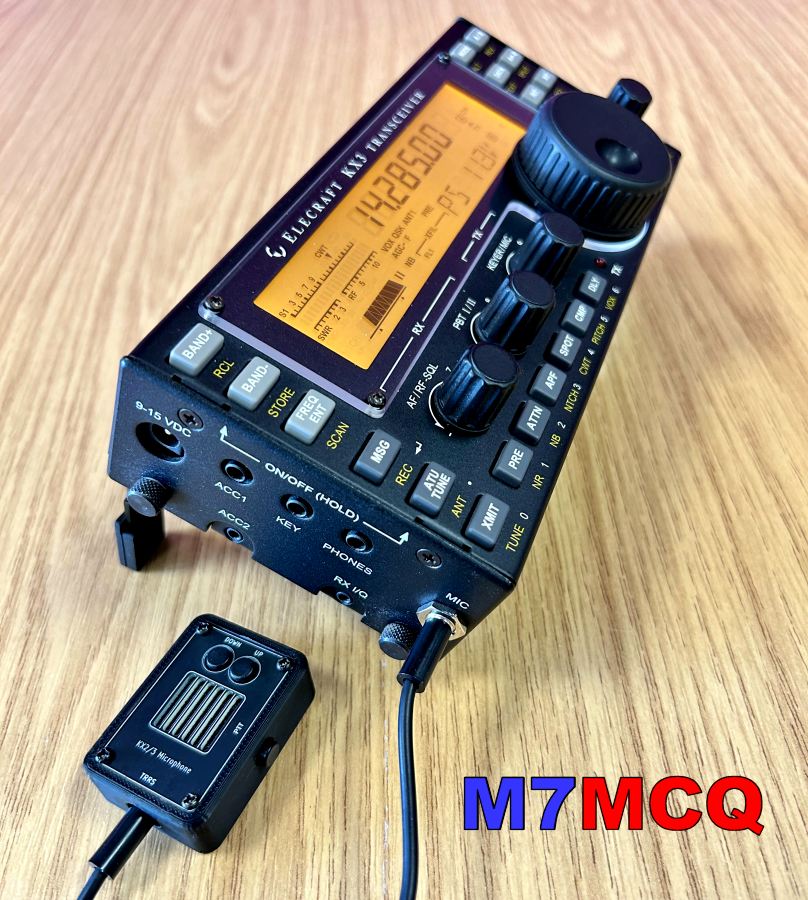
KX2/KX3 ULTRA-LIGHT MIC

The microphone which is designed for the KX3 (the MH3) is a great mic, but considering this is a compact QRP radio, the supplied mic is ridiculously big! It's like putting a size-12 boot on a baby!

Thankfully, there's alternatives out there and this one from Dave Pegler is probably the smallest one you'll find and at 27g, the lightest too!  If you want one of these, I suggest you contact Dave (M0JKS) directly and he’ll sort one out for you straight away.

They cost a measly £20 and not only is it great value, but it also includes a handy little carry case (pouch). The TRRS to TRRS lead can be detached, which I really like. 

I also like the fact that the tiny mic has two extra buttons for changing the radio's frequency, That's handy! Finally, it comes with a stick-on belt-clip which I personally won't be bothering with because it makes this little gem a bit bigger.

I ordered the mic and it was delivered very quickly and well packed. Inside was a note explaining how the microphone's performance can be tweaked to suit an individual's voice by altering the radio's setting - and Dave provides a link to a PDF file is included to show you exactly how to do this.

After plugging the mic into my KX3, I spun the dial and found EG7SDC on 15M. I only had some Duracell AA batteries inside the radio, so I tried making contact  on SSB down at 4W through an EFHW. I was rewarded with a 59 and compliment on the audio. This was very encouraging considering that I had just plugged it in and played without any setup other than to turn MIC BIAS on.

After making a few more contacts on other bands, I decided to read the PDF that Dave had written and made some adjustments to the Compression and Mic Gain levels. This made the mic produce a more ‘punchy’ sound which is great for DX, but can be switched back when you want to transmit something easier on the ear.


I’m extremely pleased with this tiny mic. IMHO Elecraft should have produced something like this themselves instead of offering the MH3 (which I never liked). I look forward to using this mic much more in the future and it would be handy if Dave gave it a proper designation so people could find it easier, such as DP27G or DPKX3 or whatever.

Anyway, no matter what it’s called, it’s a little cracker and I highly recommend it!

73, Tom, M7MCQ


Monday, 2 September 2024

VK3IL CW Pressure Paddle

I love the idea of this minimalist CW paddle - it’s so tiny you can always find room for it no matter how small your field bag is! And it’s super cheap too. So I ordered the kit and it has sat on the shelf for months!! Why??? Here’s why…..

CW Paddle from VK3IL

Yes, those SMD components are incredibly tiny 😳 😳😳  Boy, I knew before I ordered the kit that they were small, but it was only when I came to pick them up that I realised I just how awkward SMD work is for a novice. Even with a pair of tiny tweezers I struggled to pick them up and keep hold of them! They kept pinging out of the tweezer’s grip and very nearly got lost on more than one occasion.

Somehow, I managed to get them soldered onto the pads and although it’s not pretty 😂, it worked!

I plugged the paddle into a transceiver set to 20wpm and was delighted to discover that I didn’t miss a beat on my usual CQ CQ TEST DE M7MCQ string.

Very pleased with this little kit. Recommended for SOTA!


73, Tom, M7MCQ.