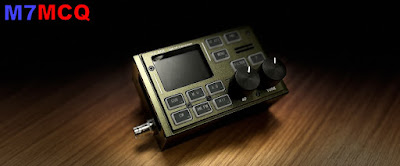
The operation of the FX-4CR is very well thought out and there's little use for the printed manual - it's really quite intuitive (but read the manual anyway lol, because some buttons have hidden functions and are mode-dependent). The buttons are a good size, well labelled and even backlit! The rotary dials have a good feel and are multi-functional as you'd expect. It doesn't take long to learn the functions of the buttons.
Surprisingly, the built-in speaker is really quite good!! It's obviously not bassy, but it produces a very crisp, loud audio which is perfect for outdoor operating. Most radios of this size require an external speaker to be connected, but not this one.
The supplied microphone is good too - small and neat. It's worth noting that the FX-4CR actually has a built-in mic too (in case you one day forget to pack the mic).
The receiver is very sensitive and the filtering is good too. Bear in mind that this radio will almost exclusively be used for outdoor activities which means there’ll more than likely be a great take-off point and a decent antenna - in those circumstances, the FX-4CR will perform every bit as well as any other radio out there. It's only when you wish to detect the most distant and weakest stations that you might wish you'd spent four times as much money on something else.
On the transmit side, you can dial in anywhere between 100mW and 20W output which is amazing for such a tiny radio. On full-tilt, the metal case does get hot and without additional cooling, digital work is restricted to less than 5W - a sensible precaution.
I’m going to fit some heatsinks to the top of the case like I did on my EE ColibriNano (pictured below). There are rumours that Yu is going to offer some sort of fan kit for the FX-4CR which may allow the radio to use more power in digital modes.
 |
| Circles show hot-spot locations |
Watching an online video by the popular Temporarily Offline Ham Radio vlogger Steve, it's clear to see that the FX-4CR has a large heatsink plate below the RF PCB and you can see how the heat is transferred away from the PA into this aluminium block. The only criticism is that there's no external heatsinking, but then I've not heard of anyone actually suffering any overheating issues.
For the CW operator, you may want to know that only semi breakin is available, but on the plus side, the filter is good and the T/R has full adjustability. Early production models had some hardware and firmware issues affecting CW operation which resulted in Yu offering full refunds or free replacement PCB’s. Thankfully, all that is behind him now and he has to be commended for not shirking his responsibilities.
I’m not a morse man, so I can’t comment further on the radio’s performance in this mode. I have just bought a paddle to start the journey, but it’s going to be quite some time before I’ll be on air,😂.
To be honest, for digital and CW work outdoors I would much more likely to be found using a QRP-Labs QMX or QDX, so the FX-4CR’s performance in these two areas is not as much a concern to me as it might be to you.
Okay, so everything's quite positive so far - what about the negatives? Well for comparison I may sometimes refer to the Xiegu X6100 because it's a similarly priced HF radio and I've owned one.
Some people will complain about two specific things about the FX-4CR - no internal battery and no internal tuner. Internal batteries are little more than a convenience to me - I almost never use them except for just playing around at home looking through the settings or using a radio for morse-practise without transmitting. When I go outdoors to play proper radio, I always use my 13.2V Lifepo4 battery. The X6100 has batteries built-in but they don't last two minutes and there seems to be an issue with the BMS which makes the whole thing a bit of a faff.
The lack of a tuner is perhaps a more valid complaint, but then again, my £1400 705 doesn't have one either! And let's face it, most internal tuners are pretty poor anyway, so a few years ago I invested in a tiny 20W Elecraft T1 ATU and that has always been my "go-to" tuner for any outdoor activity. It's super fast, super light and could tune a string vest.Onto the testing. Connected to an EFHW at home, it was an absolute doddle to pull in signals and get 55-to-59 reports from operators across the globe on just 10W. People were impressed with the modulation and were even more impressed when I asked them for a second report on 5W with barely any change to my signal. This is exactly what I love about QRP transceivers - making great contacts with people who themselves are often using 100-1000W. My IC-7610 is virtually an SWL station these days, lol.
Out in the field, the FX-4CR continued to please. I took it to the site of ROC B/G-0444 to continue my BUNKERS ON THE AIR activation from last week. I'd previously used my IC-705 with an AlexLoop, so this time I thought I'd use the FX-4CR with my SotaBeams 20/40 Linked Dipole. The noise floor was ZERO!! It’s so quiet around here.
The dipole is simple and quick to erect using a TACTICAL-7000HDS mast and within minutes I had spotted myself and was managing a mini-pileup with the FX-4CR easily pulling in signals and earning me a long string of complimentary reports.
During the activation I was trying to find things about the radio which annoyed me, but I just couldn't. It's pretty much perfect for me. The only thing that I would love to be added is a 500Hz Tuning Step. So many operators work in-between a 1kHz frequency for some reason and the 500Hz step makes it sooooo easy to flick through the band. Please, please add one Yu 🙏Once the Bunker had been activated, I relocated to an area on the edge of the Forest Of Bowland which gave me a good height advantage and provided a take-off toward the west. From here I sought out some proper chinwags to see how well the radio coped with extended TX. Everything went perfectly well and although the temperature of the case climbed, it remained "comfortably warm" - certainly no hotter than the X6100 under similar loads.
At the higher location I was going to transmit some "CQ TEST M7MCQ" morse messages and see how far my signal was reaching on PSKREPORTER. Unfortunately, the FX-4CR doesn't let you store messages in memory, so I had to use my paddle to do it manually. Maybe message-storing could be something to add to the next generation models?
The radio performed really well as a QRP Field Rig and not once did I think "Oh I wish I'd brought my IC-705 instead". Okay, so the 705 has a bigger screen and VHF/UHF but it's 3X more expensive and it’s over twice the size.
This fabulous SDR radio costs around £500 and as I've said before, you cannot pay Ford prices and expect Rolls Royce performance! But you can expect high quality and superb value for money - and that's exactly what you get with the FX-4CR. It’s a fun radio and you feel like you're a part of a great adventure with Yu in the background, constantly looking to make improvements through firmware upgrades. He listens to his customers and responds to their comments and suggestions wherever possible.
For a stand, I used some self-adhesive pop-out stands from Amazon. I've used them on all sorts of radio gear (and other) and found them to be reliable and strong.
Needless to say, any little niggles tend to annoy some people and they want fixes now, now, now, so you'll come across the odd keyboard warrior who blows things out of proportion. You only have to look at other independent radios such as the superb RGO ONE, QDX or tr(u)SDX which have all been 'works in progress' and have grown into something far greater than how they originally started.
 |
| Fitted with alternative knobs |
The great thing about the FX-4CR is that 98% of everything works extremely well and 2% awaits further improvement. The X6100 by comparison has quite a few serious issues which are very annoying (bluetooth, wi-fi and squelch virtually unusable (and we'll not even talk about those birdies 😮)) plus you have absolutely no confidence in them ever being addressed by Xiegu, which is very poor considering they’re such a big manufacturer and their products are sold by big retail outlets across the globe. When I buy from a large retail outlet, I expect a finished product!!
There's a pride of ownership with the FX-4CR. Somehow it's more than the sum of its parts. I can't quite explain it - I'm just glad I became part of the club! It suits my modus-operandi perfectly.
So in summary, I very much like the FX-4CR and look forward to being part of its development and growth. I also like that the radio has 20W finals because (to my mind at least) that means I can operate SSB at a full 10W if I need to, without worrying about being at the limit of the PA.
Some features aren't fully implemented yet, but it's early days and no doubt there's a lot more to follow in the coming months.
It's never easy investing hard earned money into a company 5,000 miles away, but when you get assurance from so many other customers that a producer is talented, honest and communicative, it really helps.
We've all occasionally experienced cheap, fake products from China and many people have been ripped off by unscrupulous overseas retailers, but let me assure you, that's not the case when you buy an FX-4CR from BG2FX. Buy with confidence (but only through his website)!
In case you were wondering what the little house-logo was about (which I've embellished here), Yu explained to me that it serves as a reminder of his humble beginnings living in a rural mud house, where everything was a great challenge and it represents the start of his journey to where he is now 💗
Here's a video-review by Bob Nagy...
Technical Specifications
- Transmission frequency range: 3.5 - 29 MHz, 6M.
- Receiving frequency range: 465 kHz - 50 MHz
- Operating Modes: USB, LSB, CW, AM, FM
- Frequency Steps: 10 Hz, 100 Hz, 1 kHz, 5 kHz, 10 kHz, 100 kHz, 1 MHz
- Antenna impedance: 50 Ohm
- Operating temperature range: -20 - +40℃
- Voltage range: DC 9 V - 18 V (please keep the maximum voltage below +16 V for long-term operation: About 14 V is recommended)
- Power Consumption: Transmit: (maximum power) ~ 2 A; Receive: ~ 220 mA.
- Overall size: length 107 mm, width 65 mm, height 43 mm
- Weight: (radio only) 0.46 kg
- Filter Bandwidth: SSB: 1.5 kHz, 1.8 kHz, 2.1 kHz, 2.4 kHz, 2.7 kHz, 3 kHz CW: 50 Hz, 100 Hz, 200 Hz, 300 Hz, 500 Hz, 800Hz FM: 5 kHz, 10 kHz AM: 6 kHz, 9 kHz
- Power range: 0.1-20 W continuously adjustable
- Spurious emission suppression: -43 dB
- Carrier suppression: -50 dB
- Microphone impedance: 2.2 k Ohm
- Audio output power: 1 W
- Receiving sensitivity: -120 dBm
Functional Characteristics:
- ☆ 2.0″TFT display screen
- ☆ Spectrum display and waterfall plot
- ☆ Dual VFO operation (VFO A and B) with split mode operation
- ☆ Internal USB sound card with serial communication via USB
- ☆ Adjustable DSP digital noise reduction
- ☆ Ultra wide input voltage: 9 V - 18 V
- ☆ Quick switching among various frequency bands and convenient operation
- ☆ CAT control over USB
73, Tom, M7MCQ.