Last year I bought some Messi and Paoloni Hyperflex 5 coax cable from ML&S and last night I decided to reroute it. This involved me cutting off the PL-259 and putting a new one on, but sadly I wasn't able to complete the work.
When I cut the outer sheath, I could see that the copper braiding was black as the ace of spades! My rerouting meant that I could afford to cut back much further, but no matter how far back I went, the braid was a matt black and I wasn't convinced that this would make a good connection to my new plug, so I binned the whole lot.
From what I've read, the "Black Death" is usually due to the outer sheathing becoming porous and the spongy dielectric stores the moisture, making the problem worse. Some people say it's due to UV damage to the sheathing which then becomes porous. One thing's for sure, though - it's not due to any moisture ingress through the PL-259 because I used very high quality compression plugs and then double-taped them (self-amalgamating tape and UPVC tape).
The coax is only a year old and rests on top of a tiled roof. It's never been stretched or under any stress. It's very disappointing indeed, especially considering that I've got other antennas fed with much cheaper 4yr old RG8 MINI.
Anyway, lesson learned - you don't always get what you pay for :-(
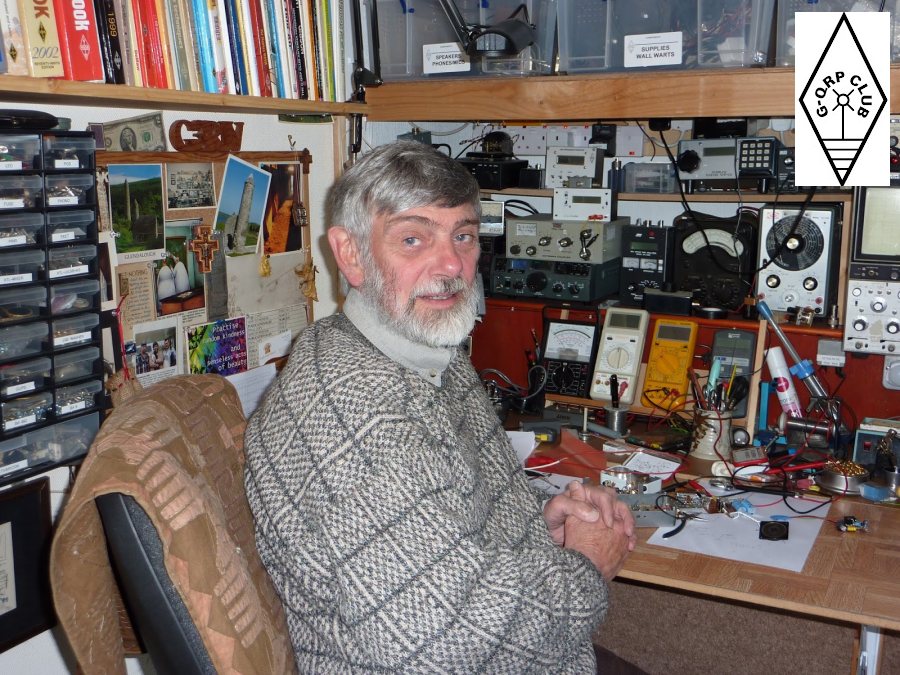
G-QRP CLUB was formed nearly 50 years ago by the late Rev. George Dobbs, G3RJV, (pictured left). Its goal was to bring together those people who had a shared interest in low-power operations, which originally meant 3W output from the transmitter to whatever antenna you had. Since then, the accepted power-levels have changed to 5W for CW and 10W for SSB.
The club's website can be found HERE and it contains a wealth of information that should be of interest to any radio ham, not just QRP enthusiasts.
Membership to the club is incredibly cheap and it includes a subscription to their quarterly printed magazines called SPRAT. It's a real pleasure when this A5 sized magazine drops through the letterbox and I enjoy it more than any of the retail mags which cost £5+ each!
The magazines contain a varied range of topics, projects, tutorials, tips, circuit designs and lots more. And even better, you can get access to any of the previous SPRATs from the G-QRP archive going back decades!
The club is peppered with extremely knowledgeable people who are keen to help others and they even have a comprehensive library of fascinating videos on YouTube.
If you're new to the hobby and haven't heard of G-QRP before, I would strongly recommend that you consider joining - it's the best six quid you'll ever spend.
OFCOM have recently announced a proposed update to the Amateur Radio Licensing Framework. What's brought this on I'm not too sure, but there's parts of it which effects Foundation License holders such as me.
The main change which FLs are focusing on is the proposed increase in permitted power levels. OFCOM are suggesting a move from 10W to 20W and I'm guessing that they won't find too much resistance to that proposal.
For me though, I couldn't really care less about the doubling of power - well not at HF anyway. I am perfectly happy with my 10W and do my utmost to use much less when able.
What I would like to see however is an increase at the VHF/UHF frequencies. Currently, my 10W limitation means that I cannot reach most repeaters in my region and I can only reach a limited number of local operators! This means that my activity on 2M and 70cm is virtually nil. As a result, I find myself turning to internet-based solutions. And that can't be good for the hobby.
I believe that FL's should be allowed to use up to 25W on VHF/UHF. That would make a huge difference to my ability to use 2M and 70cm repeater network. 20W is quite a silly figure to propose, because the vast majority of radios from the big 3 manufacturers don't even have a 20W setting in the Power Menu, but they all have a 25W setting.
The next proposal which interested me personally was the decision to permit FLs to use equipment that they have built themselves. To me, that makes perfect sense because I've been building kits for years and it's a really important and interesting part of the hobby. Building a kit and then not being able to use it on-air is very annoying.
Experimentation and self education is surely what Amateur Radio is all about - and building and testing simple kits or projects is a fabulous way to improve your skills and knowledge.
There's also a proposal to allow FLs to give non-amateurs the opportunity to use their equipment under their supervision. Who better to promote Amateur Radio than a Foundation License operator whose still got a fire in his/her belly? I can think of many times where I could have got someone interested in the hobby, had I had the authority to let them actually get "hands on" under my supervision (and staying within the terms of my license). Well done OFCOM for proposing this change.
Next up is the proposal to allow FLs to use the 2.4GHz and 5GHz bands. Great idea! Look forward to it.
There are quite a few other proposed changes but they're the main one's for FLs. Don't forget to download your form and email back your response.
UPDATE : In response to a comment made by my DX-Friend VE9KK, I decided to add a little more to this post.
Last night I went to a nearby Radio Club and was surprised by the number of people who weren't even aware of this OFCOM Consultation. It indicates to me that many operators make little or no effort to stay abreast of legislation relating to their hobby.
One guy at the club was astounded to hear that he might have to swap his 2E0 callsign for an M8 callsign - in fact he said he'd refuse (as if he has a choice, lol).
During the conversations going around the tables, I learned that there were a lot of operators who routinely (and quite openly) run around 1000W ABOVE their legal limit - and I'm not just talking about Full License holders 😲
These operators were quite glib about it, waving off my protestations about working outside the terms and conditions of their license, but the same people chastise OFCOM for not Policing the bands when they have a local rogue-operator causing them issues.
I’ve said it before - we are not allowed to erect any antennas at our Holiday Park, but you can erect a flag pole 😳🤷♂️, so originally I put up a 10M vertical, but wasn’t very happy with it, so I bought a Sigma HF-X80 and fitted it with a neat little Union Jack to keep the Park officials happy 😂.
When neighbours haven’t got their bloody LED lights and cheap phone chargers plugged in, the noise floor is pretty good and the Sigma performs quite well. I installed the antenna quite low down to the ground (I had no choice), securing it to a heavy wooden post which forms part of the caravan’s decking. It’s surprisingly secure.
According to the manufacturer, there’s no need for radials but I thought I’d discreetly attach one anyway (the thin yellow wire in the close-up image). I didn’t take any before/after measurements so I’ve no idea if it’s helped.
Taking readings from my Antenna Analyser, I got the following results…
BAND SWR / OHMS
160M - 4.4 / 90
80M - 3.5 / 157
40M - 1.99 / 34
30M - 1.09 / 45
20M - 1.04 / 52
17M - 1.76 / 62
15M - 3.1 / 24
12M - 4.1 / 13
10M - 4.5 / 11
Quite linear results there, with very acceptable figures in the middle and the rest being easily tunable by my little ATU. The Sigma only cost £90 and has provided me with a great solution to the antenna ban. No, it’s not perfect, but it’s certainly better than nothing and despite its compromised positioning, it’s doing quite well. It also copes with the very heavy winds that we get here (even with the extra loading of that flag).
I should point out that I bought this because my friend G0UXF has one and he has had amazing results with it - although his has a fabulous grounding thanks to it being attached to a huge steel fence.
Just connected my trusty 4W (tr)uSDX and got through to the first six operators I called ❤️
A couple of weeks ago I ran an SWR SWEEP on an EFHW which runs to the back of my conservatory using the NanoVNA and the RigExpert. Everything was looking good. Then last night I decided to do the same on my other EFHW (wireantennas.co.uk) which runs to the shack - and everything was definitely not alright!
I don't spend a great deal of time in the shack except in the Autumn and Winter months. It's a South facing room and it gets unbearably hot in the summer, so I tend to sit in the conservatory with the large doors wide open or even outside in the garden. As a result, it's been a while since I used the shack antenna.
When I tested it with the RigExpert, I was presented with a near infinite SWR reading and I thought it might be my antenna switch throwing up a fault, so I connected the RigExpert directly to the coax coming through the wall, but got the same results.
I checked the coax cable (Messi & Paoloni) but could find no obvious problems. Unfortunately, I wasn't able to reach the Un-Un to check inside it because it was too high up for me, so I had no choice but to cut the coax at a point where I would be able to insert a joint later.
Once the Un-Un was down, I could see that the Messi compression-type PL259 was still in perfect condition thanks to the quality of the connector itself and also thanks to the self-amalgamating tape I'd covered it with. I removed the lid of the transformer and could see that the ferrite looked to be in great condition but the main connection to the SO-239 was not looking good. As soon as I touched the wire, it was obvious that the soldered connection was loose and it simply came out.
Now bear in mind that this thing gets very little use and never more than 10W. It does, however see more FT8 use than SSB, but that shouldn't make a difference at that level of power? This is a 100W rated antenna (probably with a 30W data rating). I’m very disappointed 😢
Anyway, there's no use moping over it - it needs replacing, so I ordered a new one from UKANTENNAS and it has just arrived. The first thing I noticed about it was the size and weight - it’s smaller, but 100g heavier!
I'm not going to throw the other one away of course, I'll order a new SO-239 and clean things up. The repaired Un-Un will then be available for portable work.
Looking back, I recall buying my 17M Double Bazooka from WireAntennas and not being very happy with the quality of construction. Now that the EFHW has failed, I'll probably avoid buying from them in the future. Sorry 🤷♂️.
The UK ANTENNAS 49:1 is very well built and once connected to my wire, produced good readings across the bands. It’s good to be back to normal in the shack.
Three years ago I borrowed an MFJ-259 from a friend to help me with a Slim-Jim that I was building. It was a good antenna analyser, but a bit bulky and old fashioned, so when it came to investing in one for my shack, I decided to buy something more modern - a NanoVNA-F. It cost me around £50 and it covers 10k-1.5GHz, plus it does a lot more than the MFJ. Beware that there are a lot of fakes out there!
And then I got a bargain RigExpert AA-35 for a couple of hundred quid. They're normally around £300. This doesn't actually do as many things as the cheap NanoVNA, so I thought I'd do a 'real world' comparison of the two items. Is the AA-35 really worth 6 times more than the VNA (or 4x in my case)?
I should point out that the VNA can be used to do all sorts of clever things, but at this point, I have just used it to test and tune antennas in the most simple of ways. Thankfully, our local radio club (Bolton Wireless Club) is going to be hosting a "NanoVNA Tutorial Night" soon, so I hope to learn a lot more and will update this post when that happens.
Well let's start off with a look at the NanoVNA. The one I bought was the "F" model which has an attractive steel case and it comes supplied with lots of accessories including an SMA-SMA pigtail and a series of adapters to help calibration. The package came in a nice plastic carry-case, but I found an unused little Pelican Case in the shack which would protect the unit from any possible damage while rattling around the back of my car.
The NanoVNA has a 4.3" colour touch-screen which is very clear and sharp, but to be honest, it is next to useless in strong sunlight, so you have to use your hand as a sunscreen in order to take any readings when outdoors. Using 'touch' to select options isn't always reliable, but there are other ways of controlling things.
With a firmware upgrade, the unit will take measurements between 10kHz and 1.5GHz so that covers pretty much everything - more than I'll ever use, for sure! The unit is powered by an internal Lipo battery but that went kaput after a couple of years, so I now have to attach a USB PowerBank when I want to use it. I could of course order a replacement battery and solder it in place, but I just can't be bothered.
The first thing to do with a VNA is calibrate the device and that's a simple process with the supplied SHORT, OPEN & 50 Ohm dummy LOAD. I calibrated using different frequency ranges and then saved them to the five available memories...
That makes it super easy to quickly choose a working range and have the highest level of accuracy. I put a Dyno-Label on the back of the device to remind me of the memory contents. Being quite a cheap device, I would still insist on a re-calibration if I was carrying out some serious work or if I’d not used the device for some time.
In any case, calibration is quick and easy - just a case of taking three readings with the supplied adapters - OPEN, SHORT, LOAD.
My test of the NanoVNA was carried out on an EFHW antenna that I had installed at home. I set it up to take readings across all the bands and this was the result. SWR Readings are in yellow....
Switching to the RigExpert AA-35 gave me virtually the same results, so you could guess that I wasted £200, but the fact is, the AA-35 is infinitely easier to use. It's a self-contained unit in a traditional hand-held form factor. It's 'coverage' for want of a better word is only 60 kHz through 35 MHz, but that's more than enough for most people.
If you want to be able to work with VHF and UHF antennas, then you'll have to buy one of the more expensive models in the range. The same applies if you want a Smith Chart display - having said that, you can have a Smith Chart on the AA-35 if you connect it to a PC using the USB cable and run AntScope2 software (not very practical out in the field, but not impossible).
It comes with its own carry-case, shoulder-strap and a shielded USB A-B lead with built-in ferrite. The screen is a good size and is perfectly readable outdoors in direct sunlight. The RF connector sits on top of the device in the form of an SO-239. I'd have preferred a BNC connection instead, but it's no big deal.
The unit is conveniently powered by two AA batteries which are available everywhere, so you're unlikely to get caught out without power. They seem to last forever too - if you use good quality batteries and especially so if you opt for the amazing Energizer Ultimate Lithiums - they'll last years (well they do in my wireless CCTV cameras).
The AA-35 has a colour screen but can be set to a high-contrast monochrome scheme for those whose eyesight isn't too good. The buttons are a good size and logically laid out on the front of the unit. I prefer this to the VNA's touchscreen. In fact, I often find myself having to double or even triple the number of times I have to press the VNA's touchscreen to get it to recognise it.
The data produced by the AA-35 can be presented in a number of different ways depending on how much you want (or need) to know and whether you're a visual person (or not). Some like to see lots of numbers and some want a pretty meter. You get to choose.
The AA-35 is self-calibrating, so there's no need to ever worry about that, but, if you ever want to force a calibration (eg if you want the calibration point to be zeroed at the end of some feed line just before an antenna), then you can do that by choosing CALIBRATE in the menus and run through the usual OPEN SHORT LOAD routine and then the meter will basically ignore the feedline and take the baseline to be the very end of the feed, not the meter's SO-239.
The operational-speed of the AA-35 Zoom is quick! The various meters and sweeps work like you might expect analogue meters to work - there's very little delay and everything looks smooth and pretty darned cool.
I mentioned earlier that you can connect the analyser to a computer using the USB lead. This gives you added functionality and the ability to grab screenshots if you want to share readings with other people on a blog or email or whatever.
So overall, I much prefer to use my AA-35 when out in the field (or even out in the garden), but when I'm at home, I'm quite happy to use the cheap NanoVNA. They're both great tools!
A couple of years ago we thought we'd start a bit of a touring expedition - go visit the Isle Of Man, Ireland, Scotland, Holland, France, maybe even Spain. So we bought a big touring bike - the Yamaha FJR1300 complete with all the hard luggage. Personally, I've toured lots of times on a motorbike, but my wife hasn't, so she was looking forward to it.
But then we bought a static caravan! 😲
That purchase pretty much brought an end to the touring idea. We did the IOM, but then found ourselves staying at the caravan every weekend and the idea of us travelling many miles on a bike became less interesting. Plus Liana developed Carpal Tunnel Syndrome in both arms and really struggles to hold on to the grab rails under hard braking.
So the big tourer had to go. It weighed 600lbs and wasn't much fun if all you wanted to do was have a solo blast for a few hours at the weekend. I advertised it and very quickly got a buyer at (almost) the price I paid for it.
So then it was a case of finding me a nice little sports bike and a trip to Blackpool Honda to look at FireBlades. OMG they are £20,000!!!
I then saw an article in a Bike Magazine which really made me question the logic of investing even £10,000 on a brand new bike when you can have all the same fun on a cheap used one? Liana really liked the new ones but I knew from past experience just how good some older models were, so I knew exactly what I was going to do.
The bike I was going to search out was the HONDA CBR600Fi. And I wanted one from the very last year of build - 2007. Local searches revealed one very close to my holiday home, so I went to see it and bartered like a pro! For a couple of grand, you can enjoy all the thrills of a new multi-thousand pound bike, if you play your cards right. It's also in the absolute best colour scheme - Italian Red and Black.
This will be my fourth CBR600F. Here's the previous three....
Being light as a feather and having 109BHP, the CBR can really move! The engine redlines at a touch over 14,000rpm and there's not a great deal of power below 6,000rpm, so you have to ride these bikes like a proper supersports - not like a v-twin Harley 😂. Coming from a big grunty bike, you have to retrain your brain to ride a CBR.
Needless to say, revvy, howling engines aren't everyone's cup of tea, but they are mine! And the great thing about a 600cc supersports is that you can have a lot of fun on UK roads at full-tilt. If you tried the same on a modern FireBlade, you'd probably be arrested or scraped up off the floor.
Let's face it, the CBR600's 0-60 of a whisker over 3 seconds and top speed of 15mph is surely fast enough for anyone.
Of course, buying a bike from the previous generation means that there's going to be a few features missing and in this case - no ABS, no Traction Control, no Engine Mapping, not even a Fuel Gauge! This thing is real old-school, back to basics and if you've spent years benefiting from these 'rider aids' then you're going to miss them initially - especially the ABS. Like I said earlier, you just have to retrain your brain and change the way you respond to certain events. Luckily, the CBR's brakes are quite smooth and progressive, so there's less chance of you locking up the front wheel during an emergency stop.
The handling of the bike is pretty darned good and made even better if you can be bothered upgrading the rear shock - but I can't - so it'll stay original. If I was doing Track Days every week, then yes, I might have considered it. My bike will live its life whazzing around the Lake District, North Yorkshire and North Wales. I'll probably keep it at the caravan throughout the spring and summer months - it's a fabulous launchpoint for some of the best rideouts in the UK (apart from the myriad average-speed-cameras).
The CBR600F is a pretty comfortable bike and can easily be ridden all day. I've done 400 mile rideouts with ease on these bikes and never once had any issues. The only thing that's worrying me slightly is how my left shoulder will cope with the riding position on a long journey because of the Frozen Shoulder problem I had a few years ago - I certainly don't want to irritate my shoulder enough to bring that problem back!
Legroom is pretty good for a sports bike, but having said that, I've not got long legs. I can still get both feet down to the ground, so the 805mm seat height isn't too bad (especially compared to say an R6 for example).
The seat is a one-piece affair which for me is very important, since my wife needs to (occasionally) ride pillion and I don't want her perched up high on a small pad - but for that, I would have bought the CBR600RR model instead of the F.
The standard exhaust sounds good especially when you've got the rev-counter spinning high, but because I'm keeping this machine for a few years, I'm going to change the whole system for an MTC Stainless Steel one.
The Honda downpipes are mild-steel and although they will last a very, very long time, they do rust and look unsightly. Yes, I know they're hidden behind the fairing, but I'd rather replace those too with stainless-steel pipes - it's booked in next week. The new system will sound absolutely awesome!!
The only other things that I'll be changing are clutch/brake levers, tank grips, number-plate, clear indicators, crash-bungs, etc. Oh, and I need to install my SatNav too.
The engine is as sweet as a nut! No surprise there - Honda know a thing or two about engines and this design was good right from the very start - it's virtually bullet-proof. Now bear in mind that many people buy these as their first "big bike" and so there's been a great deal of abuse over the years from inexperienced, twonks who don't know their arse from their elbow - and still, the engines and gearboxes have withstood the test of time.
The fit and finish on CBR's from this era is second to none and it's one of the reasons that people flock to these bikes. Unlike many modern Japanese bikes, these were built in Japan and to a high standard using good quality materials.
The only negatives about this bike IMHO is the effectiveness of the mirrors and the lack of midrange punch. The former can be sorted out with a pair of extenders and the latter can be sorted by - err - dropping a gear.
Other than that, what you get for a couple of grand is a bike that can provide mountains of fun on fast, twisty roads, high-speed shenanigans on big highways and even commute through the city every day. If you want to go to the Isle Of Man for the TT Races, slip over some soft panniers and away you go! This bike will do it all - just keep an eye out for the Fuel Warning light.