Wednesday, 23 March 2022

BUILD-A-PI by KM4ACK

RASPBERRY PI ZERO 2W

Today I put together a tiny computer for use with my portable radio gear. It's in the form of a Pi Zero 2W and I used KM4ACK's Build-A-Pi utility to put it together instead of using an image from the internet.

It took a long time to complete and no disrespect to KM4ACK, but in the end, I wished I'd just downloaded an image 😏

I already have the HAM-PI software collection which I built into my Pi400, but I was curious about seeing what could be done with the smallest Pi out there - the Zero. It's amazing how compact it is! After completing this Build-A-Pi project, I've decided that I'm going to write another HAM-PI image onto a spare card and keep it with the Zero as an optional boot up.

To keep the Zero safe from knocks and drops, to avoid static damage and to provide some RF protection, I put it into a small metal case. It also looks pretty darned cool too. I got both off eBay for paltry amounts.

Because I was opting to install all the software included in the Build-A-Pi option list, I needed to use a 16Gb card, but I only had a 32Gb SDcard from Kingston which results in around 23Gb spare (wasted) space.

The case by FLIRC measures around 70x35mm and is really nicely made. A heat-transfer pad is included for the processor and all the connector holes line up perfectly. You even get a little wrist-strap with it.

The Pi Zero 2W uses a Quad Core 64-bit ARM Cortex-A53 processor running at 1GHz which is around 5 times faster than the original Pi Zero. 512Mb of ram is included.

On the PCB is a power-in and a USB connector (both Micro USB), alongside a Mini-HDMI socket. At the bottom edge is your Micro SDcard holder. 

The built-in Wi-Fi module is encased in a metal enclosure to avoid stray RF effecting it - always good when using radios close by! This mini-marvel even has Bluetooth 4.2. What it doesn't have, is a built-in soundcard.

When buying a Pi Zero 2W, you must factor in a decent little 5V PSU. One of the problems that people come across with PI's is lock-ups and black screens and it's almost invariably because they're using a cheap little usb charger from the £1 shop. The official mains supply has a 2.5A output which will allow your Pi to power other devices like a HDMI monitor and a wireless keyboard and mouse, etc.


Outdoors, you'll probably want to use a 5V battery pack or Power Bank. Depending on the capacity of it, it should last a good few hours in the field. I have a couple of Power Banks but the best one is a Baseus PD 20W which can power/recharge up to three devices at once. It has variable voltages which makes it useful for powering other devices such as QRP Labs QDX.


Once all the "building" of the Pi is complete (which is automated but can take hours), the device is ready to run all your favourite radio software. JS8CALL and WSJT-X work a treat. There's also GPS software which runs perfectly with my cheap GPS Dongle. This is essential for accurate time-keeping.

The Zero doesn't have the GPIO pin-out block, but it has all the connections to add one. Personally, I won't ever use that, so its absence is of no consequence to me. Also of no use to me is the camera-connector at one end of the pcb.

So, what's it like?? Well it works fine. There's no apparent problems with any of the software, but yes, it seems a tad sluggish compared to say the Pi400 - but then it would! In practical terms though, it works well and is certainly a lot smaller! 


MANUFACTURER'S SPEC....

1GHz quad-core 64-bit Arm Cortex-A53 CPU

512MB SDRAM

2.4GHz 802.11 b/g/n wireless LAN

Bluetooth 4.2, Bluetooth Low Energy (BLE), onboard antenna

Mini HDMI port and micro USB On-The-Go (OTG) port

microSD card slot

CSI-2 camera connector

HAT-compatible 40-pin header footprint (unpopulated)

H.264, MPEG-4 decode (1080p30); H.264 encode (1080p30)

OpenGL ES 1.1, 2.0 graphics

Micro USB power

Composite video and reset pins via solder test points

65mm x 30mm


Saturday, 5 March 2022

YAESU FTM-7250DE REVIEW

MOBILE SOLUTION

When I got my truck, I bought a radio for it but then hesitated because I didn't want to start drilling holes in it. But recently I changed my mind and have decided to fit a tiny Dual-Band Fusion rig in the form of a Yaesu FTM-7250D.


This is a very compact VHF/UHF/C4FM transceiver which will fit neatly in the centre-console of my Amorak. Despite its diminutive size, the FTM-7250 is capable of outputting 50W and a tiny fan at the rear is supposedly capable of keeping it cool. It doesn't matter to me, since I won't ever be using that much power anyway.

The receiver has an extended range of 108-580MHz so that means it's good for listening to the AirBand as well as 2M and 70cm.  AMS ensures that the radio automatically recognises the operating mode of an incoming signal and switches between AM/FM/C4FM without any input from the operator.

The radio's speaker is (thankfully) forward-facing on the front panel and is really quite loud (I think it's around 3W output). It's not the deepest, richest sound in the world, but it's perfectly adequate for what it's designed for.

Over 200 memories (with alpha-tagging)  makes it easy to store your favourite frequencies and then scan between them. You can also search between programmed band edges (ten of them). 


Because the truck is on a PCP, you have to be careful not to drill holes which the leasing company can pull you up about when the vehicle is due to go back. Needless to say, they take great delight in charging you a fortune for a new centre-console just because you drilled a hole in it!  With that in mind, I opted for a Velcro solution and to be fair, it worked out well.

I did have to drill a secret hole to reach a power source, but the hole cannot be seen. If I had to remove the radio, it's a simple affair but the likelihood is that it'll just stay in-situ. With the mic unplugged you can barely notice it and it's easy to chuck a dark cloth over it when parked up.

Programming the radio was achieved by using CHIRP and a programming lead purchased from TechnoFixUK which has an FTDI chipset in it. This USB lead creates a COM port in Windows. Just in case you're thinking this lead will work with RT SYSTEMS software - IT WON'T!! I'm getting a bit sick of RTS. Previously, I've used their software with my own leads but they're building in code which stops the software from even being installed until it detects their own unique cable, forcing you to spend even more! No thanks RT!

 
Anyway, it's real easy to program memories by hand at the front panel. You'd only need to use Chirp if you wanted to program loads of frequencies. 

SPEC :

  • VHF and UHF Operations
  • 50 W transmit power in FM and C4FM
  • Automatic Mode Selection FM/C4FM
  • Digitale GM (Group Monitor) function
  • Large LC-Display, backlit
  • 220 memories
  • Automatic Repeater Shift
  • Transmitter from 144 to 146 MHz and 430 to 440 MHz
  • Receiver continously from 108 to 580 MHz
  • AM Reception in the airband (108-136 MHz), 8.33 kHz step width provided
  • DTMF Microphone with backlit keys
  • Direct frequency entry with microphone
  • DSQ, CTCSS, DCS Squelch functions and signalling
  • Firmware updates via USB interface
UPDATE
Just got back from Winter Hill after completing some tests to make sure my programming was okay. I'm pleased to say that all was well. 

At first, I thought GB7WM (our radio-club's Fusion Repeater) wasn't working because when I put out a call on it, there was no response whatsoever - not even a beep to confirm I'd reached it and opened it. So I rang a mate Carl (G0UXF) to ask him if he could hear my calls on the repeater's output.

He confirmed that he could hear me and that my CallSign was displaying correctly. Strangely though, I could not hear him when he tried to open it (although I could hear him on the input frequency directly). He just cannot open the repeater even on 50W from his QTH.

I tried a few other repeaters and all were fine. Then I tuned into my local Gateway MB6HW which is operated by my friend Bill (G4CFP). That was working superbly although I got a gentle reminder from Ian Maude (G0VGS) about leaving adequate pauses between overs in order to give the repeaters time to reset and prevent them from timing out. Ian also discussed the potential problems with simplex gateways and recommended watching a video on YouTube called THE SIMPLEX CONUNDRUM

So overall I am VERY happy with the FTM-7250 and I like its simplicity. Very few bells and whistles, cheap and cheerful. I'm glad I managed to get hold of one before Yaesu bring out something that does the same thing but for more money and with more features that I don't need.

Thanks again for the help from G0UXF, G4CFP and G0VGS.


Thanks for visiting - please take a minute to leave a comment below 

73, Tom, M7MCQ.


Tuesday, 1 March 2022

Virpil VPC Mongoos T-50 CM3 REVIEW (Not Radio)

RELUCTANT UPGRADE!

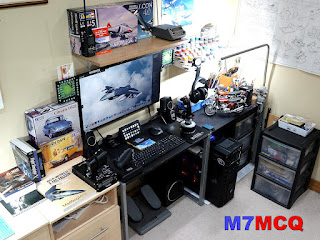
I recently moved my FlightSim PC from my Radio Shack to our Hobby Room. It would make both hobbies so much more pleasant due to spacing. Unfortunately, it ended in a bit of a disaster too. My beloved Thrustmaster Warthog Hotas Throttle decided to transform itself into a  very expensive paperweight.

 
No amount of fettling would bring the old girl (well only two year old actually) back to life, so it meant I'd have to order a replacement PCB at a cost of around £60 but they're not currently available due to the global Silicon Chip shortage.  So I dug out my CH PRO USB throttle in its place and then immediately remembered why I'd put it away in the first place. 
Windows cannot recognise your device 😰

The CH PRO throttle and FighterStick cost around £250, so they're not exactly budget items, but after using a Warthog Hotas, they certainly feel cheap! It was no use - I just couldn't live with the CH kit any more and so I looked for a new throttle  (I'll still repair the broken one when PCB's become available again and then sell it to recoup some money).

Needless to say, I could buy a new Warthog Throttle replacement, but looking on the internet I could see that plenty of people had suffered the same premature failure I had. Not good at these prices. 

So after some research, I discovered that the 'next level up' was the VIRPIL products. They looked magnificent and had rave reviews, but my God, they are expensive 😰

Top of the range is the Virpil VPC Mongoos T-50 CM3. It's their latest model and provides the user with over 140 programmable buttons, dials, switches and sliders. Some may think that's overkill, but believe me, FlightSims soon gobble up those assignments!

The Virpil £Ouch!

The unit costs a staggering £450. Yeh, that's outrageous! That's more than I paid for my Warthog Thottle & Stick combined! Well if you spend a lot of time on your hobbies and want the best, then you have to pay for it - or don't - your choice.


Just like everything else, the Virpil products are on back-order and it was just a stroke of luck that I stumbled upon one for sale on eBay - couldn't believe it! I ordered it on a Sunday night and it arrived on the following Tuesday.

As soon as you pick this baby up, you just know that it's something very, very special. It OOZES quality and all those switches and rotaries feel oh so smooth. The big throttle levers slide backwards and forwards with almost no lateral movement at all. The supplied detents allow you to choose where and when the idle/off and afterburner starts and stops. The finger-levers at the front just fall into your grip, allowing you to move past the detents with ease.

Most of the rotaries and hats also have a push-button to add to their usefulness. The six large square buttons are illuminated and each one can be altered to display its own colour. Additionally, you can flick off the covers of the switches and insert a description label - there's a pack of useful icons supplied in the box, but I prefer to make my own.

 
In addition to the supplied configuration software, you can also open up the throttle and make physical adjustments to the way the levers work. It's just another way that Virpil provide the ultimate levels of customisation. That's cool!


The connections for the USB leads are proprietary and at first I couldn't see the value in them, but then I realised that the option would be to have a fixed cable or a USB socket, neither of which is great afaik. Virpil's connector is very strong and stable and they provide a pass-thru socket for attaching other Virpil products to - that's a big plus!


The configuration software that I mention earlier is errr, just like most other hotas software - complex!!! I guess there's now way to dumb these things down and you just have to get your head stuck into a book or a few videos. That's where I'm up to right now - figuring out by trial and error how to assign all the functions of my sim to this throttle.


This is where I'm up to right now. It takes a lot of time to get through it all and even more to refine things. And remember, assignments usually relate to a specific aircraft, like the F-16C in DCS WORLD. If I switch to a HARRIER or an A-10, then I have to use different assignments (although some will obviously be common to all). 

Thankfully, the VPC T-50 CM3 has a 5-position selector switch which I'm hoping will permit me to program five different aircraft into the device and switch from one to another quickly and easily. I'll report back on that 😂 Wish me luck! 

Finally, I managed to replicate the ICP from the F-16 on my StreamDeck. This will be really handy, since it means you don't have to scramble around for your mouse to make adjustments. I've not assigned keystrokes to it yet, because some of the ICP buttons don't have keys assigned by default.


Here's some VPC pix...


Specification from manufacturer:

VPC MongoosT-50CM3 - Throttle Control System

The VPC MongoosT-50CM3 Throttle is the newest generation of our popular VPC MongoosT-50 Throttle design. Designed to integrate into every VPCockpit control set, it can also be used as a stand alone throttle unit.

As with our flightstick base units, the internal mechanics are constructed from high precision aircraft-grade duralumin which offer tension adjustment (accessed internally) and use our high precision, digital contactless VPC sensors.

The MongoosT-50CM3 Throttle now includes our brand new detent system. Controlled via all-metal finger-lift levers, the detent system can be adjusted via quickly interchangable detent plates to create the perfect setup no matter what you're flying!

Included Detent Sets:

★ “Classic” Detents - Lift to pass detents, push return.
★ “Classic Plus” Detents - Lift to pass detents, push return but with an additional tactile bump immediately after crossing the detent range.
★ “Warthog-Type” Detents - Lift to pass and lift to return detents.
★ “Aerobatic” Detents - Push through and push return detents.
★ “CosmoSim” Detents - Push through central detent.

Featuring 6 x LED momentary buttons with a transparent cap which can be removed to insert your own button inlays - perfect for labelling your controls!

There is now our detachable USB and AUX connection points which will allow daisy chaining with other VPC devices such as our VPC Control Panels for simplifying your setup.

The full feature set includes a huge number of controls surfaces and configuration possibilities that will surely satisfy even the most avid of virtual pilots!

Throttle Base Panel:

★ 6 x Customisable Momentary Buttons
★ 3 x Momentary Toggle Switches (ON-OFF-ON) 
★ 4 x Latched Toggle Switches (ON-ON) 
★ 1 x 5-Way Mode Dial
★ 2 x Encoder Dials (+ Push)
★ 2 x Throttle Axes (VPC Contactless Sensors)
★ 1 x Auxiliary Axis (VPC Contactless Sensor)

Throttle Handles:

 1 x 8-Way Hat (+ Push)
 3 x 4-Way Hat (+ Push)
 1 x 2-Way Hat (+ Push)
 1 x Encoder Dial
 1 x Encoder Dial (+ Push)
 4 x Momentary Push Buttons
 1 x Slider Axis
 1 x Analogue Ministick (+ Push)


.